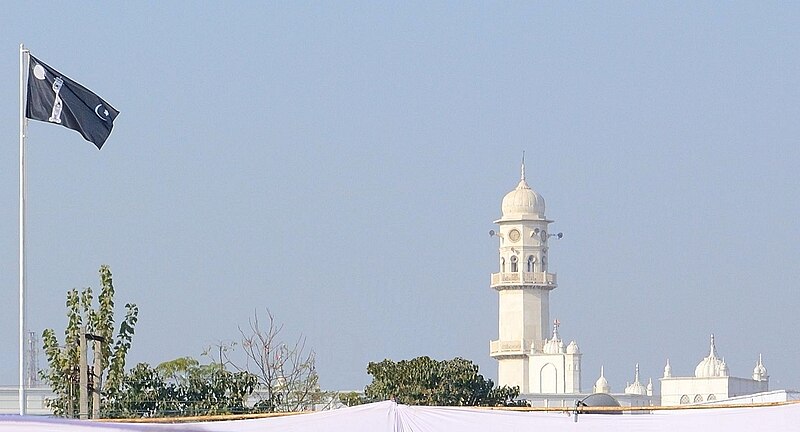
Also known as Ahmadiyya Muslim Community, Ahmadiyyat, Islam Ahmadiyya, Ahmadiyya Muslim Jama'at, AMJ, Ahmadiyya Muslim Association, Ahmadiyya Muslim Jamaat, Islam Ahmadiyyat
inriktning av islam
Ahmadiyya is an Islamic movement founded in late 19th-century India by Mirza Ghulam Ahmad, who claimed to be the promised Messiah and Mahdi expected in Islamic theology. The movement matters because it represents a significant branch of Islam with distinct theological beliefs, and its followers have faced both growth and controversy in various parts of the world due to their interpretations of Islamic doctrine.
AI-generated from the Wikipedia summary — may contain errors.
Ahmadiyya (arabiska: الجماعة الإسلامية الأحمدية, urdu: احمدِیہ) är en gren inom islam som etablerades under slutet av 1800-talet av Mirza Ghulam Ahmad i provinsen Punjab i Indien. Han gjorde anspråk på att vara den utlovade Mahdi och Messias som samtliga abrahamitiska religioner har väntat på. Gruppen ser sig själv som en reformrörelse av islam, dock hävdar de att de inte tillfört någon ny lära, utan följer den ursprungliga läran som den siste lagbärande profeten Muhammed lärde ut. Majoriteten av muslimerna har inte accepterat anspråket utan väntar fortfarande på att den utlovade Mahdi och Messias skall komma. Rörelsen delas in i två huvudinriktningar: Ahmadiyya Muslim Jamaat och Ahmadiyya Anjuman Ishaat-i-Islam Lahore, som representerar en liten del av alla ahmadiyyamuslimer. Efter dess grundares död så har ena inriktningen letts av kalifer. Den nuvarande kalifen är Hans Helighet Mirza Masroor Ahmad som valdes i april 2003. Hans officiella titel är Khalifatul Masih V och han har sitt säte i London. Den andra inriktningen utnämner en emir. Idag har rörelsen drygt 10 miljoner anhängare världen över.
Abstract from DBpedia / Wikipedia · CC BY-SA
via Wikipedia infobox
Ahmadiyya Muslim Community - Al Islam Online - Official Website
alislam.org →Link to the official site · 16,419 chars · not written by Vinony
MAR | Data | Assessment for Ahmadis in Pakistan
mar.umd.edu →The Ahmadis are not currently in open rebellion but they have been engaged in political protest to varying degrees, in recent years. While Ahmadis are not very politically organized, individual Ahmadis do lodge protests with government officials and Ahmadis, along with other minority groups, were successful in getting the separate electorate for non-Muslims abolished for all elections starting in 2002. The government views Ahmadis as non-Muslims while Ahmadis see themselves as Muslims. Despite exclusionary political discrimination, the chances of Ahmadi rebellion in the near future are close to zero. Ahmadis will likely continue to suffer discrimination by the government and persecution by other communal groups in Pakistan. The growing strength of Sunni fundamentalist groups and continuing military rule both militate against Ahmadi well-being. Furthermore, little international attention is given to the plight of the Ahmadis in Pakistan. Western governments are more likely to pay attention to limitations placed on the Christian minority or on women, while governments of Islamic countries share Pakistan’s official stance on Ahmadis. Unless and until democratic institutions fully return and mature in Pakistan, and until Pakistan replaces religious unity with civic unity, their position remains precarious. The Ahmadis (also known as Qadyanies) are followers of Mirza Ghulam Ahmed (1839-1908) and have become separate from the main body of Islam due to major differences in their beliefs (BELIEF = 1). By accepting Ahmed as a prophet, the Ahmadis reject the finality of the prophesy of Mohammed. Further, by accepting Ahmed's teachings, they reject the concept of the "jihad" or holy war. The Ahmadis have also shown a resistance to the politicization of Islam and, therefore, to the concept of the Islamic state, which has been the symbol of national unity in Pakistan. The Ahmadis, who are relatively well-educated as a group, have at times been well-represented in both the pre- and post-independence administrations in Pakistan and have occupied many high posts. However, fundamentalist Islamic groups (both Sunni and Shi a) have agitated against them consistently and targeted them for violence. Furthermore, from 1974 (when Ahmadis were declared non-Muslims) to 2001, Ahmadis could only vote for one Ahmadi at-large representative. As a result, Ahmadis were virtually disenfranchised. In 2002 Musharraf removed the system of a separate electorate for non-Muslims, but the government still maintains Ahmadis on separate voter lists (POLDIS06 = 4), which the Ahmadis have continued to protest (PROT04-06 = 1). Anti-Ahmadi agitation first exploded in the spring of 1953 in Lahore and in several other urban centers in Punjab. Government actions to de-legitimize the provocations of the Islamic clergy resulted in a period of relative calm between the two factions, which lasted until 1970. In the 1970 elections, the Ahmadis allied with the Bhutto regime and returned to the provincial legislature in Punjab in significant numbers. As the country fell under increasing secessionist pressures, first from the Bengalis in the east and then from the Baluchs and Pushtuns, the demands for Islamic unity in the west resulted in renewed attacks on "non-Muslim" groups. Following riots in April and May 1974 in Punjab province, a constitutional amendment legally declared the Ahmadis as "non-Muslims." Active persecution of the Ahmadiyya sect by the Pakistan government was instituted by a martial law decree on April 26, 1984. Under the decree, all Ahmadis were declared infidels. Under Section 298(c) in the Penal Code, Ahmadis are prohibited from calling themselves Muslim and use of Islamic words or phrases is punishable by up to 3 years in jail (CULPO1 = 3). Each year since, Ahmadis have faced criminal charges under these religious laws (REPGENCIV04-06 =3). In addition, all manifestations of Ahmadi religious practices have become punishable by law, and violation of places
Excerpt from a page describing this subject · 10,102 chars · not written by Vinony
via Wikidata · CC0
via Wikidata sitelinks · CC0
Discovered by embedding cosine similarity (sentence-transformers MiniLM, 384-dim).