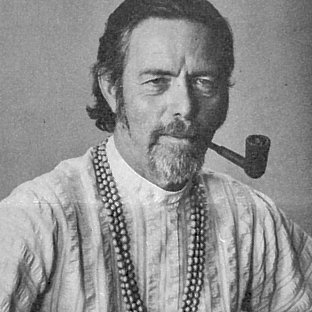
File:Alan_Watts.png · Wikimedia Commons · See Wikimedia Commons
Alan Watts
Sign in to saveAlso known as Alan Wilson Watts
British American author and lecturer (1915–1973)
OverviewAI-generated
Alan Watts (1915–1973) was a British-American philosopher, theologian, writer, and Anglican priest. Born in Kent, England, and dying in Mount Tamalpais, he held citizenship in the United Kingdom and the United States. His work focused on philosophy, Zen, Taoism, and Hinduism, aligning with the movement of Eastern philosophy during the contemporary period. He was educated at The King's School Canterbury and spoke English.
Watts is associated with Buddhism and was influenced by D. T. Suzuki, Timothy Leary, Marshall McLuhan, and Carl Jung. His notable works include *The Way of Zen*, *Zen Buddhism*, *An outline of Zen Buddhism*, *The meaning of priesthood*, and *Psychotherapy East & West*. He is also linked to spoken word and psychedelic tags in music databases.
Synthesized by Vinony from 34 facts across 5 sources: Wikidata, Open Library, MusicBrainz, Last.fm, TMDb. Generated from structured data (not the Wikipedia text) and checked against those facts — may still contain errors.
Person · Open Library
- Born
- 1915-01-06
- Died
- 1973-11-16
- Works
- 151
Top works
- Zen Buddhism
- An outline of Zen Buddhism
- The meaning of priesthood
- L.S.D., a complete program giving both pro and con views by leading authorities in the field of psychedelic research sponsored by the Progressive Young Democrats
- psychotherapy east & west
via Open Library + Wikidata
Film & TV
Chislehurst, Kent, England, UK
Alan Wilson Watts was a British philosopher, writer and speaker known for interpreting and popularising Buddhism, Taoism, and Hinduism for a Western audience. Born in Chislehurst, England, he moved to the United States in 1938 and began Zen training in New York. He received a master's degree in theology from Seabury-Western Theological Seminary and became an Episcopal priest in 1945. He left the…
Known for
- The Monkey Conflict — Storyteller2024
- Until There Was Nothing — Narrator2020
- Play — Self (voice recording)2018
- Everything — Narrator (archive footage)2017
- Zen Dog — Alan Watts (voice)2016
- Zen: The Best of Alan Watts — Himself1994
- Work as Play — Himself1973
- Conversation with Myself — Himself1972
- Time and the More It Changes — Self1972
- The Essential Lectures of Alan Watts — Alan Watts1972
via TMDB
Listeners · Last.fm
- Listeners
- 54,460
- Total plays
- 877,152
Tags
Alan Wilson Watts (January 6, 1915 – November 16, 1973) was a philosopher, writer, speaker, and expert in comparative religion. He wrote over twenty-five books and numerous articles on subjects such as personal identity, the true nature of reality, consciousness and the pursuit of happiness, relating his experience to scientific knowledge and to the teachings of Eastern and Western religions or philosophies (Zen Buddhism, Taoism, Christianity, Hinduism). <a href="https://www.last.fm/music/Alan+W
Key facts
- Born
- Alan Wilson Watts , ( 1915-01-06 ) 6 January 1915, Chislehurst , Kent, England
- Died
- 16 November 1973 (1973-11-16) (aged 58), Marin County, California , U.S.
- Spouses
- Eleanor Everett ( married</span>"}]]}'>m. 1938 ; annulled</span>"}]]}'>ann. 1949 ) Dorothy DeWitt ( married</span>"}]]}'>m. 1950 ; divorced</span>"}]]}'>div. 1963 ) Mary Jane Yates King ( married</span>"}]]}'>m. 1964 )
- Alma mater
- Seabury-Western Theological Seminary
- Era
- 20th-century philosophy
- Institutions
- The King's School Canterbury American Academy of Asian Studies Society for Comparative Philosophy San Jose State University
- Main interests
- Comparative religion
- Notable works
- The Way of Zen (1957)
- Website
- alanwatts .org
via Wikipedia infobox
Wikidata facts
- Instance of
- human
- Family name
- Watts
- Gender
- male
- Citizenship
- United States
- Place of birth
- Kent
- Place of death
- Mount Tamalpais
- Occupation
- videographer
- Languages spoken
- English language
- Religion
- Buddhism
- Notable work
- The Way of Zen
- Field of work
- Buddhism
- Image
- Alan Watts painted on mural.jpg
Show 7 more facts
- date of birth
- 1915-01-06
- date of death
- 1973-11-16
- name in native language
- Alan Watts
- Commons category
- Alan Watts
- time period
- contemporary philosophy
- influenced by
- Ludwig Wittgenstein
- P12674
- 4431 Holeungholee
Sources (2)
via Wikidata · CC0
~30 min read
Encyclopedic overview
(Learn how and when to remove this message)
Alan Wilson Watts (6 January 1915 – 16 November 1973) was a British and American writer, speaker, and self-styled "philosophical entertainer", known for interpreting and popularising Buddhist, Taoist, and Hindu philosophy for a Western audience.
Excerpted from Wikipedia’s “Alan Watts” article, available under the CC BY-SA 4.0 licence.