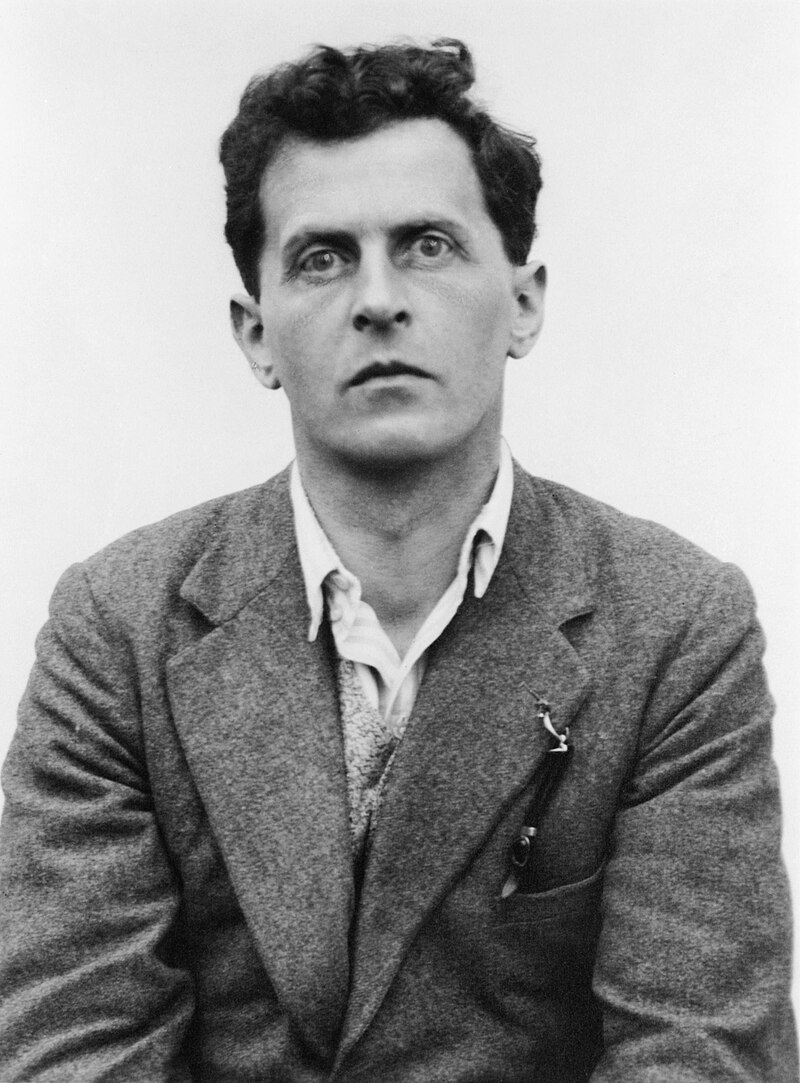
File:Ludwig_Wittgenstein_1929.jpg · Wikimedia Commons · See Wikimedia Commons
Ludwig Wittgenstein
Sign in to saveAustrian philosopher and logician (1889–1951)
OverviewAI-generated
Ludwig Josef Johann Wittgenstein was a logician, mathematician, philosopher, and teacher. He held citizenship in the United Kingdom and Austria. His primary field of work was philosophy. He earned a doctorate and was employed by Trinity College and the University of Cambridge. He spoke and wrote in German and English.
Wittgenstein is the author of notable works including *Tractatus Logico-Philosophicus* and *Philosophical Investigations*. Other listed works include *Big Typescript*, *Rzeczy i fakty*, and *文化和价值*. He was influenced by Bertrand Russell, Søren Kierkegaard, Gottlob Frege, and Arthur Schopenhauer. His students included Alice Ambrose and G. E. M. Anscombe.
Born on 26 April 1889, he participated in World War I. He died of prostate cancer on 29 April 1951 in Cambridge. His father was Karl Wittgenstein, and his siblings were Margaret Stonborough-Wittgenstein and Paul Wittgenstein.
Synthesized by Vinony from 28 facts across 3 sources: Wikidata, Open Library, Europeana Sparql. Generated from structured data (not the Wikipedia text) and checked against those facts — may still contain errors.
Person · Open Library
- Born
- 26 Apr 1889
- Died
- 29 Apr 1951
- Works
- 351
Top works
- 文化和价值
- 哲学研究
- [Wittgenstein's lectures I-III, 1930-1933. Draft for GEM's articles in Mind, 1953]
- Rzeczy i fakty
- Big Typescript
via Open Library + Wikidata
Wikidata facts
- Instance of
- human
- Given name
- Johann
- Gender
- male
- Citizenship
- Austria
- Place of death
- Cambridge
- Father
- Karl Wittgenstein
- Occupation
- university teacher
- Employer
- University of Cambridge
- Languages spoken
- English language
- Native language
- German
- Award
- Medal for Bravery
- Notable work
- Philosophical Investigations
- Academic degree
- doctorate
- Doctoral advisor
- G. E. Moore
- Field of work
- philosophy
- Movement
- analytic philosophy
- Instrument
- clarinet
- Conflict
- World War I
- Official website
- www.wittgen-cam.ac.uk
- Image
- Ludwig Wittgenstein.jpg
- Residence
- Wiener Neustadt
Show 20 more facts
- date of birth
- 1889-04-26
- topic's main category
- Category:Ludwig Wittgenstein
- cause of death
- prostate cancer
- name in native language
- Ludwig Josef Johann Wittgenstein
- on focus list of Wikimedia project
- Wikipedia:Vital articles/Level/4
- influenced by
- Arthur Schopenhauer
- Commons category
- Ludwig Wittgenstein
- date of death
- 1951-04-29
- IPA transcription
- ˈvɪtɡənˌstaɪn
- student
- G. E. M. Anscombe
- manner of death
- natural causes
- Commons gallery
- Ludwig Wittgenstein
- relative
- Joseph Joachim
- academic thesis
- Tractatus Logico-Philosophicus
- P8168
- Wood Sandpiper
- medical condition
- prostate cancer
- Commons Creator page
- Ludwig Wittgenstein
- maintained by WikiProject
- WikiProject Mathematics
- P12674
- Bernkastel-Kues
- sexual orientation
- homosexuality
Sources (15)
via Wikidata · CC0
Works in European collections
1 object attributed to Ludwig Wittgenstein, held across European museums, libraries & archives · via Europeana
~40 min read
Encyclopedic overview
Ludwig Josef Johann Wittgenstein (/ˈvɪtɡənʃtaɪn, -staɪn/ VIT-gən-s(h)tyne; Austrian German: [ˈluːdvɪç ˈjoːsɛf ˈjoːhan ˈvɪtɡn̩ʃtaɪn]; 26 April 1889 – 29 April 1951) was an Austro-British philosopher who worked primarily in logic, philosophy of mathematics, philosophy of mind, and philosophy of language.
From 1929 to 1947, Wittgenstein taught at the University of Cambridge. Despite his position, only one book of his philosophy was published during his life: the 75-page Logisch-Philosophische Abhandlung (Logical-Philosophical Treatise, 1921), which appeared, together with an English translation, in 1922 under the Latin title Tractatus Logico-Philosophicus. His only other published works were an article, "Some Remarks on Logical Form" (1929); a review of The Science of Logic by P. Coffey; and a children's dictionary. His voluminous manuscripts were edited and published posthumously. The first and best-known of this posthumous series is the 1953 book Philosophical Investigations. A 1999 survey of American university and college teachers ranked Philosophical Investigations as the most important book of 20th-century philosophy, standing out as "the one crossover masterpiece in twentieth-century philosophy, appealing across diverse specializations and philosophical orientations".
Excerpted from Wikipedia’s “Ludwig Wittgenstein” article, available under the CC BY-SA 4.0 licence.
Gallery (12)
Available in 127 languages
- Español
- Français
- Deutsch
- 中文
- 日本語
- Русский
- Português
- Italiano
- العربية
- हिन्दी
- Afrikaans
- Albanian
- Albanian
- Amharic
- Aragonese
- Armenian
- Assamese
- Asturian
Show 108 more
- azb
- Azerbaijani
- Bahasa Indonesia
- Bangla
- Bashkir
- Basque
- bat_smg
- be_x_old
- Belarusian
- Bosnian
- Breton
- btm
- Bulgarian
- Buriat
- Catalan
- Central Kurdish
- Chechen
- Chuvash
- Cornish
- Croatian
- Czech
- Danish
- Egyptian Arabic
- Erzya
- Esperanto
- Estonian
- Fiji Hindi
- Filipino
- Finnish
- Galician
- Georgian
- Greek
- Guarani
- Hebrew
- Hungarian
- Icelandic
- Ido
- Iloko
- Interlingua
- Irish
- Javanese
- Kanuri
- Kazakh
- Kurdish
- Kyrgyz
- Latin
- Latvian
- Lithuanian
- Lombard
- Low German
- Luxembourgish
- Macedonian
- Madurese
- Malagasy
- Malay
- Malayalam
- Manx
- Marathi
- Mingrelian
- Moksha
- Mongolian
- Moroccan Arabic
- Nederlands
- Newari
- Northern Frisian
- Norwegian
- Norwegian Nynorsk
- Occitan
- Pampanga
- Papiamento
- Pashto
- Piedmontese
- Polski
- Punjabi
- Romanian
- Rusyn
- Scots
- Serbian
- Serbian (Latin)
- Sicilian
- simple
- Sindhi
- Slovak
- Slovenian
- Svenska
- Swahili
- Tamil
- Tatar
- Tibetan
- Tiếng Việt
- Türkçe
- Turkmen
- Ukrainian
- Urdu
- Uzbek
- Veps
- Volapük
- Waray
- Welsh
- Western Panjabi
- Wu Chinese
- Yiddish
- Yoruba
- zh_min_nan
- zh_yue
- فارسی
- ไทย
- 한국어
via Wikidata sitelinks · CC0