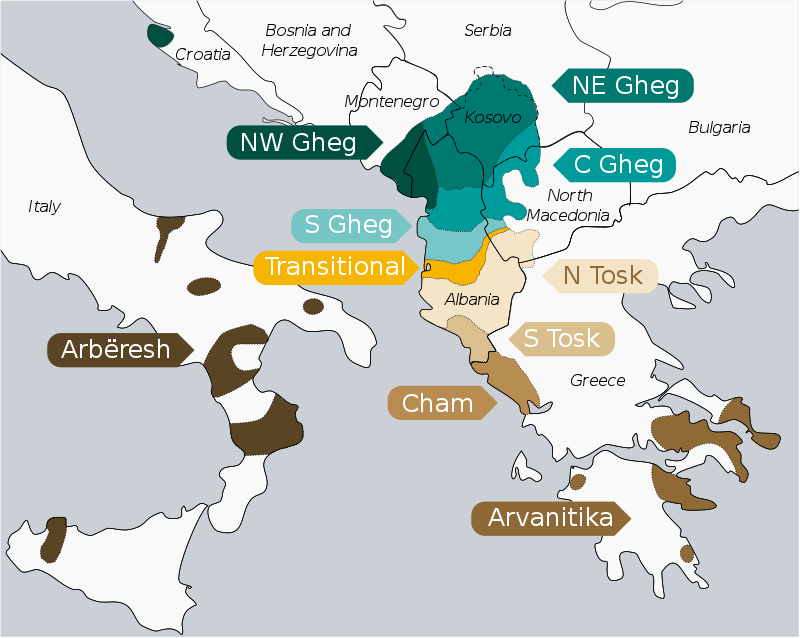
File:Albanian_language_map_en.svg · Wikimedia Commons · See Wikimedia Commons
Albanian
Sign in to saveAlso known as Albanian language, Shqip
Indo-European language, spoken primarily in Albania, Kosovo, North Macedonia, and Montenegro
Albanian is an Indo-European language spoken primarily in Albania, Kosovo, North Macedonia, and Montenegro. It matters because it is the native language of millions of people in the Balkans and represents an important linguistic and cultural presence in southeastern Europe.
AI-generated from the Wikipedia summary — may contain errors.
Wikidata facts
- Instance of
- macrolanguage
- Country
- Albania
- Image
- Oldest Surviving Albanian Text.jpg
Show 22 more facts
- has grammatical case
- vocative case
- entry in abbreviations table
- алб.
- Stack Exchange tag
- linguistics.stackexchange.com/tags/albanian
- has tense
- past tense
- number of speakers, writers, or signers
- 6200000
- short name
- albanščina
- P11012
- Category:Office work
- Wikimedia language code
- sq
- Commons category
- Albanian language
- writing system
- Albanian Braille
- topic's main category
- Category:Albanian language
- native label
- Gjuha shqipe
- has grammatical mood
- admirative
- language regulatory body
- Academy of Sciences of Albania
- linguistic typology
- nominative–accusative language
- category for films in this language
- Category:Albanian-language films
- studied by
- albanology
- exact match
- afbo.info/languages/18
- different from
- Caucasian Albanian
- P10369
- Greece
- has grammatical gender
- neuter
- female form of label
- la langue albanaise
via Wikidata · CC0
~40 min read
Encyclopedic overview
Albanian (endonym: shqip [ʃcip] , gjuha shqipe [ˈɟuha ˈʃcipɛ] , or arbërisht [aɾbəˈɾiʃt]) is an Indo-European language and the only surviving representative of the Albanoid branch, which belongs to the Paleo-Balkan group. It is the native language of the Albanian people. Standard Albanian is the official language of Albania and Kosovo, and a co-official language in North Macedonia and Montenegro, where it is the primary language of significant Albanian minority communities. Albanian is recognized as a minority language in Italy, Croatia, Romania, and Serbia. It is also spoken by long-established communities in Greece, and by the Albanian diaspora, which is generally concentrated in the Americas, Europe, and Oceania. Albanian is estimated to have as many as 7.5 million native speakers.
Albanian and other Paleo-Balkan languages had their formative core in the Balkans after the Indo-European migrations in the region. Albanian in antiquity is often thought to have been an Illyrian language for obvious geographic and historical reasons, or otherwise an unmentioned Balkan Indo-European language that was closely related to Illyrian and Messapic. The Indo-European subfamily that gave rise to Albanian is called Albanoid in reference to a specific ethnolinguistically pertinent and historically compact language group. Whether descendants or sisters of what was called 'Illyrian' by classical sources, Albanian and Messapic, on the basis of shared features and innovations, are grouped together in a common branch in the current phylogenetic classification of the Indo-European language family.
Excerpted from Wikipedia’s “Albanian” article, available under the CC BY-SA 4.0 licence.
Gallery (10)
Available in 163 languages
- Español
- Français
- Deutsch
- 中文
- 日本語
- Русский
- Português
- Italiano
- العربية
- हिन्दी
- Abkhazian
- Adyghe
- Afrikaans
- Albanian
- Albanian
- Amharic
- Angika
- Aragonese
Show 144 more
- Aramaic
- Armenian
- Arpitan
- Asturian
- Azerbaijani
- Bahasa Indonesia
- Balinese
- Bangla
- Bashkir
- Basque
- bat_smg
- be_x_old
- Belarusian
- Bosnian
- Breton
- Bulgarian
- Catalan
- Cebuano
- Central Kurdish
- Chechen
- Chuvash
- Cornish
- Corsican
- Crimean Tatar
- Croatian
- Czech
- Danish
- Egyptian Arabic
- Erzya
- Esperanto
- Estonian
- Faroese
- Fiji Hindi
- Filipino
- Finnish
- fiu_vro
- Gagauz
- Galician
- Georgian
- Greek
- Hakka Chinese
- Hebrew
- Hungarian
- Icelandic
- Ido
- Iloko
- Interlingua
- Irish
- Javanese
- Kabardian
- Kannada
- Kara-Kalpak
- Karachay-Balkar
- Kashmiri
- Kazakh
- kge
- Kinyarwanda
- Komi
- Komi-Permyak
- Kurdish
- Kyrgyz
- Lao
- Latin
- Latvian
- Limburgish
- Lingua Franca Nova
- Lithuanian
- Lombard
- Low German
- Lower Sorbian
- Luxembourgish
- Macedonian
- Malagasy
- Malay
- Malayalam
- Manx
- Māori
- Marathi
- Mazanderani
- Mingrelian
- Moksha
- Mongolian
- Nederlands
- Newari
- Northern Frisian
- Northern Sami
- Norwegian
- Norwegian Nynorsk
- Occitan
- Old English
- Ossetic
- Papiamento
- Pashto
- Polski
- Punjabi
- Quechua
- roa_rup
- Romanian
- Romansh
- Rusyn
- Samoan
- Santali
- Sardinian
- Scots
- Scottish Gaelic
- Serbian
- Serbian (Latin)
- Shan
- Sicilian
- Silesian
- simple
- Slovak
- Slovenian
- Standard Moroccan Tamazight
- Svenska
- Swahili
- Tajik
- Talysh
- Tamil
- Tatar
- Tiếng Việt
- Tok Pisin
- Toki Pona
- Türkçe
- Ukrainian
- Upper Sorbian
- Urdu
- Uyghur
- Uzbek
- Veps
- Volapük
- Waray
- Welsh
- Western Panjabi
- wikifunctions
- Wu Chinese
- Yoruba
- Zaza
- zh_classical
- zh_min_nan
- zh_yue
- فارسی
- ไทย
- 한국어
via Wikidata sitelinks · CC0