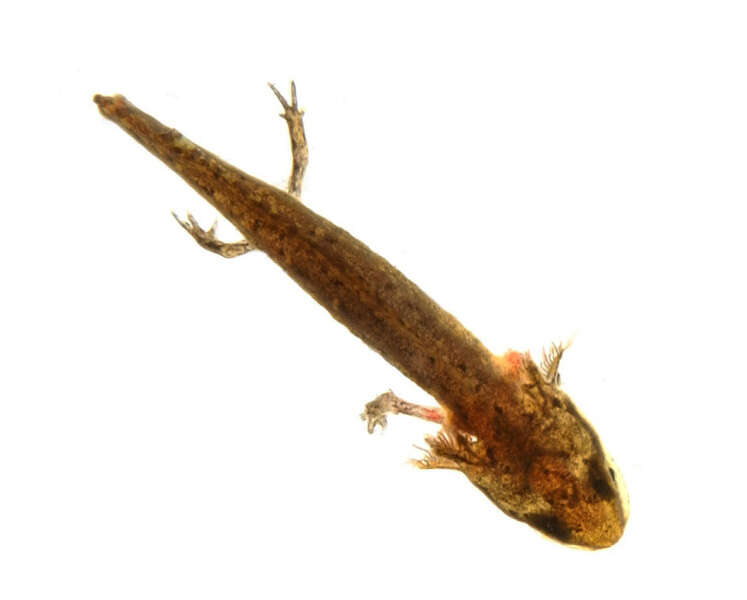
Encyclopedia of Life · EOL (see source)
Ambystomatidae
Sign in to saveAmbystomatidae is a family of salamanders belonging to the Suborder Salamandroidea in the class Amphibia. It contains two genera, Ambystoma (the mole salamanders) and Dicamptodon (the Pacific giant salamanders). Ambystoma contains 32 species and are distributed widely across North America, while Dicamptodon contains four species restricted to the Pacific Northwest. These salamanders are mostly terrestrial and eat invertebrates, although some species are known to eat smaller salamanders. They can be found throughout the US and some areas of Canada in damp forests or plains. This family contains
Species
FAMILY
- KingdomAnimalia
- PhylumChordata
- ClassAmphibia
- OrderCaudata
- FamilyAmbystomatidae
トラフサンショウウオ科(トラフサンショウウオか、Ambystomatidae)は、両生綱有尾目に属する科。別名アンビストマ科。マルクチサラマンダー科。
via GBIF
Museum specimens
- Specimen records
- 134
- With media
- 2
- Family
- Ambystomatidae
- Collections
- FHSM, NMMNHS, CMN, CHAS, UCMP
- Recorded in
- United States, Canada
Research
3,218 papers- Single-cell Stereo-seq reveals induced progenitor cells involved in axolotl brain regeneration.Science (New York, N.Y.) · 2022
- Evolutionarily divergent mTOR remodels translatome for tissue regeneration.Nature · 2023
- Single-cell analysis uncovers convergence of cell identities during axolotl limb regeneration.Science (New York, N.Y.) · 2018
- Molecular basis of positional memory in limb regeneration.Nature · 2025
- A matter of nerves.eLife · 2021
via PubMed
Wikidata facts
Show 5 more facts
- Commons category
- Ambystomatidae
- taxon rank
- family
- taxon name
- Ambystomatidae
- topic's main category
- Category:Mole salamanders
- described by source
- Brockhaus and Efron Encyclopedic Dictionary
Sources (1)
via Wikidata · CC0
~3 min read
Encyclopedic overview
5 sectionsContents
- Characteristics and behavior
- Taxonomy
- Intrinsic Phylogeny
- References
- External links
Ambystomatidae is a family of salamanders belonging to the Suborder Salamandroidea in the class Amphibia. It contains two genera, Ambystoma (the mole salamanders) and Dicamptodon (the Pacific giant salamanders). Ambystoma contains 32 species and are distributed widely across North America, while Dicamptodon contains four species restricted to the Pacific Northwest. These salamanders are mostly terrestrial and eat invertebrates, although some species are known to eat smaller salamanders. They can be found throughout the US and some areas of Canada in damp forests or plains. This family contains some of the largest terrestrial salamanders in the world, the tiger salamander and the coastal giant salamander. Some species are toxic and can secrete poison from their bodies as protection against predators or infraspecific competition. Neoteny has been observed in several species in Ambystomatidae, and some of them like the axolotl live all of their lives under water in their larval stage.
== Characteristics and behavior == Ambystomatids have chunky bodies with broad, flat heads and short legs. Tails are long and flattened. Colors range from black, brown, or a dull grey and can have brightly colored speckles or spots. Their skin is smooth and shiny. Most adults lack gills/gill slits and moveable eyes. There are no nasolabial grooves on the snout. Lungs are well-developed and functional. They have 10 costal grooves. Adult males have six sets of cloacal glands. Adult females have spermathecae in cloaca. Ambystomatids are nocturnal. Although they are more active at night, they may be found on cool days under moist leaf litter, logs, or rocks near water bodies.
Excerpted from Wikipedia’s “Ambystomatidae” article, available under the CC BY-SA 4.0 licence.