File:Notophthalmus_viridescensPCCA20040816-3983A.jpg · Wikimedia Commons · See Wikimedia Commons
Salamandridae
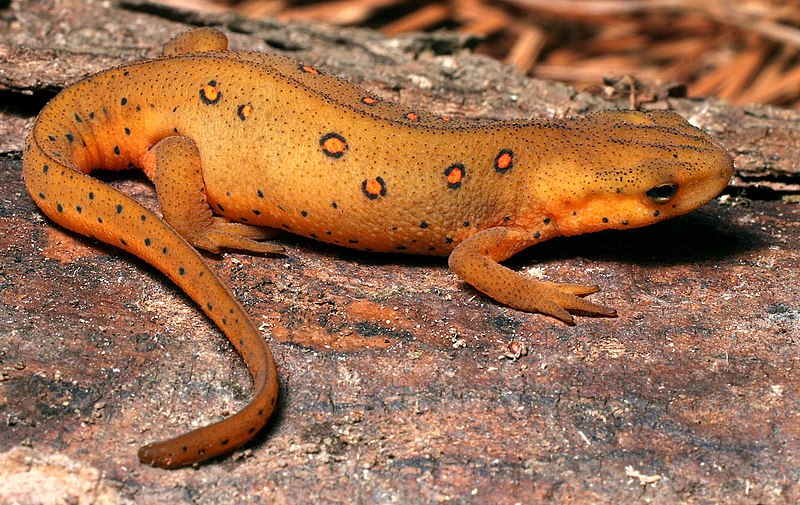
Sign in to saveSalamandridae is a family of salamanders consisting of true salamanders and newts. Salamandrids are distinguished from other salamanders by the lack of rib or costal grooves along the sides of their bodies and by their rough skin. Their skin is very granular because of the number of poison glands. They also lack nasolabial grooves. Most species of Salamandridae have moveable eyelids but lack lacrimal glands.
OverviewAI-generated
Salamandridae is a family of organisms within the order Caudata and class Amphibia. It belongs to the phylum Chordata and kingdom Animalia. The taxon was described by Goldfuss in 1820 and is governed by the International Code of Zoological Nomenclature. Its status is accepted, and it is distinct from newts. The family originated about 89 million years ago.
The habitat for this family is freshwater. Records indicate presence in the United States, Mexico, Australia, and China, as well as locations marked as unknown or invalid. Specimens are held by institutions including SDNHM, ASNHC, MADUG-UG, UF, and UCM. There are 1,675,309 occurrence records, 4,221 PubMed entries, and 265 iDigBio records associated with the family.
Synthesized by Vinony from 35 facts across 7 sources: Wikidata, GBIF, PubMed, Gbif Occ, WoRMS, iDigBio, Vinony graph. Generated from structured data (not the Wikipedia text) and checked against those facts — may still contain errors.
Species
Salamandridae
FAMILY
- KingdomAnimalia
- PhylumChordata
- ClassAmphibia
- OrderCaudata
- FamilySalamandridae
模式屬 真螈屬 SalamandraLaurenti, 1768 蠑螈是通常顏色鮮艷的中小型兩棲綱有尾目動物,分佈於北半球的溫帶地區(北美、歐洲、亞洲和非洲地中海沿岸)。終生有尾,沒有鳞片,是有尾目兩棲動物的代表,也是兩棲動物中較原始的一群,與其同屬一目的,還有鰻螈、鈍口螈、洞螈等。蠑螈和水蜥在成長過程中,通常都要經歷蛻變過程。 目录 1 生活習性 2 變態生長 3 形態 4 生態 5 分類 6 參考 7 參見 生活習性 無論是陸棲蠑螈還是水棲蠑螈,它們都喜歡潮濕的生存環境,以便保持皮膚的溫潤,利於水和空氣的流通。蠑螈還具有休眠的習性。在寒冷地區,蠑螈在冬天冬眠;在溫暖地區,如果氣候乾旱燥熱,它們就進行夏眠。在遭遇敵害時,蠑螈和水蜥有好幾種防衛方法。有此種類呈彎曲防衛姿勢,舉起尾巴,直立下頜,顯示出它們色彩豔麗的腹面,以恐嚇敵人;有的蠑螈皮膚有毒,體表呈現警戒色;還有些蠑 螈在遭到攻擊時能自動脫落尾巴迷惑敵人,趁機逃生。 變態生長 水棲蠑螈和水蜥在水中產卵,卵孵化成形似蝌蚪的幼體;幼體用鰓患呼吸,在成長中鰓逐漸消失,體態特徵逐漸趨向成體。 形態 最大種的歐非肋突螈(Pleurodeles waltl)全長可達30公分。 沒有肋骨間溝,身體的全部或部份具有鮮明的警戒色,皮膚可分泌河豚毒素(TTX)。 生態 棲息於森林、河川、溪流、池沼等地。有完全生活於陸地的陸棲種,也有完全生活於水中的水棲種。 肉食性,以昆蟲、節肢動物、甲殼類、貝類、蚯蚓、其他小型兩棲類的卵和幼體等為食。 在池塘完全乾涸,最後階段的變形前,較大型的蠑螈以同類小型為食。 分類 伸舌螈屬 Chioglossa Bocage, 1864 金紋伸舌螈 - C. lusitanica Bocage, 1864 蠑螈屬 Cynops Tschudi, 1838 呈貢蠑螈 - C. chenggongensis Kou and Xing, 1983 藍尾蠑螈 - C. cyanurus Liu, Hu and Yang, 1962 劍尾蠑螈 - C. ensicauda (Hallowell, 1861) 東方蠑螈 - C. orientalis (David, 1873) 汕頭蠑螈 - C. orphicus Risch, 1983 紅腹蠑螈 - C. pyrrhogaster (Boie, 1826) C. wolterstorffi (Boulenger, 1905) 棘螈屬 Echinotriton Nussbaum and Brodie, 1982 琉球棘螈 - E. andersoni (Boulenger, 1892) 鎮海棘螈 - E. chinhaiensis (Chang, 1932) 山螈屬 Euproctus Gené, 1838 比利牛斯山螈 - E. asper (Dugès,
via GBIF
Museum specimens
- Specimen records
- 265
- Family
- Salamandridae
- Collections
- SDNHM, ASNHC, MADUG-UG, UF, UCM, ANWC
- Recorded in
- United States, Mexico, Unknown Or Invalid, Australia, China, Germany
Research
4,221 papers- Axolotl/newt.ReviewMethods in molecular biology (Clifton, N.J.) · 2008Maden MDOI: 10.1007/978-1-60327-483-8_32
- Axolotl/newt.ReviewMethods in molecular biology (Clifton, N.J.) · 1999Maden MDOI: 10.1385/1-59259-270-8:415
- Tetrodotoxin in Asian newts (Salamandridae).Toxicon : official journal of the International Society on Toxinology · 2017Yotsu-Yamashita M, Toennes SW, Mebs DDOI: 10.1016/j.toxicon.2017.05.014
- Regeneration.Journal of plastic, reconstructive & aesthetic surgery : JPRAS · 2008Burd ADOI: 10.1016/j.bjps.2008.06.011
- Mitochondrial genome of Pachytriton feii (Urodela: Salamandridae).Mitochondrial DNA. Part A, DNA mapping, sequencing, and analysis · 2017Fang K, Zhang C, Guo W et al.DOI: 10.3109/19401736.2015.1118083
- Time to grow up: the PETM climatic event favoured metamorphosing salamanders (Urodela, Salamandridae).Proceedings. Biological sciences · 2025Macaluso L, Villa A, Rozzi R et al.DOI: 10.1098/rspb.2025.1333
- Comparative Anatomy of Trunk Musculature in Salamandridae with Different Habitats.Zoological science · 2019Omura ADOI: 10.2108/zs180131
- Characterization, Comparison of Two New Mitogenomes of Crocodile Newts Tylototriton (Caudata: Salamandridae), and Phylogenetic Implications.Genes · 2022Wang JX, Lan XY, Luo QH et al.DOI: 10.3390/genes13101878
via PubMed
Wikidata facts
- Instance of
- taxon
- Parent taxon
- Salamandroidea
- Image
- Notophthalmus viridescensPCCA20040816-3983A.jpg
Show 7 more facts
- Commons category
- Salamandridae
- taxon rank
- family
- topic's main category
- Category:Salamandridae
- taxon name
- Salamandridae
- Code of nomenclature
- International Code of Zoological Nomenclature
- different from
- newt
- start time
- 89000000-0
via Wikidata · CC0
~11 min read
Encyclopedic overview
7 sectionsContents
- Toxicity
- Conservation status (IUCN Redlist)
- Phylogeny
- Taxonomy
- Fossil record
- References
- External links
Salamandridae is a family of salamanders consisting of true salamanders and newts. Salamandrids are distinguished from other salamanders by the lack of rib or costal grooves along the sides of their bodies and by their rough skin. Their skin is very granular because of the number of poison glands. They also lack nasolabial grooves. Most species of Salamandridae have moveable eyelids but lack lacrimal glands.
Nearly all salamandrids produce a potent toxin in their skin, with some species being deadly to many other animal species. With a few exceptions, salamandrids have patterns of bright and contrasting colours, most of these are to warn potential predators of their toxicity. They have four well-developed limbs, with four toes on the fore limbs, and (in most cases) five toes on the hind limbs. They vary from in length.
Excerpted from Wikipedia’s “Salamandridae” article, available under the CC BY-SA 4.0 licence.