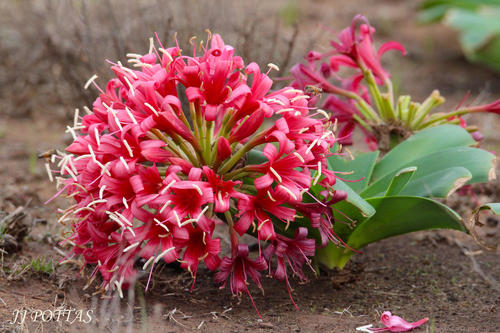
(c) pottasjj, some rights reserved (CC BY-NC) · cc-by-nc
Ammocharis
Sign in to saveAmmocharis is a small genus from sub-Saharan Africa, in the family Amaryllidaceae (subfamily Amaryllidoideae) which includes seven species distributed in Africa. The plant grows as above-ground bulb, preferring seasonally wet, hot, sandy soils and full sun. thumb|right|Ammocharis coranica ==Taxonomy == The botanist William Herbert segregated Ammocharis from Crinum in 1821, with two species, A. coranica and A. falcata (both originally Amaryllis). He also placed one of Linnaeus' original Amaryllis species, A. longifolia, in Crinum as C. capense. This species would also eventually find its way in
Species
Ground lily
GENUS
- KingdomPlantae
- PhylumTracheophyta
- ClassLiliopsida
- OrderAsparagales
- FamilyAmaryllidaceae
via GBIF · Kew POWO
Museum specimens
- Specimen records
- 3
- With media
- 3
- Family
- Amaryllidaceae
- Collections
- MO, B
- Recorded in
- Burundi, Angola, Malawi
Wikidata facts
- Instance of
- taxon
- Image
- Ammocharis coranica 139.jpg
Show 6 more facts
- taxon rank
- genus
- taxon name
- Ammocharis
- Commons category
- Ammocharis
- topic's main category
- Category:Ammocharis
- taxon common name
- 沙殊兰属
Sources (1)
via Wikidata · CC0
~4 min read
Encyclopedic overview
6 sectionsContents
- Taxonomy
- Subdivision
- Etymology
- References
- Bibliography
- External links
Ammocharis is a small genus from sub-Saharan Africa, in the family Amaryllidaceae (subfamily Amaryllidoideae) which includes seven species distributed in Africa. The plant grows as above-ground bulb, preferring seasonally wet, hot, sandy soils and full sun. thumb|right|Ammocharis coranica ==Taxonomy == The botanist William Herbert segregated Ammocharis from Crinum in 1821, with two species, A. coranica and A. falcata (both originally Amaryllis). He also placed one of Linnaeus' original Amaryllis species, A. longifolia, in Crinum as C. capense. This species would also eventually find its way into Ammocharis. In 1847 Roemer placed Amaryllis longifolia in Ammocharis as Ammocharis longifolfolia, (Linn.) Roem. without realising it was conspecific with Ammocharis falcata. However, many subsequent authors included only the two original species.
A major review of the genus was undertaken by Milne-Redhead and Schweickerdt in 1939. In their recircumscription they identified five species. With respect to A. longifolia=falcata they concluded that while very closely related, it was sufficiently distinct as to deserve of generic status, coining the term Cybistetes , or tumbler, after the way the wind tumbles the infructescence. From then onwards Cybistetes was treated as a separate genus.
Excerpted from Wikipedia’s “Ammocharis” article, available under the CC BY-SA 4.0 licence.