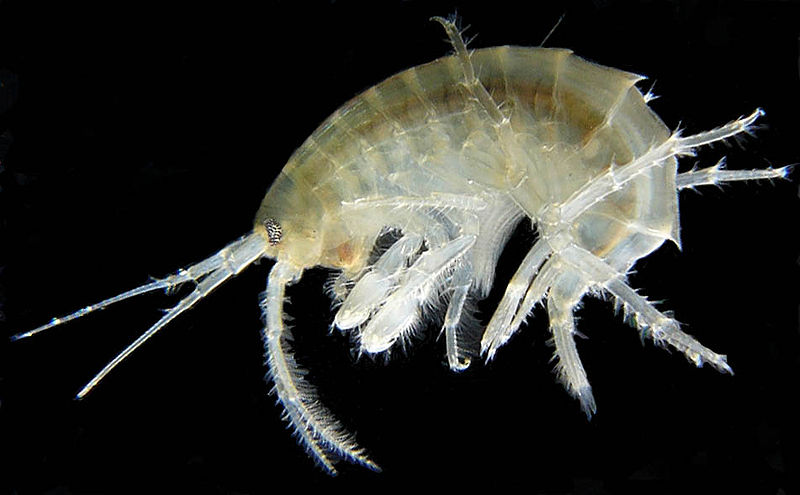
File:Gammarus_roeselii.jpg · Wikimedia Commons · See Wikimedia Commons
Amphipoda
Sign in to saveAlso known as amphipods, amphipod
Amphipoda () is an order of malacostracan crustaceans with no carapace and generally with laterally compressed bodies. Amphipods () range in size from 1 to 340 millimetres (0.039 to 13 in) and are mostly detritivores or scavengers. More than 10,700 amphipod species are currently recognized. They are mostly marine animals but are found in almost all aquatic environments. Some 2,250 species live in fresh water, and the order also includes the terrestrial sandhoppers, such as Talitrus saltator and Arcitalitrus sylvaticus.
OverviewAI-generated
Amphipoda is an order of animals within the class Malacostraca and phylum Arthropoda. The taxon, commonly known as amphipods, was described by Latreille in 1816 and holds an accepted status in taxonomic records. These organisms inhabit marine, brackish, and freshwater environments.
Records of Amphipoda are held by several institutions, including NMV, YPM, FMNH, CAS, and ECOSUR. These collections span countries such as Australia, the British West Indies, the United States, Mexico, and the Turks And Caicos Islands. The order is referenced by 1,438 other encyclopedia articles.
Synthesized by Vinony from 26 facts across 7 sources: Wikidata, GBIF, PubMed, Gbif Occ, WoRMS, iDigBio, Vinony graph. Generated from structured data (not the Wikipedia text) and checked against those facts — may still contain errors.
Species
amphipods
Amphipoda
ORDER
- KingdomAnimalia
- PhylumArthropoda
- ClassMalacostraca
- OrderAmphipoda
via GBIF
Museum specimens
- Specimen records
- 21,415
- With media
- 3,968
- Collections
- NMV, YPM, FMNH, CAS, ECOSUR, MUSEU NACIONAL/UFRJ
- Recorded in
- Australia, British West Indies, United States, Mexico, Turks And Caicos Islands, Brasil
Research
3,115 papers- Pathogens and other symbionts of the Amphipoda: taxonomic diversity and pathological significance.ReviewDiseases of aquatic organisms · 2019Bojko J, Ovcharenko MDOI: 10.3354/dao03321
- Comparative Mitogenomics in Hyalella (Amphipoda: Crustacea).Genes · 2021Zapelloni F, Jurado-Rivera JA, Jaume D et al.DOI: 10.3390/genes12020292
- A review of the world Cyphocarididae with description of three new species (Crustacea, Amphipoda, Lysianassoidea).ReviewZootaxa · 2015Hughes LE, Lowry JKDOI: 10.11646/zootaxa.4058.1.1
- Two new species of Sarothrogammarus (Crustacea, Amphipoda) from Swat Valley, Pakistan.Zootaxa · 2024Xin W, Zhang C, Ali A et al.DOI: 10.11646/zootaxa.5432.4.3
- Review of amphipods of the family Pleustidae Buchholz, 1874 (Amphipoda) from the coastal waters of Sakhalin Island (Far East of Russia). II. Subfamily Eosymtinae Bousfield & Hendrycks, 1994.ReviewZootaxa · 2022Labay VSDOI: 10.11646/zootaxa.5125.5.5
- A review of the hyperiidean amphipod genus Hyperoche Bovallius, 1887 (Crustacea: Amphipoda: Hyperiidea: Hyperiidae), with the description of a new genus to accommodate H. shihi Gasca, 2005.ReviewZootaxa · 2015Zeidler WDOI: 10.11646/zootaxa.3905.2.1
- Ampithoidae (Crustacea: Amphipoda) from the Persian Gulf and the Gulf of Oman.Zootaxa · 2022Momtazi FDOI: 10.11646/zootaxa.5159.3.3
- Review of amphipods of the family Pleustidae Buchholz, 1874 (Crustacea: Amphipoda) from the coastal waters of Sakhalin Island (Far East of Russia). I. Subfamily Neopleustinae Bousfield & Hendrycks, 1994.ReviewZootaxa · 2021Labay VSDOI: 10.11646/zootaxa.4974.2.3
via PubMed
Wikidata facts
- Instance of
- taxon
- Parent taxon
- Peracarida
- Image
- Gammarus roeselii.jpg
Show 8 more facts
- Commons category
- Amphipoda
- taxon rank
- order
- taxon common name
- Vlokreeftjes
- taxon name
- Amphipoda
- topic's main category
- Category:Amphipoda
- on focus list of Wikimedia project
- Wikipedia:Vital articles/Level/4
- temporal range start
- Eocene
- main food source
- carrion
via Wikidata · CC0
~13 min read
Encyclopedic overview
12 sectionsContents
- Description
- Anatomy
- Size
- Reproduction and life cycle
- Ecology
- Foraging behaviour
- Nomenclature
- Taxonomy
- Fossil record
- See also
- References
- External links
Amphipoda () is an order of malacostracan crustaceans with no carapace and generally with laterally compressed bodies. Amphipods () range in size from 1 to 340 millimetres (0.039 to 13 in) and are mostly detritivores or scavengers. More than 10,700 amphipod species are currently recognized. They are mostly marine animals but are found in almost all aquatic environments. Some 2,250 species live in fresh water, and the order also includes the terrestrial sandhoppers, such as Talitrus saltator and Arcitalitrus sylvaticus.
==Description== ===Anatomy=== thumb|Anatomical diagram of the gammaridean amphipod [[Leucothoe incisa]] Amphipods are characterized by sessile eyes (without eyestalks), no carapace, and the presence of gills on the coxae. Their bodies are divided into 13 segments, which can be grouped into the head, thorax and abdomen.
Excerpted from Wikipedia’s “Amphipoda” article, available under the CC BY-SA 4.0 licence.