File:Amfm3-en-de.gif · Wikimedia Commons · See Wikimedia Commons
amplitude modulation
Sign in to saveAlso known as AM
in amplitude modulation, the amplitude (signal strength) of the carrier wave is varied in proportion to the waveform being transmitted
Amplitude modulation is a way to transmit information by changing the strength of a radio wave up and down in sync with the signal you want to send. This method has been widely used for radio broadcasting and communication because it's a straightforward way to encode messages into waves that can travel long distances.
AI-generated from the Wikipedia summary — may contain errors.
Wikidata facts
- Subclass of
- modulation
- Image
- Amplitude modulation.png
- Has use
- AM broadcasting
Show 2 more facts
- Commons category
- Amplitude modulation
- opposite of
- frequency modulation
Sources (3)
via Wikidata · CC0
~30 min read
Encyclopedic overview
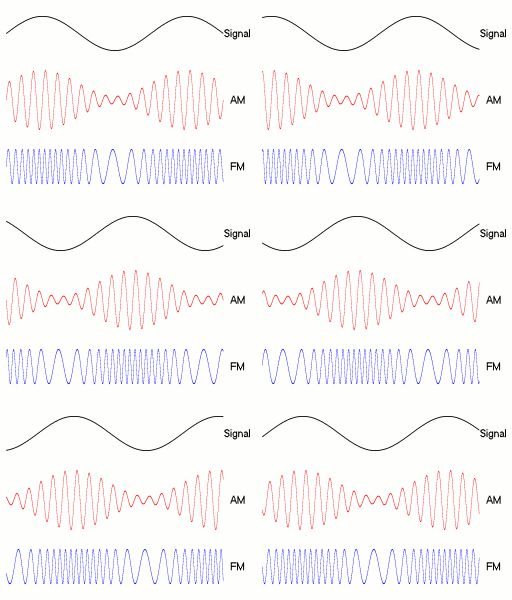
An audio signal (top) carried by a carrier signal using amplitude modulation (middle) and frequency modulation (bottom)
Amplitude modulation (AM) is a signal modulation technique used in electronic communication, most commonly for transmitting messages with a radio wave. In amplitude modulation, the instantaneous amplitude of the wave is varied in proportion to that of the message signal, such as an audio signal. This technique contrasts with angle modulation, in which either the frequency of the carrier wave is varied, as in frequency modulation, or its phase, as in phase modulation.
Excerpted from Wikipedia’s “amplitude modulation” article, available under the CC BY-SA 4.0 licence.