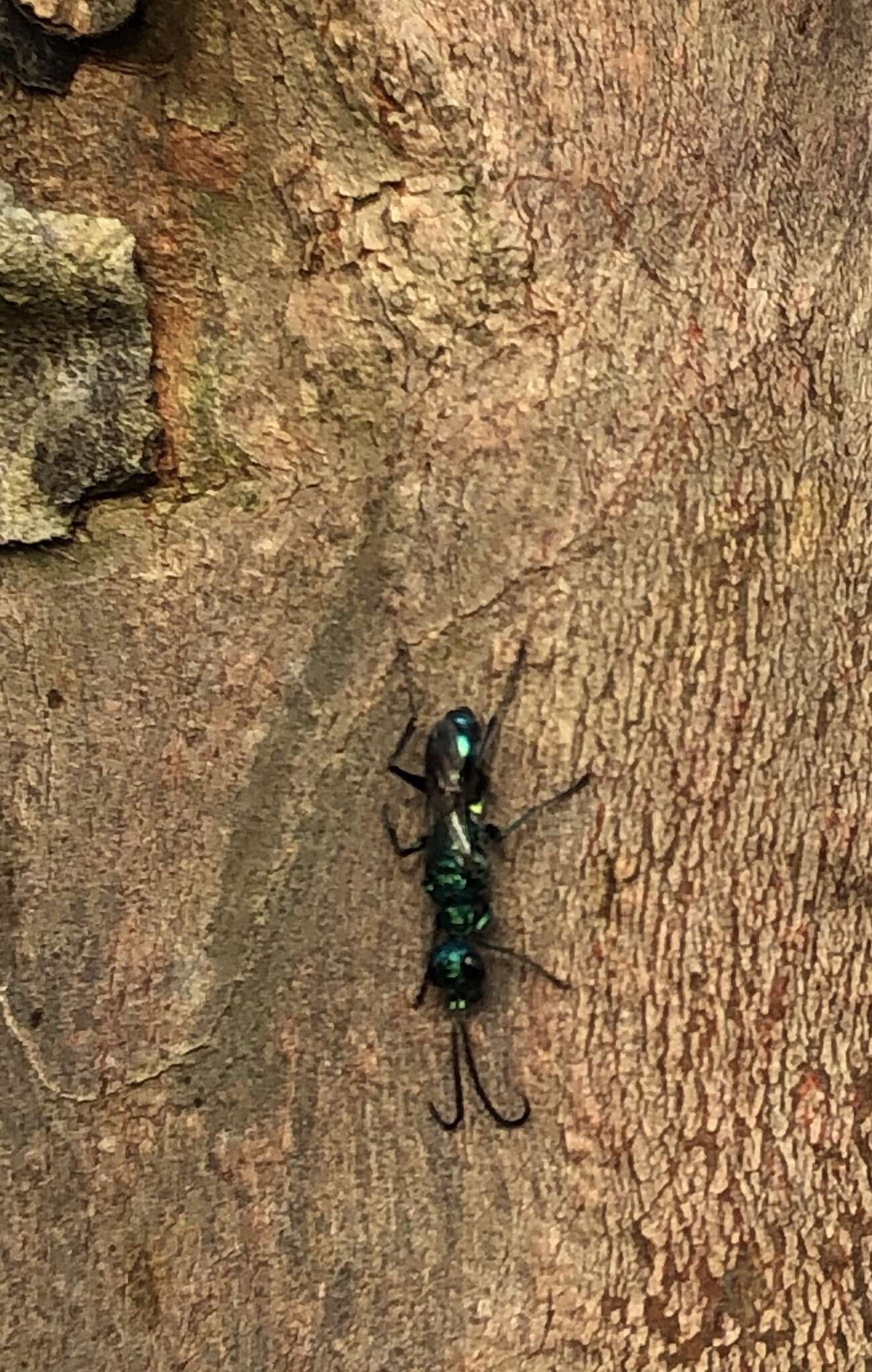
Encyclopedia of Life · EOL (see source)
Ampulicidae
Sign in to saveAmpulicidae, or cockroach wasps, are a small (about 170 species), primarily tropical family of sphecoid wasps, all of which use various cockroaches as prey for their larvae. They are the most primitive family of sphecoid hunting wasps. They tend to have elongated jaws, pronounced neck-like constrictions behind the head, strongly petiolate abdomens, and deep grooves on the thorax. Many are quite ant-like in appearance, though some are brilliant metallic blue, green, and hot pink.
Species
FAMILY
- KingdomAnimalia
- PhylumArthropoda
- ClassInsecta
- OrderHymenoptera
- FamilyAmpulicidae
These primitive sphecoid wasps occur principally in the tropics of the Old and New Worlds. Appropriately, they prey upon cockroaches, one of the most primitive of insect orders. The biology of only a few species has been observed. The nests are constructed in pre-existing cavities or crevices, such as in twigs, beneath bark of trees or in the soil. Unlike other sphecoids, the prey is carried backwards on foot as in most pompilid wasps.
via GBIF
Museum specimens
- Specimen records
- 55
- Family
- Ampulicidae
- Collections
- NMV, KU, INHS, FMNH, UNIVERSITY OF CENTRAL FLORIDA COLLECTION OF ARTHOPODS (UCFC), PSUC
- Recorded in
- Australia, Peru, Costa Rica, Indonesia, United States, Panamá, Nicaragua, Paraguay
Wikidata facts
Show 5 more facts
- Commons category
- Ampulicidae
- taxon rank
- family
- topic's main category
- Category:Ampulicidae
- taxon name
- Ampulicidae
- taxon common name
- gravevepser
Sources (1)
via Wikidata · CC0
~2 min read
Encyclopedic overview
3 sectionsContents
- Description
- Classification
- References
Ampulicidae, or cockroach wasps, are a small (about 170 species), primarily tropical family of sphecoid wasps, all of which use various cockroaches as prey for their larvae. They are the most primitive family of sphecoid hunting wasps. They tend to have elongated jaws, pronounced neck-like constrictions behind the head, strongly petiolate abdomens, and deep grooves on the thorax. Many are quite ant-like in appearance, though some are brilliant metallic blue, green, and hot pink.
Most species sting the roach more than once and in a specific way. The first sting is directed at nerve ganglia in the cockroach's thorax, temporarily paralyzing the victim for a few minutes – more than enough time for the wasp to deliver a second sting. The second sting is directed into a region of the cockroach's brain that controls the escape reflex, among other things. When the cockroach has recovered from the first sting, it makes no attempt to flee. The wasp clips the antenna with its mandibles and drinks some of the haemolymph before walking backwards and dragging the roach by its clipped antenna to steer it to a burrow, where an egg will be laid on it. The wasp larva feeds on the subdued, living cockroach.
Excerpted from Wikipedia’s “Ampulicidae” article, available under the CC BY-SA 4.0 licence.
Available in 29 languages
- Español
- Français
- Deutsch
- 中文
- 日本語
- Русский
- Português
- Italiano
- العربية
- Azerbaijani
- Bahasa Indonesia
- Catalan
- Cebuano
- Czech
- Egyptian Arabic
- Kyrgyz
- Macedonian
- Navajo
via Wikidata sitelinks · CC0