
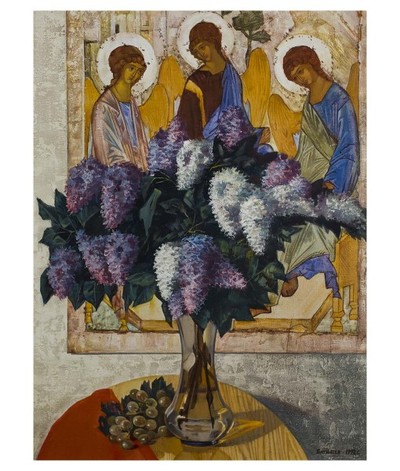
File:1961_CPA_2553.jpg · Wikimedia Commons · See Wikimedia Commons
Andriej Rublow
Sign in to saveAlso known as Андрей Рублев, Andrej Rublëv, Andréj Rubljov, Andrej Rubliow, André Roublov, Andrej Rublev, Andrei Rubljoff, Andrey Rublyov
ruski twórca ikon, święty Cerkwi prawosławnej
Andrei Rublev was a medieval Russian painter (active roughly 1360s-1428) best known for creating religious icons and frescoes during a pivotal period in Russian Orthodox art. His works are considered foundational to Russian artistic tradition and helped establish a distinctive style that influenced Orthodox Christian art for centuries afterward.
AI-generated from the Wikipedia summary — may contain errors.
Wikidata facts
- Instance of
- human
- Given name
- Andrey
- Gender
- male
- Citizenship
- Grand Principality of Moscow
- Place of birth
- Grand Principality of Moscow
- Place of death
- Andronikov Monastery
- Occupation
- illuminator
- Religion
- Eastern Orthodoxy
- Student of
- Theophanes the Greek
- Official website
- andrey-rublev.ru
- Image
- Andrei Rublev (miniature, 16 c) detail.jpg
Show 13 more facts
- date of death
- 1430-01-29
- Commons category
- Andrej Rublëv
- date of birth
- 1360-00-00
- Commons Creator page
- Andrej Rublëv
- canonization status
- The Venerable
- cause of death
- plague
- manner of death
- natural causes
- name in native language
- Андрей Рублёв
- place of burial
- Andronikov Monastery
- feast day
- July 4
- on focus list of Wikimedia project
- Wikipedia:Vital articles/Level/4
- has works in the collection
- Russian Museum
- different from
- Andrey Rublev
via Wikidata · CC0
Works in European collections
1 object attributed to Andriej Rublow, held across European museums, libraries & archives · via Europeana
Article · Polski
Andriej Rublow, ros. Андрей Рублёв (ur. ok. 1360, zm. prawdopodobnie 29 stycznia 1430) – ruski mnich, święty Rosyjskiego Kościoła Prawosławnego, artysta malarz. Tworzył ikony, freski, miniatury oraz ilustracje do manuskryptów. Jego twórczość wywarła znaczny wpływ na malarstwo ikoniczne i była naśladowana przez innych artystów, jest uważany za najwybitniejszego przedstawiciela moskiewskiej szkoły pisania ikon. Podczas Soboru Stu Rozdziałów, zwołanego w Moskwie w 1551 roku, ikonografom zalecono wzorowanie się na stylu Rublowa. Część prac artysty nie zachowała się, większość znajduje się w zbiorach Galerii Tretiakowskiej w Moskwie.
Abstract from DBpedia / Wikipedia · CC BY-SA
Gallery (12)
Available in 69 languages
- Español
- Français
- Deutsch
- 中文
- 日本語
- Русский
- Português
- Italiano
- العربية
- Armenian
- Asturian
- Azerbaijani
- Bahasa Indonesia
- Bashkir
- Basque
- be_x_old
- Belarusian
- Bulgarian
Show 50 more
- Buriat
- Catalan
- Chuvash
- Croatian
- Czech
- Danish
- Egyptian Arabic
- Esperanto
- Estonian
- Fiji Hindi
- Finnish
- Galician
- Georgian
- Greek
- Hebrew
- Hungarian
- Ido
- Irish
- Kyrgyz
- Latin
- Latvian
- Lithuanian
- Macedonian
- Malagasy
- Malayalam
- Nederlands
- Norwegian
- Norwegian Nynorsk
- Occitan
- Polski
- Romanian
- Serbian
- Serbian (Latin)
- simple
- Slovak
- Slovenian
- Svenska
- Swahili
- Tatar
- Tiếng Việt
- Türkçe
- Ukrainian
- Urdu
- Uzbek
- Waray
- Western Frisian
- Wu Chinese
- zh_yue
- فارسی
- 한국어
via Wikidata sitelinks · CC0