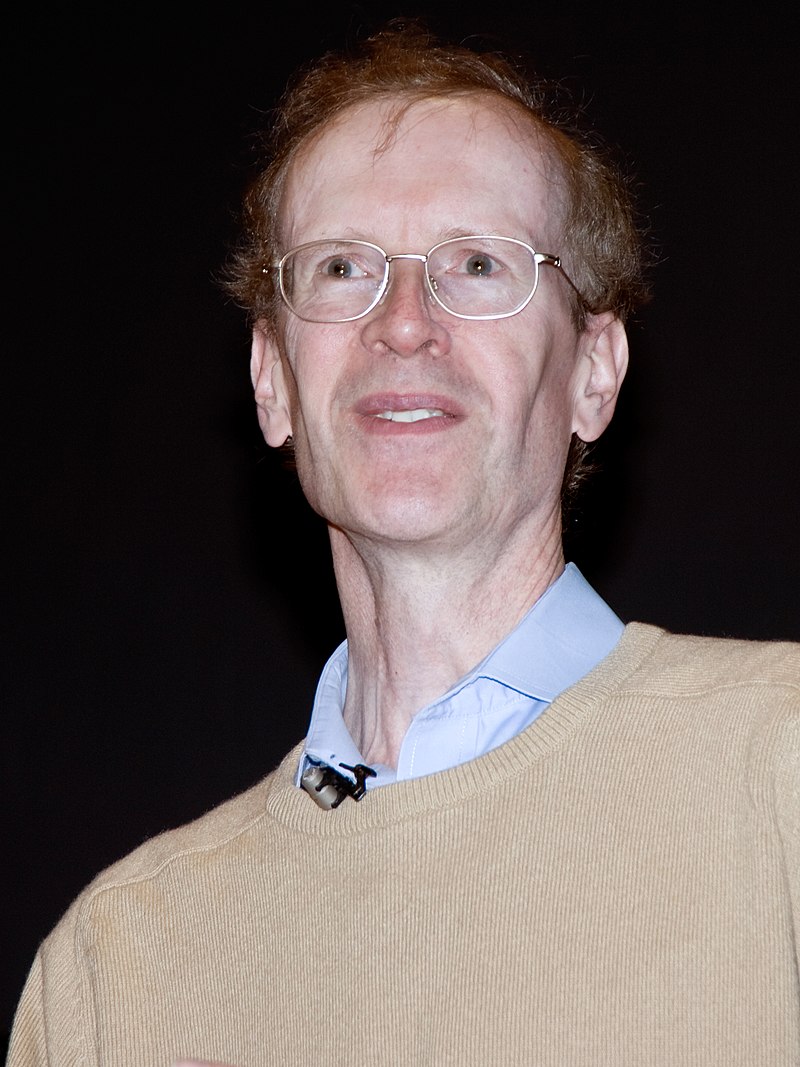
File:Andrew_wiles1-3.jpg · Wikimedia Commons · See Wikimedia Commons
Andrew Wiles
Sign in to saveAlso known as Sir Andrew John Wiles, Andrew John Wiles, Andrew J. Wiles, Dr. Andrew Wiles, Prof. Sir Andrew Wiles FRS
English mathematician (1953–)
Andrew Wiles is an English mathematician born in 1953 who became famous for proving Fermat's Last Theorem, a centuries-old mathematical problem that had stumped experts worldwide. His proof, completed in 1995, is considered one of the greatest mathematical achievements of modern times and demonstrated the power of connecting different areas of mathematics to solve seemingly impossible problems.
AI-generated from the Wikipedia summary — may contain errors.
Wikidata facts
- Instance of
- human
- Given name
- John
- Gender
- male
- Citizenship
- United Kingdom
- Place of birth
- Cambridge
- Occupation
- university teacher
- Employer
- Institute for Advanced Study
- Languages spoken
- English language
- Native language
- English language
- Doctoral advisor
- John H Coates
- Field of work
- number theory
- Image
- Andrew wiles1-3.jpg
- Residence
- Princeton
Show 9 more facts
- Commons category
- Andrew Wiles
- member of
- Royal Society of Canada
- date of birth
- 1953-04-11
- Erdős number
- 3
- Commons gallery
- Andrew Wiles
- name in native language
- Andrew Wiles
- student
- Manjul Bhargava
- described by source
- Fermat's Last Theorem
- maintained by WikiProject
- WikiProject Mathematics
Sources (6)
via Wikidata · CC0
~13 min read
Encyclopedic overview
Sir Andrew John Wiles (born 11 April 1953) is an English mathematician and a Royal Society Research Professor at the University of Oxford, specialising in number theory. He is best known for proving Fermat's Last Theorem, for which he was awarded the 2016 Abel Prize and the 2017 Copley Medal and for which he was appointed a Knight Commander of the Order of the British Empire in 2000. In 2018, Wiles was appointed the first Regius Professor of Mathematics at Oxford. Wiles is also a 1997 MacArthur Fellow.
Wiles was born in Cambridge to theologian Maurice Frank Wiles and Patricia Wiles. While spending much of his childhood in Nigeria, Wiles developed an interest in mathematics and in Fermat's Last Theorem in particular. After moving to Oxford and graduating from there in 1974, he worked on unifying Galois representations, elliptic curves and modular forms, starting with Barry Mazur's generalizations of Iwasawa theory. In the early 1980s, Wiles spent a few years at the University of Cambridge before moving to Princeton University, where he worked on expanding out and applying Hilbert modular forms. In 1986, upon reading Ken Ribet's seminal work on Fermat's Last Theorem, Wiles set out to prove the modularity theorem for semistable elliptic curves, which implied Fermat's Last Theorem. By 1993, he had been able to convince a knowledgeable colleague that he had a proof of Fermat's Last Theorem, though a flaw was subsequently discovered. After an insight on 19 September 1994, Wiles and his student Richard Taylor were able to circumvent the flaw, and published the results in 1995, to widespread acclaim.
Excerpted from Wikipedia’s “Andrew Wiles” article, available under the CC BY-SA 4.0 licence.
Gallery (3)
Available in 64 languages
- Español
- Français
- Deutsch
- 中文
- 日本語
- Русский
- Português
- Italiano
- العربية
- हिन्दी
- Albanian
- Aragonese
- Armenian
- Assamese
- azb
- Azerbaijani
- Bahasa Indonesia
- Bangla
Show 45 more
- Basque
- Belarusian
- Breton
- Bulgarian
- Catalan
- Czech
- Danish
- Egyptian Arabic
- Esperanto
- Estonian
- Finnish
- Galician
- Georgian
- Greek
- Haitian Creole
- Hebrew
- Hungarian
- Icelandic
- Irish
- Kannada
- Latvian
- Malayalam
- Nederlands
- Norwegian
- Norwegian Nynorsk
- Polski
- Romanian
- Serbian
- Serbian (Latin)
- Sicilian
- simple
- Slovak
- Slovenian
- Svenska
- Tamil
- Tiếng Việt
- Türkçe
- Ukrainian
- Urdu
- Uzbek
- Welsh
- Wu Chinese
- فارسی
- ไทย
- 한국어
via Wikidata sitelinks · CC0