
Annapurna I
Sign in to saveAlso known as Annapurna, Annapurna I Main
Annapurna (; ) is a mountain situated in the Annapurna mountain range of Gandaki Province, north-central Nepal. It is the 10th highest mountain in the world at above sea level and is well known for the difficulty and danger involved in its ascent.
Key facts
- Mountain.name
- Annapurna
- Mountain.photo
- South Face of Annapurna I (Main).jpg
- Mountain.photo_caption
- South face of Annapurna I (Main)
- Mountain.elevation_m
- 8091
- Mountain.parent_peak
- Cho Oyu
- Mountain.prominence_m
- 2984
- Mountain.prominence_ref
- Ranked 94th
- Mountain.listing
- Eight-thousanderUltra
- Mountain.location
- Gandaki Province, Nepal
- Mountain.range
- Annapurna
- Mountain.label_position
- right
- Mountain.first_ascent
- 3 June 1950Maurice Herzog and Louis Lachenal(First winter ascent 3 February 1987 Jerzy Kukuczka and Artur Hajzer)
- Mountain.easiest_route
- northeast face
via Wikipedia infobox
Described at
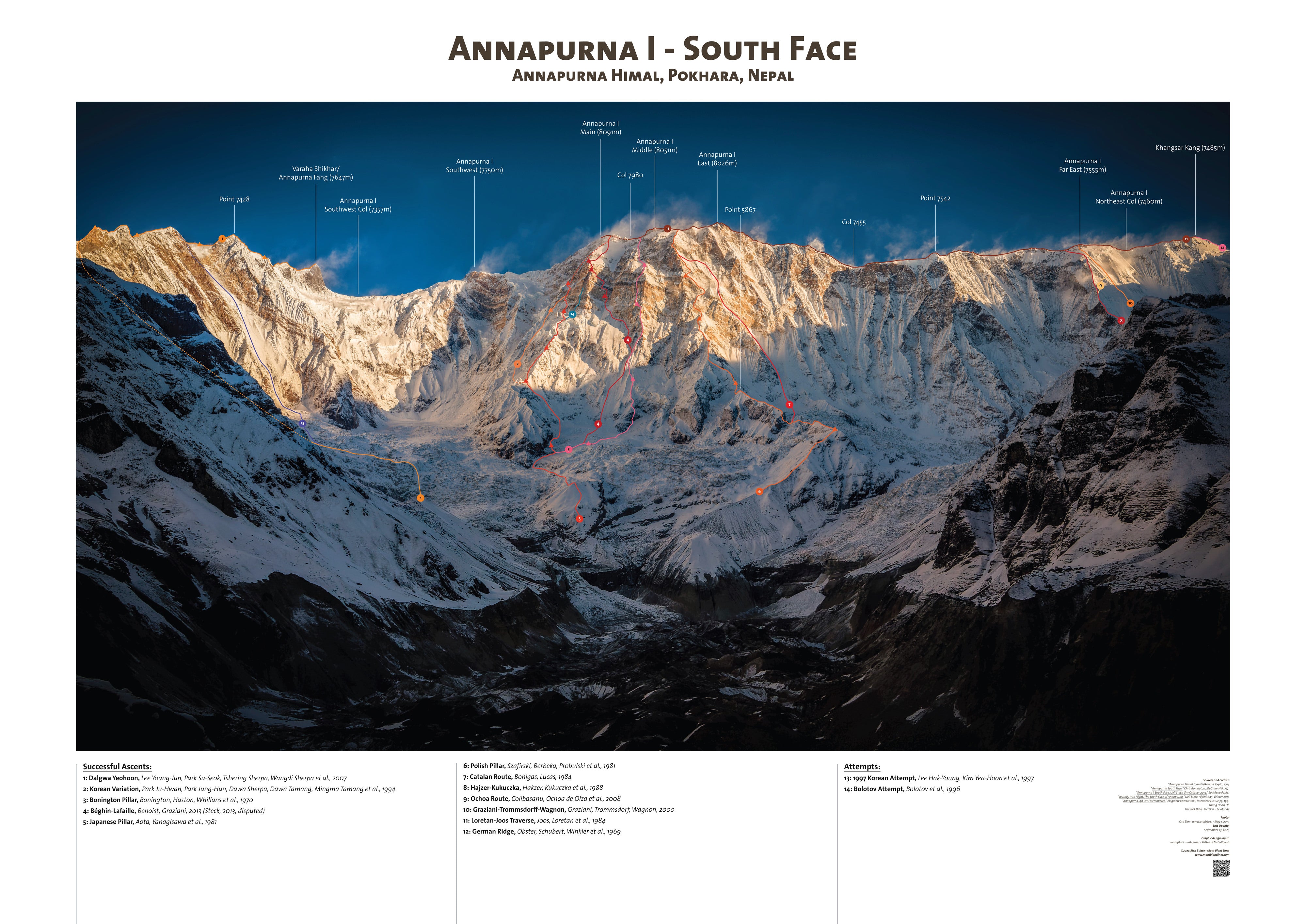
Annapurna I - South Face – Mont Blanc Lines
The 1970 British ascent of the south face of Annapurna I marked a watershed event in the history of Himalayan climbing: suddenly, the goal was not just to reach the summit via the easiest possible route (the first ascent happened 20 years earlier via the north face) but to deliberately tackle difficult walls because th
montblanclines.com →SOME SELECT POSTERS ARE NOW INTERACTIVE! CHECK OUT THE NEW (ALL FREE) EXPLORE FEATURE The 1970 British ascent of the south face of Annapurna I marked a watershed event in the history of Himalayan climbing: suddenly, the goal was not just to reach the summit via the easiest possible route (the first ascent happened 20 years earlier via the north face) but to deliberately tackle difficult walls because they were difficult. Another side effect of the expedition was to put its leader, a little known British climber named Chris Bonington, on the climbing map. His expeditions would become legendary. The south face of Annapurna I, part of the horseshoe of the Annapurna Sanctuary, is a 3,000m tall monster, a series of steep buttresses and corners with no major weakness. It has seen as many beautiful ascents as tragedies, with climbers like Ian Clough, Alex MacIntyre, Pierre Béghin, Anatoli Boukreev, Iñaki Ochoa and Park Young-Seok losing their lives on its slopes. Note that Ueli Steck's claimed 2013 ascent is not included, as a convincing case has been made he did not reach the summit. His line is very similar to the subsequent ascent by Yannick Graziani and Stéphane Benoist (line 4). Sept 23, 2024: Changed the name of the Benoist-Graziani line to Béghin-Lafaille, per their wishes, and added a mention of Ueli's disputed ascent.
Excerpt from a page describing this subject · 5,423 chars · not written by Vinony
Wikidata facts
- Instance of
- mountain
- Country
- Nepal
- Located in
- Dhaulagiri Zone
- Elevation
- 8091
- Image
- Annapurna I.jpg
Show 9 more facts
- Commons category
- Annapurna I
- Commons gallery
- Annapurna
- topographic prominence
- 2984
- topographic isolation
- 34
- parent peak
- Cho Oyu
- mountain range
- Annapurna
- peak bagging classification
- eight-thousander
- different from
- Annapurna
- described at URL
- www.montblanclines.com/products/annapurna-i-south-face
Sources (5)
via Wikidata · CC0
~6 min read
Encyclopedic overview
11 sectionsContents
- Etymology
- Geology
- Climbing history
- Climbing expeditions
- Fatality rate
- Flights
- See also
- References
- Bibliography
- Further reading
- External links
Annapurna (; ) is a mountain situated in the Annapurna mountain range of Gandaki Province, north-central Nepal. It is the 10th highest mountain in the world at above sea level and is well known for the difficulty and danger involved in its ascent.
Maurice Herzog led a French expedition to its summit through the north face in 1950, making it the first eight-thousander to be successfully climbed. The entire massif and surrounding area are protected within the Annapurna Conservation Area, the first and largest conservation area in Nepal. The Annapurna Conservation Area is home to several world-class treks, including Annapurna Sanctuary and Annapurna Circuit.
Excerpted from Wikipedia’s “Annapurna I” article, available under the CC BY-SA 4.0 licence.
Gallery (4)
On the map
55 mapped locations