
File:Anthony_Caro_balanced.png · Wikimedia Commons · See Wikimedia Commons
Anthony Caro
Sign in to saveAlso known as Sir Anthony Alfred Caro, Anthony Alfred Caro, Sir Anthony Caro, Tony Caro
English abstract sculptor (1924-2013)
Key facts
- Born
- Anthony Alfred Caro , ( 1924-03-08 ) 8 March 1924, New Malden , Surrey, England
- Died
- 23 October 2013 (2013-10-23) (aged 89), London , England
- Education
- Regent Street Polytechnic
- Alma mater
- Christ's College, Cambridge
- Known for
- Sculpture, drawing
- Notable work
- Twenty Four Hours (1960) , Early One Morning (1962) , Prairie (1967)
- Movement
- Constructed steel sculpture, abstract art , modernism
- Spouse s
- Sheila Girling ( married</span>"}]]}'>m. 1949 ) ; 2 children
- Awards
- CBE (1969) Knight Bachelor (1987) Praemium Imperiale (1992) Commander of the Order of Arts and Letters (1996) ISC Lifetime Achievement Award (1997) Order of Merit (2000)
- Website
- www .anthonycaro .org
via Wikipedia infobox
Described at
Sir Anthony Caro obituary | Anthony Caro | The Guardian
Britain's finest sculptor since Henry Moore, he broke new ground with his abstract works in metal
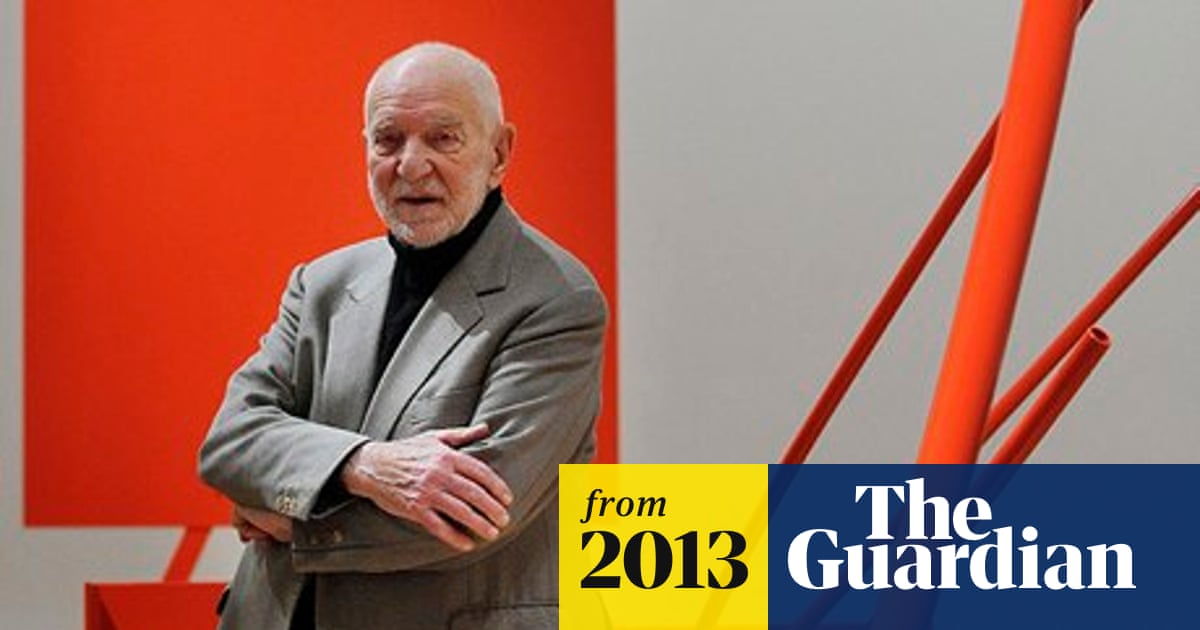
theguardian.com →Sir Anthony Caro with his sculpture Early One Morning in 2011. Photograph: Ben Stansall/AFP/Getty Images Sir Anthony Caro with his sculpture Early One Morning in 2011. Photograph: Ben Stansall/AFP/Getty Images The career of Anthony Caro , who has died aged 89 , was so enduring and substantial that it long seemed part of our permanent British art landscape. We are good at that – ignoring our best artists until we can take them for granted. There was a short period, at the start of the 1960s, when his new work drew a lot of attention, at a time when British art was erupting with new energies and optimism: St Ives going strong, plus situation painting, pop art, op art. By the mid-60s he was firmly established. His work was being shown, discussed and beginning to be bought on both sides of the Atlantic. He had had an exhibition of new work at the Whitechapel Gallery in 1963 , and he was teaching at St Martin's School of Art. Thus, in 1965, New Generation at the Whitechapel featured sculpture done mostly by people who had studied under him or were teaching with him. He was now chef d'école to a degree that no sculptor had ever been in Britain – and no sculptor anywhere since Rodin. On the other hand, though he did cause a lot of young sculptors to make abstract sculpture in welded steel, his example led others to find their own methods and idioms, even to reject formal sculpture altogether – for example, the young Barry Flanagan , Bruce McLean and the Gilbert and George partnership. By rights, Caro should have been made president of the Royal Academy. Abstract art still riles Britain's cultural upper crust, but major abstract artists have been academicians for some years. Caro could well have stood at their head; some of his best artist friends are among them. But he stayed out until 2004, the year the presidency of his former pupil Phillip King ended. There was always a private side to the man, for all the calls of international fame. The work came out of intimate thought and doing, not out of polemics. One feels it was centred on his family life as much as in the potency that made him decide to be a sculptor, not an engineer. He was born in New Malden, south-west London, the youngest of the three children of Alfred Caro, a stockbroker who had married his distant cousin Mary Rose. At Charterhouse school, Surrey, his interest in sculpture was encouraged by a housemaster who introduced him to the sculptor Charles Wheeler, later president of the RA. Young Caro worked with him in the holidays, learning the traditional methods of sculpture. He studied engineering at Christ's College, Cambridge, from 1942 to 1944 and got his degree, but still worked on sculpture in the vacations, at Farnham Art School, Surrey, followed by two years in the Fleet Air Arm. Sir Anthony Caro with his sculpture Millbank Steps 2004 at Tate Britain. Photograph: Kirsty Wigglesworth/PA By 1946 the die was cast. He went full time to the then Regent Street Polytechnic (now part of the University of Westminster) and the Royal Academy schools, becoming well grounded in traditional techniques and materials and in the aesthetics of ancient and medieval sculpture. Medals and other awards came his way in 1948 and 1949. That year he married a fellow student, the painter Sheila Girling, with whom he had two sons, Timothy, born in 1951, and Paul, born in 1958. Their mutual professional criticism was important to both their careers. The best room at the 2009 summer show of the Royal Academy had Erl King , a grand metal sculpture by Caro, opposite a glowing abstract painting by Girling. Two years earlier, at Roche Court sculpture park, near Salisbury, Wiltshire, the couple had shown together for the first time in their marriage: he with a dozen huge, rusted steel pieces from the series called Flats, made in 1974 in Canada with the aid of a crane; she indoors with a sequence of vibrantly coloured canvases painted with architectural forms not far distant from his. In l
Excerpt from a page describing this subject · 19,996 chars · not written by Vinony
Wikidata facts
- Instance of
- human
- Given name
- Anthony
- Gender
- male
- Citizenship
- United Kingdom
- Place of birth
- Surrey
- Place of death
- London
- Occupation
- artist
- Employer
- Saint Martin's School of Art
- Languages spoken
- English language
- Participant in
- 4. documenta
- Field of work
- art of sculpture
- Genre
- abstract art
- Movement
- contemporary art
- Official website
- www.anthonycaro.org
- Image
- Anthony Caro balanced.png
Show 9 more facts
- date of birth
- 1924-03-08
- Commons category
- Anthony Caro
- date of death
- 2013-10-23
- cause of death
- myocardial infarction
- manner of death
- natural causes
- Commons Creator page
- Anthony Caro
- influenced by
- Henry Moore
- described at URL
- www.theguardian.com/artanddesign/2013/oct/24/sir-anthony-caro
Sources (9)
via Wikidata · CC0
~12 min read
Encyclopedic overview
Sir Anthony Alfred Caro OM CBE (8 March 1924 – 23 October 2013) was an English abstract sculptor whose work is characterised by assemblages of metal using 'found' and industrial objects. He began as a member of the modernist school, having worked with Henry Moore early in his career. He was lauded as the greatest British sculptor of his generation.
Early life and education
Excerpted from Wikipedia’s “Anthony Caro” article, available under the CC BY-SA 4.0 licence.