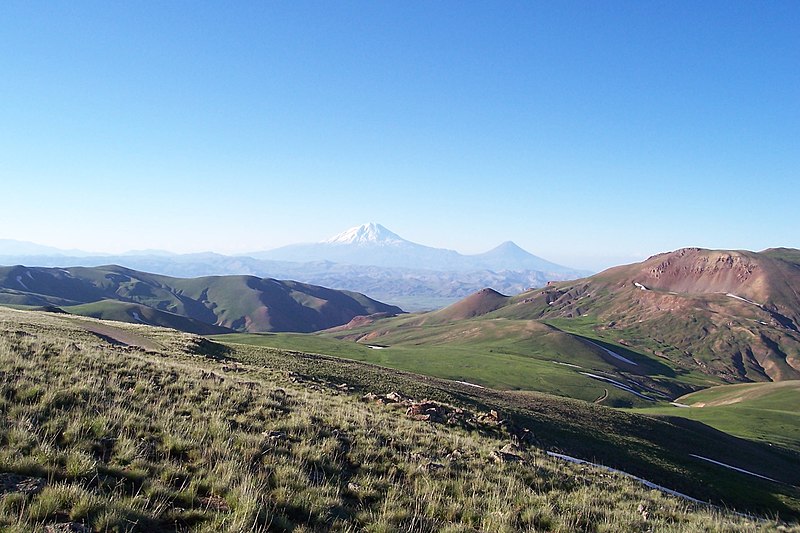
Armenian Highlands
Also known as Javakheti-Armenian Uplands, Armenian Plateau, Eastern Anatolian highlands, Armenia (region), Armenian tableland, Armenian Upland
highland area in western Asia south of the Caucasus
AI overview
The Armenian Highlands is a mountainous region in western Asia located south of the Caucasus mountains. It is a significant geographical area that has shaped the history and culture of the peoples inhabiting it.
AI-generated from the Wikipedia summary — may contain errors.
Wikidata facts
- Image
- Khor Virap Monastery and Mount Ararat, Armenia.jpg
Sources (1)
via Wikidata · CC0
Article
The Armenian highlands (Armenian: Հայկական լեռնաշխարհ, romanized: Haykakan leṙnašxarh; also known as the Eastern Anatolian highlands, Armenian upland, Armenian plateau, or Armenian tableland) comprise the most central and the highest of the three plateaus that together form the northern sector of West Asia. Clockwise starting from the west, the Armenian highlands are bounded by the Anatolian plateau, the Caucasus, the Kura-Aras lowlands, the Iranian Plateau, and Mesopotamia. The highlands are divided into western and eastern regions, defined by the Ararat Valley where Mount Ararat is located. Since the turn of the 20th century, Western Armenia has been relabeled as "Eastern Anatolia" by Ottoman and Turkish authorities. Eastern Armenia is part of Lesser Caucasus, which was historically known by some as the Anti-Caucasus, meaning "opposite of the Caucasus".
During the Iron Age, the region was known by variations of the name Ararat (Urartu, Uruatri, Urashtu). Later, the Highlands were known as Armenia Major, a central region to the history of Armenians, and one of the four geopolitical regions associated with Armenians, the other three being Armenia Minor, Sophene, and Commagene. The highlands are primarily defined by the geographical dispersal of its native inhabitants, the Armenians. Prior to the appearance of nominally Armenian people in historical records, historians have hypothesized that the region must have been home to various ethnic groups who became homogenous when the Armenian language came to prominence. The population of the Armenian highlands has had a high level of regional genetic continuity for over 6,000 years. Recent studies indicate that the Armenian people descend from the indigenous people of the Armenian highlands and form a distinct genetic isolate in the region. The region was also inhabited during Antiquity by minorities such as Assyrians, Georgians, Greeks, Jews, and Iranians. During the Middle Ages, Arabs and particularly Turkmens and Kurds settled in large numbers in the Armenian highlands.
Gallery (9)
On the map
2 mapped locations