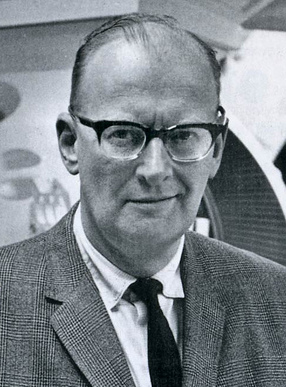
File:Arthur_C._Clarke_1965_(cropped).jpg · Wikimedia Commons · See Wikimedia Commons
Arthur C. Clarke
Sign in to saveAlso known as Arthur Charles Clarke, Sir Arthur Charles Clarke, Charles Willis, Arthur Clarke
British science fiction writer, inventor, and futurist (1917–2008)
Arthur C. Clarke was a British science fiction writer, inventor, and futurist who lived from 1917 to 2008 and is widely regarded as one of the most influential figures in the genre. He matters because his imaginative stories and forward-thinking ideas about space exploration and technology shaped how millions of people envision the future and influenced real scientific thinking about space travel and communications satellites.
AI-generated from the Wikipedia summary — may contain errors.
Film & TV
Minehead, Somerset, England, UK
Sir Arthur Charles Clarke CBE FRAS (16 December 1917 – 19 March 2008) was an English science-fiction writer, science writer, futurist, inventor, undersea explorer, and television series host. He co-wrote the screenplay for the 1968 film 2001: A Space Odyssey, one of the most influential films of all time. Clarke was a science fiction writer, an avid populariser of space travel, and a futurist of…
Known for
- Starman2025
- Rendezvous with the Future — Self (archive footage)2022
- Kubrick by Kubrick — Self (archive footage)2020
- 9/11 Alchemy: Facing Reality — Himself2018
- I Saw the Future — Self (archive footage)2017
- Sky Line — Self (archive footage)2015
- The Real History of Science Fiction — Self (archive footage)2014
- 2001: A Space Odyssey – What Is Out There? — Self (archive footage)2007
- Vision of a Future Passed: The Prophecy of 2001 — Self2007
- To Mars by A-Bomb: The Secret History of Project Orion — Self2003
via TMDB
Wikidata facts
- Instance of
- human
- Given name
- Charles
- Family name
- Clarke
- Gender
- male
- Citizenship
- United Kingdom
- Place of birth
- Minehead
- Place of death
- Colombo
- Occupation
- futurist
- Languages spoken
- English language
- Religion
- agnosticism
- Notable work
- 3001: The Final Odyssey
- Academic degree
- Doctor of Letters
- Field of work
- science fiction literature
- Genre
- popular science
- Military branch
- Royal Air Force
- Image
- Arthur C. Clarke 1965.jpg
- Residence
- Sri Lanka
Show 19 more facts
- birth name
- Arthur Charles Clarke
- Commons category
- Arthur C. Clarke
- date of birth
- 1917-12-16
- topic's main category
- Category:Arthur C. Clarke
- pseudonym
- E.G. O'Brien
- date of death
- 2008-03-19
- ethnic group
- English people
- cause of death
- heart failure
- medical condition
- poliomyelitis
- member of
- The World Academy of Sciences
- name in native language
- Arthur C. Clarke
- writing language
- English language
- start of work period
- 1946-00-00
- influenced by
- Olaf Stapledon
- archives at
- National Air and Space Museum
- on focus list of Wikimedia project
- Wikipedia:Vital articles/Level/4
- hashtag
- ArthurCClarke
- P12749
- Lully
- manner of death
- natural causes
Sources (8)
via Wikidata · CC0
Works in European collections
1 object attributed to Arthur C. Clarke, held across European museums, libraries & archives · via Europeana
~40 min read
Encyclopedic overview
Sir Arthur Charles Clarke CBE FRAS (16 December 1917 – 19 March 2008) was an English science fiction writer, science writer, futurist, inventor, undersea explorer, and television series host.
Clarke was a science fiction writer, an avid populariser of space travel, and a futurist of distinguished ability. He wrote many books and many essays for popular magazines. In 1961, he received the Kalinga Prize, a UNESCO award for popularising science. Clarke's science and science fiction writings earned him the moniker "Prophet of the Space Age". His science fiction writings in particular earned him a number of Hugo and Nebula awards, which, along with a large readership, made him one of the towering figures of the genre. For many years, science fiction had a "Big Three", comprising Clarke and American writers Robert Heinlein and Isaac Asimov. Clarke co-wrote the screenplay for the 1968 film 2001: A Space Odyssey, widely regarded as one of the most influential films of all time.
Excerpted from Wikipedia’s “Arthur C. Clarke” article, available under the CC BY-SA 4.0 licence.
Gallery (10)
Available in 92 languages
- Español
- Français
- Deutsch
- 中文
- 日本語
- Русский
- Português
- Italiano
- العربية
- हिन्दी
- Afrikaans
- Albanian
- Albanian
- Aragonese
- Armenian
- Asturian
- azb
- Azerbaijani
Show 73 more
- Bahasa Indonesia
- Bangla
- Bashkir
- Basque
- be_x_old
- Belarusian
- Bosnian
- Breton
- Bulgarian
- Catalan
- Central Kurdish
- Cornish
- Croatian
- Czech
- Danish
- Egyptian Arabic
- Esperanto
- Estonian
- Fiji Hindi
- Filipino
- Finnish
- Galician
- Georgian
- Goan Konkani
- Greek
- Hebrew
- Hungarian
- Icelandic
- Ido
- Irish
- Javanese
- Kazakh
- Latin
- Latvian
- Lithuanian
- Luxembourgish
- Macedonian
- Malagasy
- Malay
- Malayalam
- Marathi
- Mingrelian
- Mongolian
- Nederlands
- Newari
- Norwegian
- Occitan
- Pampanga
- Piedmontese
- Polski
- Punjabi
- Romanian
- Scots
- Serbian
- Serbian (Latin)
- simple
- Sinhala
- Slovak
- Slovenian
- Svenska
- Tamil
- Tiếng Việt
- Türkçe
- Ukrainian
- Urdu
- Waray
- Welsh
- Wu Chinese
- zh_min_nan
- zh_yue
- فارسی
- ไทย
- 한국어
via Wikidata sitelinks · CC0