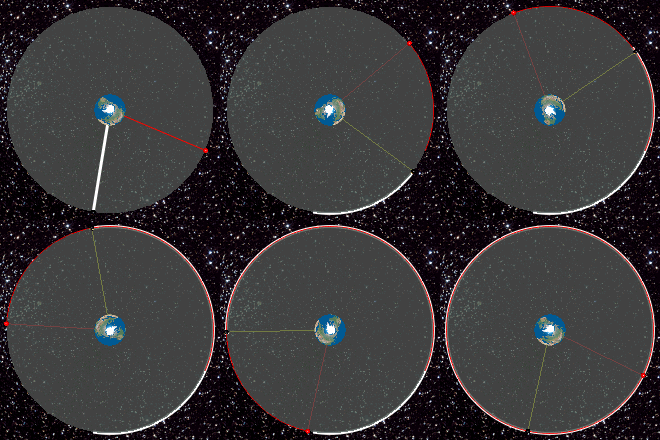
File:Geostationaryjava3D.gif · Wikimedia Commons · See Wikimedia Commons
geostationary orbit
Sign in to saveAlso known as geostationary Earth orbit, geosynchronous equatorial orbit, GEO, Clarke orbit, geostationary orbits
geosynchronous orbit with zero eccentricity at a fixed longitude and a nominally fixed latitude; common orbit for communications satellites
A geostationary orbit is a special position in space where a satellite stays in the same spot above Earth at all times, making it ideal for communications since it doesn't move across the sky. This matters because satellites in this orbit can continuously transmit signals to the same region of Earth without needing to be tracked or repositioned.
AI-generated from the Wikipedia summary — may contain errors.
Wikidata facts
- Part of
- outer space
- Parent body
- Earth
Show 4 more facts
- Commons category
- Geostationary orbit
- topic's main category
- Category:Geostationary orbit
- on focus list of Wikimedia project
- Wikipedia:Vital articles/Level/4
- short name
- GEO
Sources (3)
via Wikidata · CC0
~22 min read
Encyclopedic overview
Two geostationary satellites in the same orbit A 5° × 6° view of a part of the geostationary belt, showing several geostationary satellites. Those with inclination 0° form a diagonal belt across the image; a few objects with small inclinations to the Equator are visible above this line. The satellites are pinpoint, while stars have created star trails due to Earth's rotation.
A geostationary orbit, also referred to as a GEO or GSO, is a circular geosynchronous orbit 35,786 km (22,236 mi) in altitude above Earth's equator, 42,164 km (26,199 mi) in radius from Earth's center, and following the direction of Earth's rotation.
Excerpted from Wikipedia’s “geostationary orbit” article, available under the CC BY-SA 4.0 licence.
Gallery (8)
Available in 67 languages
- Español
- Français
- 中文
- 日本語
- Русский
- Português
- Italiano
- العربية
- हिन्दी
- Afrikaans
- Aragonese
- Armenian
- Asturian
- Azerbaijani
- Bahasa Indonesia
- Bangla
- Basque
- be_x_old
Show 48 more
- Belarusian
- Bosnian
- Breton
- Bulgarian
- Catalan
- Croatian
- Czech
- Danish
- Esperanto
- Estonian
- Finnish
- Galician
- Georgian
- Greek
- Hebrew
- Hungarian
- Kazakh
- Latvian
- Malay
- Malayalam
- Mongolian
- Nederlands
- Norwegian
- Norwegian Nynorsk
- Occitan
- Polski
- Romanian
- Serbian
- Serbian (Latin)
- simple
- Sinhala
- Slovak
- Slovenian
- Sundanese
- Svenska
- Tajik
- Tamil
- Telugu
- Tiếng Việt
- Türkçe
- Ukrainian
- Urdu
- Western Panjabi
- Wu Chinese
- zh_yue
- فارسی
- ไทย
- 한국어
via Wikidata sitelinks · CC0