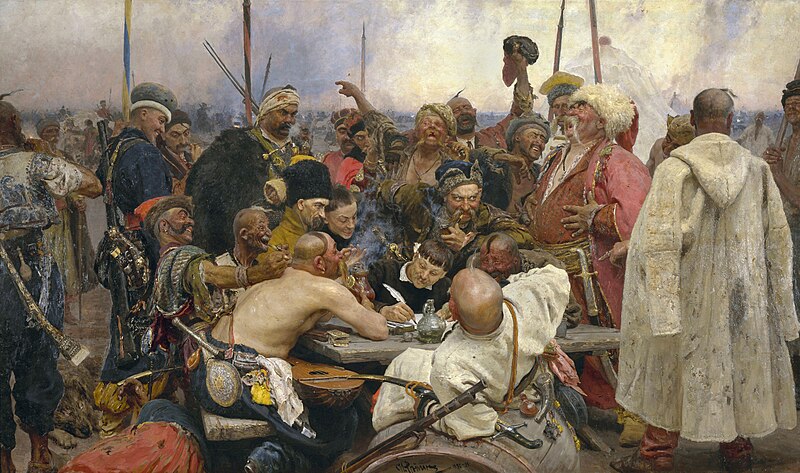
File:Ilja_Jefimowitsch_Repin_-_Reply_of_the_Zaporozhian_Cossacks_-_Yorck.jpg · Wikimedia Commons · See Wikimedia Commons
ataman
Sign in to saveright|thumb|262px|Ivan Matveevich Krasnoshchekov, Ataman of the Don Cossacks. Portrait is from 1761. The term Ataman is a theme of various Russian folk songs () Ataman (variants: otaman, wataman, vataman; ; , ) was a title of Cossack and haidamak leaders of various kinds. In the Russian Empire, the term was the official title of the supreme military commanders of the Cossack armies. The Ukrainian version of the same word is hetman. Otaman in Ukrainian Cossack forces was a position of a lower rank.
Wikidata facts
- Instance of
- military rank
Show 1 more fact
- topic's main category
- Category:Atamans
Sources (1)
via Wikidata · CC0
~4 min read
Encyclopedic overview
6 sectionsContents
- Etymology
- Otaman in Ukraine
- 20th century to present
- See also
- References
- External links
right|thumb|262px|Ivan Matveevich Krasnoshchekov, Ataman of the Don Cossacks. Portrait is from 1761. The term Ataman is a theme of various Russian folk songs () Ataman (variants: otaman, wataman, vataman; ; , ) was a title of Cossack and haidamak leaders of various kinds. In the Russian Empire, the term was the official title of the supreme military commanders of the Cossack armies. The Ukrainian version of the same word is hetman. Otaman in Ukrainian Cossack forces was a position of a lower rank.
==Etymology== The etymologies of the words ataman and hetman are disputed. There may be several independent Germanic and Turkic origins for seemingly cognate forms of the words, all referring to the same concept. The hetman form cognates with German Hauptmann ('captain', literally 'head-man') by the way of Czech or Polish, like several other titles. The Russian term ataman is probably connected to Old East Slavic vatamanŭ, and cognates with Turkic odoman (Ottoman Turks). The term ataman may have also had a lingual interaction with Polish hetman and German hauptmann.
Excerpted from Wikipedia’s “ataman” article, available under the CC BY-SA 4.0 licence.