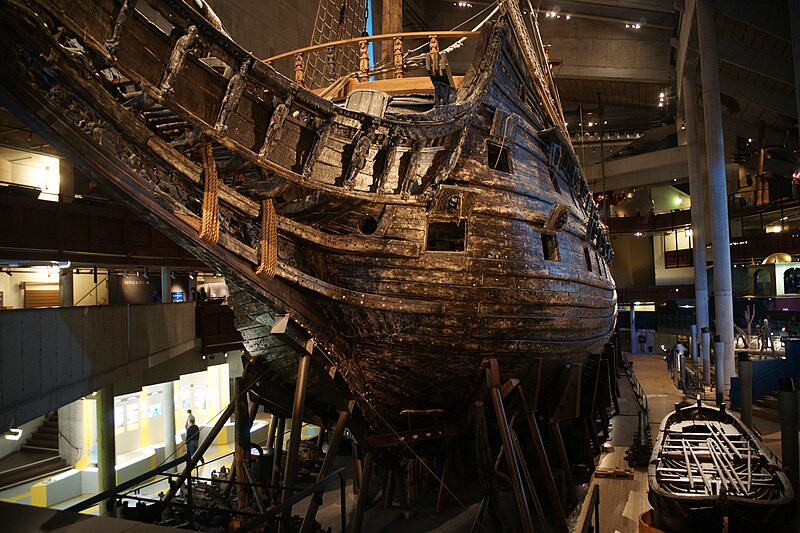
File:The_Vasa_from_the_Bow.jpg · Wikimedia Commons · See Wikimedia Commons
Key facts
- Builder
- navy yard, Stockholm
- Laid down
- 1626 ; 400 years ago ( 1626 )
- Launched
- March 1627 ; 399 years ago ( 1627-03 )
- Tonnage
- 1210 tonnes displacement
- Length
- Sparred length: 69 m (226 ft) (estimated) Between perpendiculars 47.5 m (156 ft)
- Beam
- 11.7 m (38 ft)
- Height
- 52.5 m (172 ft) from keel to mainmast truck (estimated)
- Draft
- 4.8 m (16 ft)
- Propulsion
- Sails, 1,275 m (13,720 sq ft)
- Crew
- 145 sailors, 300 soldiers
- Armament
- 64 guns, including: 24-pounders—48 3-pounders—8 1-pounders—2 stormstycken ( howitzers )—6
- Notes
- Source for dimensions & tonnage
via Wikipedia infobox
Official website

Vasamuseet
Skeppet Vasa kantrade och sjönk i Stockholm 1628. Efter 333 år på botten bärgades det väldiga krigsskeppet och resan kunde fortsätta. Idag är Vasa ett av världens bäst bevarade 1600-talsskepp och Vasamuseet är ett av Skandinaviens mest välbesökta museer.
vasamuseet.se →Link to the official site · 28,217 chars · not written by Vinony
Wikidata facts
- Operator
- Swedish Navy
- Location
- Vasa Museum
- Designed by
- Henrik Hybertsson
- Official website
- www.vasamuseet.se
- Image
- The Vasa from the Bow.jpg
- Height
- 52.5
- Width
- 11.7
- Length
- 61.0
- Significant event
- marine salvage
- Has use
- museum ship
Show 8 more facts
Sources (7)
via Wikidata · CC0
~40 min read
Encyclopedic overview
Vasa (previously Wasa) ( Swedish pronunciation: [²vɑːsa] ) is a Swedish warship built between 1626 and 1628. The ship sank after sailing roughly 1,300 m (1,400 yd) into her maiden voyage on 10 August 1628. She fell into obscurity after most of her valuable bronze cannons were salvaged in the 17th century, until she was located again in the late 1950s in a busy shipping area in Stockholm harbor. The ship was salvaged with a largely intact hull in 1961 after spending 333 years on the seabed. She was housed in a temporary museum called Wasavarvet ("The Vasa Shipyard") until 1988 and then moved permanently to the Vasa Museum in the Royal National City Park in Stockholm. Between her recovery in 1961 and the beginning of 2025, Vasa has been seen by over 45 million visitors.
The ship was built on the orders of the King of Sweden Gustavus Adolphus as part of the military expansion he initiated in a war with Poland-Lithuania (1621–1629). She was constructed at the navy yard in Stockholm under a contract with private entrepreneurs in 1626–1627 and armed primarily with bronze cannons cast in Stockholm specifically for the ship. Richly decorated as a symbol of the king's ambitions for Sweden and himself, upon completion she was one of the most powerfully armed vessels in the world. However, Vasa was dangerously unstable, with too much weight in the upper structure of the hull. Despite this lack of stability, she was ordered to sea and sank only a few minutes after encountering a wind stronger than a breeze.
Excerpted from Wikipedia’s “Vasa” article, available under the CC BY-SA 4.0 licence.