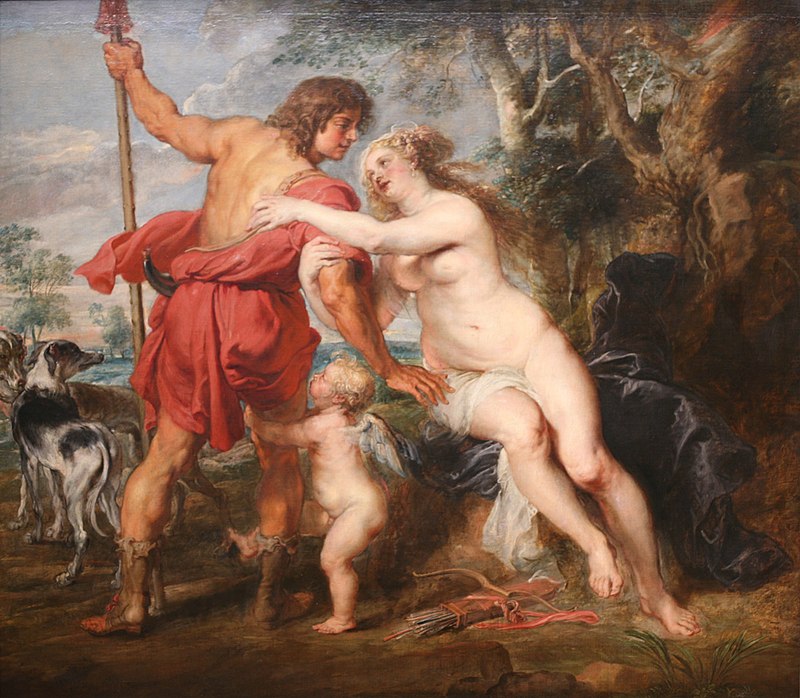
File:WLA_metmuseum_Venus_and_Adonis_by_Peter_Paul_Rubens.jpg · Wikimedia Commons · See Wikimedia Commons
Baroque
Sign in to saveThe Baroque ( , , ) is a Western style of architecture, music, dance, painting, sculpture, poetry, and other arts that flourished from the early 17th century until the 1750s. It followed Renaissance art and Mannerism and preceded the Rococo (in the past often referred to as "late Baroque") and Neoclassical styles. It was encouraged by the Catholic Church as a means to counter the simplicity and austerity of Protestant architecture, art, and music, though Lutheran Baroque art developed in parts of Europe as well.
Baroque was a style of art, architecture, and music that flourished throughout the 17th century and early 18th century, known for its dramatic and ornate qualities. It emerged partly as the Catholic Church's response to Protestant simplicity, though it eventually spread across Europe and influenced many different forms of creative expression.
AI-generated from the Wikipedia summary — may contain errors.
Key facts
- Art movement.name
- Baroque
- Art movement.caption
- Top: Venus and Adonis by Peter Paul Rubens (1635–1640); centre: Ecstasy of Saint Teresa by Bernini (1651); bottom: the Palace of Versailles in France ( 1660–1715)
- Art movement.yearsactive
- 17th–18th centuries
- Art movement.location
- Europe and the Americas
- Art movement.commons
- yes
via Wikipedia infobox
Wikidata facts
- Instance of
- architectural style
- Follows
- Renaissance
- Location
- Europe
- Image
- Church of Sant'Ignazio di Loyola - interno.jpg
Show 8 more facts
- subject named as
- Barock
- Commons category
- Baroque art
- topic's main category
- Category:Baroque
- influenced by
- Council of Trent
- end time
- 1750-00-00
- start time
- 1590-00-00
- on focus list of Wikimedia project
- Wikipedia:Vital articles/Level/4
- significant person
- Anthony van Dyck
Sources (8)
via Wikidata · CC0
~103 min read
Encyclopedic overview
35 sectionsContents
- Origin of the word
- Architecture: origins and characteristics
- Italian Baroque
- Spanish Baroque
- Dutch Baroque
- Central Europe
- German Baroque
- French Baroque
- Portuguese Baroque
- Russian Baroque
- Baroque in the Spanish and Portuguese Colonial Americas
- Baroque in the Spanish and Portuguese Colonial Asia
- Echoes in Wallachia and Moldavia
- Painting
- Hispanic Americas
- Sculpture
- Furniture
- Music
- Composers and examples
- Dance
- Literary theory
- Theatre
- Spanish colonial Americas
- Gardens
- Urban planning and design
- Posterity
- Transition to rococo
- Condemnation and academic rediscovery
- Revivals and influence through eclecticism
- Postmodern appreciation and reinterpretations
- See also
- Notes
- Sources
- Further reading
- External links
The Baroque ( , , ) is a Western style of architecture, music, dance, painting, sculpture, poetry, and other arts that flourished from the early 17th century until the 1750s. It followed Renaissance art and Mannerism and preceded the Rococo (in the past often referred to as "late Baroque") and Neoclassical styles. It was encouraged by the Catholic Church as a means to counter the simplicity and austerity of Protestant architecture, art, and music, though Lutheran Baroque art developed in parts of Europe as well.
The Baroque style used contrast, movement, exuberant detail, deep color, grandeur, and surprise to achieve a sense of awe. The style began at the start of the 17th century in Rome, then spread rapidly to the rest of Italy, France, Spain, and Portugal, then to Austria, southern Germany, Poland and Russia. By the 1730s, it had evolved into an even more flamboyant style, called rocaille or Rococo, which appeared in France and Central Europe until the mid to late 18th century. In the territories of the Spanish and Portuguese Empires including the Iberian Peninsula it continued, together with new styles, until the first decade of the 19th century.
Excerpted from Wikipedia’s “Baroque” article, available under the CC BY-SA 4.0 licence.
Gallery (322)
Available in 117 languages
- Español
- Français
- Deutsch
- 中文
- 日本語
- Русский
- Português
- Italiano
- العربية
- हिन्दी
- Afrikaans
- Albanian
- Albanian
- Aragonese
- Armenian
- Asturian
- Azerbaijani
- Bahasa Indonesia
Show 98 more
- Bangla
- Bashkir
- Basque
- Bavarian
- be_x_old
- Belarusian
- Bosnian
- Bulgarian
- Catalan
- Chuvash
- Croatian
- Czech
- Danish
- Egyptian Arabic
- Esperanto
- Estonian
- Extremaduran
- Faroese
- Filipino
- Finnish
- Galician
- Gan Chinese
- gcr
- Georgian
- Greek
- Guarani
- Haitian Creole
- Hausa
- Hebrew
- Hungarian
- Icelandic
- Ido
- Interlingua
- Irish
- Jamaican Creole English
- Javanese
- Kannada
- Kazakh
- Kurdish
- Kyrgyz
- Latin
- Latvian
- Ligurian
- Limburgish
- Lingala
- Lithuanian
- Low German
- Lower Sorbian
- Luxembourgish
- Macedonian
- Malay
- Maltese
- Mingrelian
- Mongolian
- nds_nl
- Neapolitan
- Nederlands
- Newari
- Northern Frisian
- Norwegian
- Norwegian Nynorsk
- Occitan
- Pashto
- Piedmontese
- Polski
- Punjabi
- Romanian
- Rusyn
- Saterland Frisian
- Serbian
- Serbian (Latin)
- Sicilian
- simple
- Slovak
- Slovenian
- Svenska
- Swahili
- Tajik
- Tamil
- Tatar
- Tiếng Việt
- Türkçe
- Ukrainian
- Upper Sorbian
- Urdu
- Uzbek
- Waray
- Welsh
- West Flemish
- Western Frisian
- Western Panjabi
- Wu Chinese
- Yakut
- zh_min_nan
- zh_yue
- فارسی
- ไทย
- 한국어
via Wikidata sitelinks · CC0