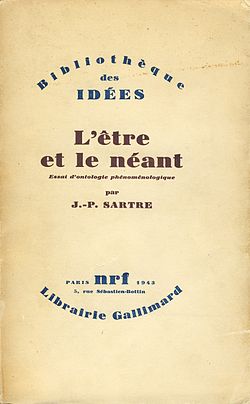
File:Being_and_Nothingness_(French_first_edition).JPG · Wikimedia Commons · See Wikimedia Commons
Being and Nothingness
Sign in to saveAlso known as Being and Nothingness: An Essay on Phenomenological Ontology
essay by Jean-Paul Sartre
Key facts
- Author
- Jean-Paul Sartre
- Original title
- L'Être et le néant
- Translators
- Hazel Barnes (1956: 1st English translation), Sarah Richmond (2018: 2nd English translation)
- Language
- French
- Subject
- Ontology
- Publisher
- Éditions Gallimard , Philosophical Library
- Publication place
- France
- Media type
- Print ( Hardcover and Paperback )
- Pages
- 638 (Routledge edition)
- Isbn
- 0-415-04029-9 (Routledge edition)
via Wikipedia infobox
Wikidata facts
- Author
- Jean-Paul Sartre
- Genre
- essay
- Country of origin
- France
- Publisher
- Éditions Gallimard
- Main subject
- ontology
- Movement
- atheist existentialism
- Dedicated to
- Simone de Beauvoir
- Image
- Cover Das Sein und das Nichts.jpg
Show 4 more facts
- title
- L'Être et le Néant
- subtitle
- Essai d'ontologie phénoménologique
- publication date
- 1943-00-00
- language of work or name
- French
via Wikidata · CC0
~29 min read
Encyclopedic overview
Being and Nothingness: An Essay on Phenomenological Ontology (French: L'Être et le néant : Essai d'ontologie phénoménologique), sometimes published with the subtitle A Phenomenological Essay on Ontology, is a 1943 book by the philosopher Jean-Paul Sartre. In the book, Sartre develops a philosophical account in support of his existentialism, dealing with topics such as consciousness, perception, social philosophy, self-deception, the existence of "nothingness", psychoanalysis, and the question of free will.
While a prisoner of war in 1940 and 1941, Sartre read Martin Heidegger's Being and Time (1927), which uses the method of Husserlian phenomenology as a lens for examining ontology. Sartre attributed the course of his own philosophical inquiries to his exposure to this work. Though influenced by Heidegger, Sartre was profoundly skeptical of any measure by which humanity could achieve a kind of personal state of fulfillment comparable to the hypothetical Heideggerian "re-encounter with Being". In Sartre's account, man is a creature haunted by a vision of "completion" (what Sartre calls the ens causa sui, meaning literally "a being that causes itself"), which many religions and philosophers identify as God. Born into the material reality of one's body, in a material universe, one finds oneself inserted into being. In accordance with Husserl's notion that consciousness can only exist as consciousness of something, Sartre develops the idea that there can be no form of self that is "hidden" inside consciousness. On these grounds, Sartre goes on to offer a philosophical critique of Sigmund Freud's theories, based on the claim that consciousness is essentially self-conscious.
Excerpted from Wikipedia’s “Being and Nothingness” article, available under the CC BY-SA 4.0 licence.