Encyclopedia of Life · EOL (see source)
Bengal slow loris
Sign in to saveAlso known as Nycticebus bengalensis, Northern slow loris
species of mammal
Species
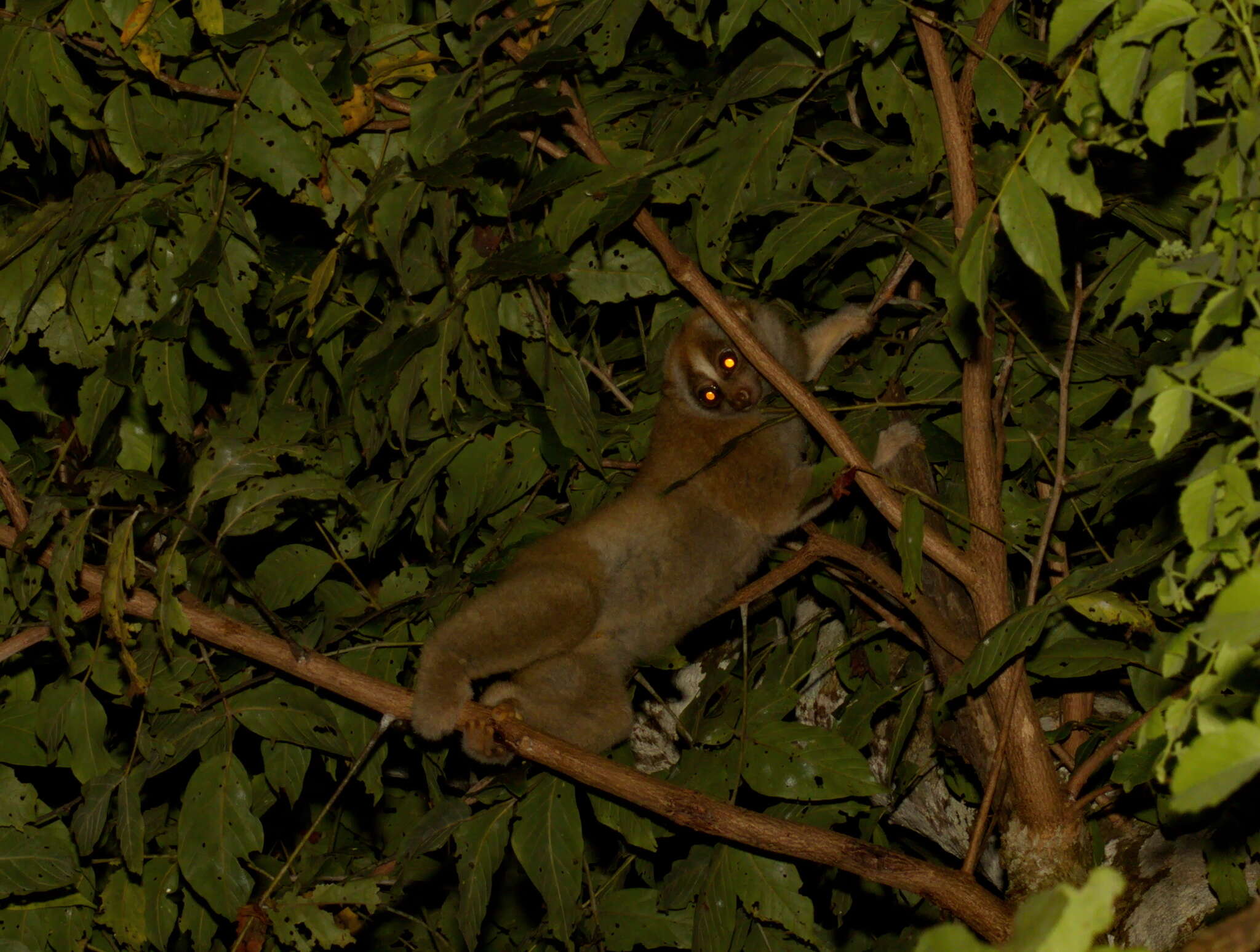
EndangeredУ бенгальского лори большие глаза, круглая голова и короткие уши Бенгальские лори самые крупные представители толстых лори, их вес составляет от 1 до 2,1 кг,[5] длина тела от 26 до 38 см. Длина черепа около 62 мм.[6] Шерсть густая, коричневато-серая на спине и белая на нижней поверхности тела.[2] На голове тёмная полоса, достигающая макушки, но не спускающаяся к ушам. Передние конечности почти белые. Задние конечности могут быть различной расцветки от коричневого до почти белого, ступни всегда белые. В зависимости от линьки цвет шерсти на спине различается в зависимости от сезона.[7] Хвост рудиментарный, как и у других толстых лори. Голова круглая, уши короткие.[2][8] Имеется ринариум (влажная безволосая область вокруг ноздрей), лицо широкое, плоское, с большими глазами.[9] В отражённом свете глаза оранжевые из-за тапетума.[10] На передних конечностях второй палец меньше остальных, большой палец на задних конечностях отстоящий, что улучшает хват. Второй палец на задних конечностях снабжён когтем, используемым для груминга, остальные пальцы имеют плоские ногти.[9] Симпатричный вид Nycticebus coucang меньше в размерах и отличается расцветкой: на голове, плечах и загривке нет светлых
via IUCN
Wikidata facts
- Instance of
- taxon
- Parent taxon
- Nycticebus
- Image
- Captive N. bengalensis from Laos with 6-week baby.JPG
Show 7 more facts
- taxon rank
- species
- IUCN conservation status
- Endangered status
- taxon name
- Nycticebus bengalensis
- Commons category
- Nycticebus bengalensis
- taxon common name
- loris de bengala
- CITES Appendix
- Appendix I of CITES
- habitat
- forest
Sources (2)
via Wikidata · CC0
~16 min read
Encyclopedic overview
The Bengal slow loris (Nycticebus bengalensis) or northern slow loris is a strepsirrhine primate and a species of slow loris native to the Bangladesh, Northeast India, Cambodia, Laos, Burma, Vietnam, southern China, and Thailand. Its geographic range is larger than that of any other slow loris species. Considered a subspecies of the Sunda slow loris (N. coucang) until 2001, phylogenetic analysis suggests that the Bengal slow loris is most closely related to the Sunda slow loris. However, some individuals in both species have mitochondrial DNA sequences that resemble those of the other species, due to introgressive hybridization. It is the largest species of slow loris, measuring 26 to 38 cm (10 to 15 in) from head to tail and weighing between 1 and 2.1 kg (2.2 and 4.6 lb). Like other slow lorises, it has a wet nose (rhinarium), a round head, flat face, large eyes, small ears, a vestigial tail, and dense, woolly fur. The toxin it secretes from its brachial gland (a scent gland in its arm) differs chemically from that of other slow loris species and may be used to communicate information about sex, age, health, and social status.
The Bengal slow loris is nocturnal and arboreal, occurring in both evergreen and deciduous forests. It prefers rainforests with dense canopies, and its presence in its native habitat indicates a healthy ecosystem. It is a seed disperser and pollinator, as well as a prey item for carnivores. Its diet primarily consists of fruit, but also includes insects, tree gum, snails, and small vertebrates. In winter, it relies on plant exudates, such as sap and tree gum. The species lives in small family groups, marks its territory with urine, and sleeps during the day by curling up in dense vegetation or in tree holes. It is not a seasonal breeder, reproducing once every 12–18 months and usually giving birth to a single offspring. For the first three months, mothers carry their offspring, which reach sexual maturity at around 20 months. The Bengal slow loris can live up to 20 years.
Excerpted from Wikipedia’s “Bengal slow loris” article, available under the CC BY-SA 4.0 licence.