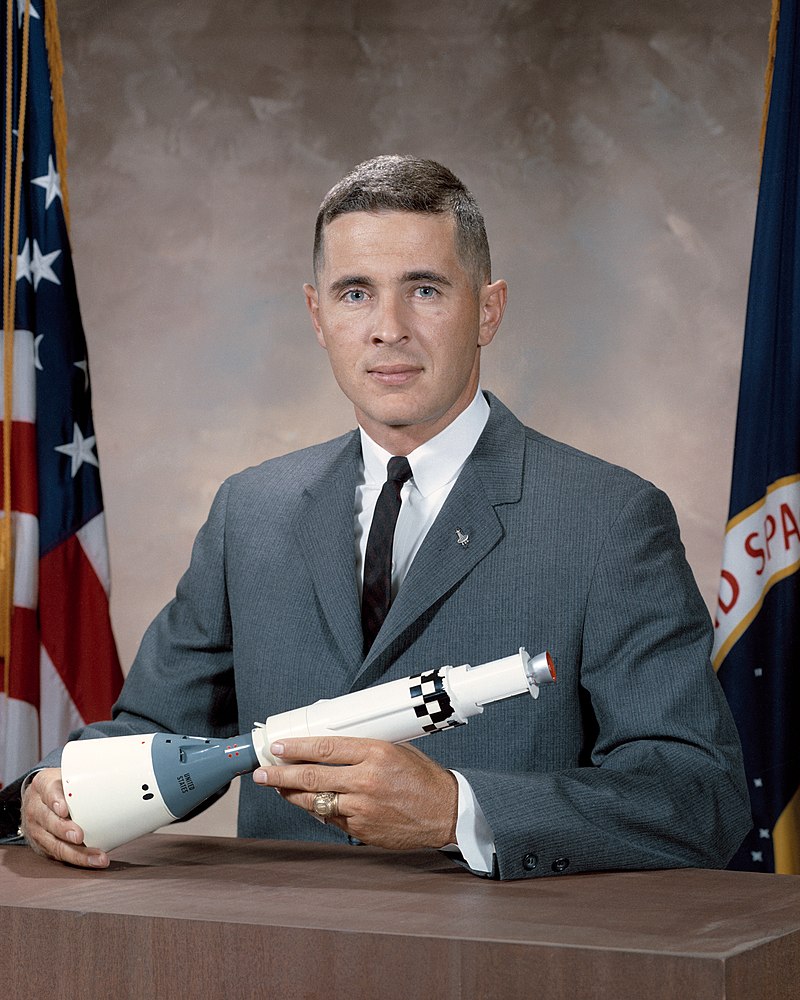
File:William_Anders.jpg · Wikimedia Commons · See Wikimedia Commons
Bill Anders
Sign in to saveAlso known as William Anders, William Alison Anders, William A. Anders, Bill A. Anders
American astronaut and lunar explorer (1933–2024)
OverviewAI-generated
William Anders was a United States citizen born in British Hong Kong in 1933. He served as an engineer, astronaut, diplomat, and aircraft pilot. His military career included service in the United States Air Force, where he held the rank of major general. He was part of NASA Astronaut Group 3 and worked for NASA.
Anders is noted for his work on Earthrise. He received several awards, including the Air Force Distinguished Service Medal, Harmon Trophy, National Aviation Hall of Fame, and NASA Distinguished Service Medal. His works are held in the National Gallery of Victoria and he is recognized in the Astronauts collection. He also served as the United States Ambassador to Norway.
He was educated at the United States Naval Academy and Harvard Business School. Anders spent 8820 units of time in space. He died by accidental death in San Juan County on June 7, 2024. He spoke English.
Synthesized by Vinony from 23 facts across 2 sources: Wikidata, Vinony collections. Generated from structured data (not the Wikipedia text) and checked against those facts — may still contain errors.
Wikidata facts
- Instance of
- human
- Part of
- NASA Astronaut Group 3
- Gender
- male
- Citizenship
- United States
- Place of birth
- British Hong Kong
- Place of death
- San Juan County
- Occupation
- entrepreneur
- Position held
- United States Ambassador to Norway
- Educated at
- Harvard Business School
- Employer
- NASA
- Languages spoken
- English language
- Native language
- English language
- Notable work
- Earthrise
- Military branch
- United States Air Force
- Military rank
- major general
- Image
- William Anders.jpg
Show 12 more facts
- Commons category
- William Anders
- date of birth
- 1933-10-17
- time in space
- 8820
- floruit
- 1969-01-01
- date of death
- 2024-06-07
- manner of death
- accidental death
- name in native language
- William Anders
- birth name
- William Alison Anders
- place of burial
- United States Naval Academy Cemetery
- member of the crew of
- Apollo 8
- P450
- Apollo 8
Sources (13)
via Wikidata · CC0
~28 min read
Encyclopedic overview
William Alison Anders (17 October 1933 – 7 June 2024) was a United States Air Force (USAF) major general, electrical engineer, nuclear engineer, NASA astronaut, and businessman. In December 1968, he was a member of the crew of Apollo 8, the first three people to leave low Earth orbit and travel to the Moon. Along with fellow astronauts Frank Borman and Jim Lovell, he circled the Moon ten times, and broadcast live images and commentary back to Earth, including the Christmas Eve Genesis reading. During one of the mission's lunar orbits, he took the iconic Earthrise photograph.
A 1955 graduate of the United States Naval Academy, Anders was commissioned a second lieutenant in the USAF the same year and became a fighter pilot flying Northrop F-89 Scorpions equipped with AIR-2A nuclear-tipped air-to-air rockets. In 1962, he earned a Master of Science degree in nuclear engineering at the Air Force Institute of Technology (AFIT) of Air University, and was sent to the Air Force Weapons Laboratory to manage the technical aspects of the service's nuclear reactor programs.
Excerpted from Wikipedia’s “Bill Anders” article, available under the CC BY-SA 4.0 licence.