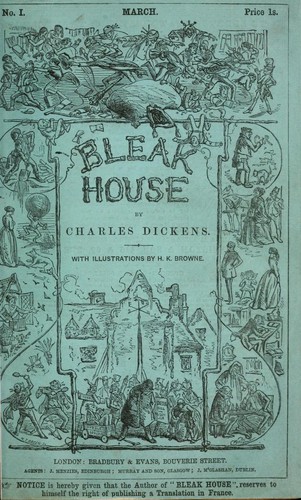
Cover via Open Library · Open Library
Bleak House
Sign in to savenovel by Charles Dickens (1853)
Key facts
- Author
- Charles Dickens
- Illustrator
- Hablot Knight Browne ( Phiz )
- Cover artist
- Hablot Knight Browne (Phiz)
- Language
- English
- Genre
- Novel
- Published
- Serialised: 12 March 1852 – 12 September 1853 Book: 12 September 1853
- Publisher
- Bradbury & Evans
- Publication place
- England
- Preceded by
- David Copperfield
- Followed by
- A Child's History of England
via Wikipedia infobox
Wikidata facts
- Read free · Project Gutenberg
- #1023
- Instance of
- literary work
- Author
- Charles Dickens
- Country of origin
- England
- Publisher
- Chapman and Hall
- Followed by
- A Child's History of England
- Follows
- David Copperfield
- Narrative location
- England
- Image
- Cover, Bleak House (1852-3).png
Show 12 more facts
- publication date
- 1853-00-00
- Commons category
- Bleak House
- illustrator
- Hablot Knight Browne
- cover art by
- Hablot Knight Browne
- inception
- 1852-00-00
- language of work or name
- English language
- title
- Bleak House
- copyright status
- public domain
- first line
- London. Michaelmas term lately over, and the Lord Chancellor sitting in Lincoln's Inn Hall.
- last line
- "But I know that my dearest little pets are very pretty, and that my darling is very beautiful, and that my husband is very handsome, and that my guardian has the brightest and most benevolent face that ever was seen, and that they can very well do without much beauty in me—even supposing—."
- form of creative work
- novel
- work available at URL
- standardebooks.org/ebooks/charles-dickens/bleak-house
via Wikidata · CC0
~33 min read
Encyclopedic overview
Bleak House is a novel by the English author Charles Dickens, first published as a 20-episode serial between 12 March 1852 and 12 September 1853. The novel has many characters and several subplots, and is told partly by the novel's heroine, Esther Summerson, and partly by an omniscient narrator. At the centre of Bleak House is a long-running legal case in the Court of Chancery, Jarndyce and Jarndyce, which comes about because a testator has written several conflicting wills. In a preface to the 1853 first edition, Dickens said there were many actual precedents for his fictional case. One such was probably Thellusson v Woodford, in which a will read in 1797 was contested and not determined until 1859. Though many in the legal profession criticised Dickens's satire as exaggerated, Bleak House helped support a judicial reform movement that culminated in the enactment of legal reform in the 1870s.
Some scholars debate when Bleak House is set. The English legal historian Sir William Holdsworth sets the action in 1827; however, reference to preparation for the building of a railway in Chapter LV suggests the 1830s. A work of Gothic fiction depicting London as a murky city swathed in fog, Bleak House is credited with introducing urban fog to the novel, which would become a frequent characteristic of urban Gothic literature and film. Released in 1901, the Bleak House-inspired The Death of Poor Joe is the earliest filmed adaptation of a Dickens work.
Excerpted from Wikipedia’s “Bleak House” article, available under the CC BY-SA 4.0 licence.