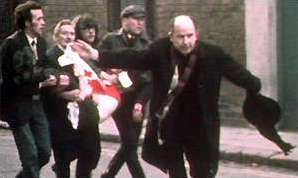
File:Edward_Daly_Bloody_Sunday.jpg · Wikimedia Commons · See Wikimedia Commons
Bloody Sunday
Sign in to saveAlso known as Boggi Massacre, 1972 Bogside Massacre
shooting of 26 civilians by British soldiers in Derry, Northern Ireland in 1972 during the Troubles
Key facts
- Date
- 30 January 1972 ; 54 years ago ( 1972-01-30 ) , 16:10 (UTC+00:00)
- Attack type
- Mass shooting
- Weapons
- L1A1 SLR rifles
- Deaths
- 14 (13 immediate, one died four months later)
- Injured
- 15+ (12 from gunshots, two from vehicle impact, others from rubber bullets and flying debris)
- Perpetrators
- British Army ( Parachute Regiment )
- Accused
- Soldier F
- Charges
- murder (2) attempted murder (5)
via Wikipedia infobox
Wikidata facts
- Instance of
- massacre
- Part of
- The Troubles
- Country
- United Kingdom
- Time zone
- UTC±00:00
- Location
- Derry
- Number of deaths
- 14
- Number of injured
- 1777
Show 3 more facts
- Commons category
- Bloody Sunday, Derry
- point in time
- 1972-01-30
- native label
- Domhnach na Fola
Sources (3)
via Wikidata · CC0
~40 min read
Encyclopedic overview
Bloody Sunday, or the Bogside Massacre, occurred on 30 January 1972 when British soldiers shot 26 unarmed civilians during a protest march in the Bogside area of Derry, Northern Ireland. Thirteen men were killed outright, and the death of another man four months later has been attributed to his gunshot injuries. Many of the victims were shot while fleeing from the soldiers and some were shot while trying to help the wounded. All of those shot were Catholics. The march had been organised by the Northern Ireland Civil Rights Association (NICRA) to protest against internment without trial. The soldiers were from the 1st Battalion of the Parachute Regiment ("1 Para"), the same battalion implicated in the Ballymurphy massacre several months earlier.
The incident became one of the most significant events of the Troubles. It was the highest number of people killed in a single shooting during the conflict, and is regarded as the worst mass shooting in Northern Irish history. Bloody Sunday fuelled Catholic and Irish nationalist hostility towards the British Army, intensified the conflict, and led to a surge of support for the Provisional Irish Republican Army (IRA), especially in Derry. The Republic of Ireland held a national day of mourning, and crowds besieged and burnt down the chancery of the British Embassy in Dublin.
Excerpted from Wikipedia’s “Bloody Sunday” article, available under the CC BY-SA 4.0 licence.