
Sierra Leone
Sign in to saveAlso known as Republic of Sierra Leone, sl, SLE
Sierra Leone, officially the Republic of Sierra Leone, is a country on the west coast of West Africa. It is bordered to the southeast by Liberia and by Guinea to the north. Sierra Leone's land area is 73,252 km2 (28,283 sq mi). It has a tropical climate and environments ranging from savannas to rainforests. As of the 2023 census, Sierra Leone has a population of 8,460,512. Freetown is its capital and largest city.
OverviewAI-generated
Sierra Leone, officially the Republic of Sierra Leone, is a sovereign state and republic located in Western Africa. It shares borders with Guinea and Liberia. The capital city is Freetown. The country has an area of 71740 and a population of 9077691. Its official languages are English and Krio. The national currency is the leone.
The nation is a member of the United Nations, the Commonwealth of Nations, the African Union, and the World Trade Organization. It contains the Northern Province, Southern Province, Eastern Province, and Western Area. The anthem is High We Exalt Thee, Realm of the Free. The top-level Internet domain is .sl. The telephone country code is 232. The time zone is UTC±00:00. The demonym is Sierra Leonean.
Synthesized by Vinony from 72 facts across 10 sources: Wikidata, Open Meteo, Openweathermap, World Bank, OpenStreetMap, Firecrawl, REST Countries, PubMed, Vinony graph, Geo. Generated from structured data (not the Wikipedia text) and checked against those facts — may still contain errors.
In the Vinony graph
Vinony catalogs Sierra Leone in its Countries collection (215 entries).
Within Vinony's link graph, Sierra Leone is referenced by 12,240 other articles, and connects out to African Union, unicameralism and Sierra Leone Creole people.
The entry is geolocated on the map in W, across 2 mapped points.
Vinony files it under 1961 establishments in Sierra Leone, Countries and territories where English is an official language and Countries in Africa.
Weather now
cached 14h ago7-day forecast
via Open-Meteo
Country
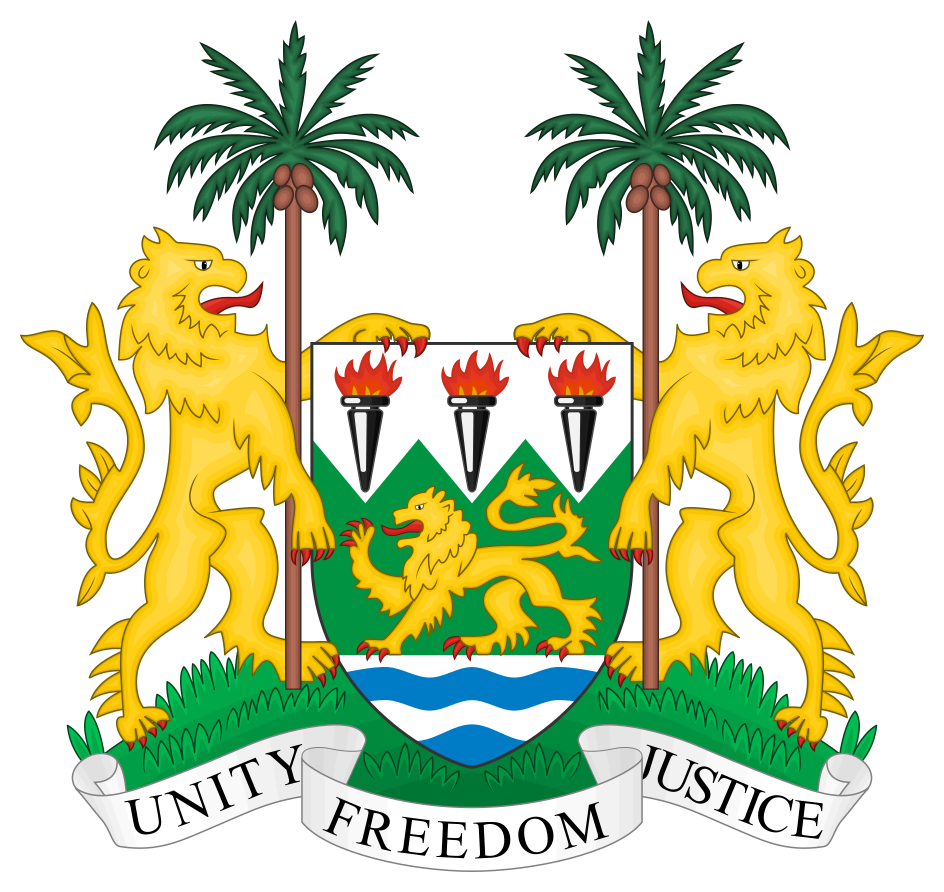
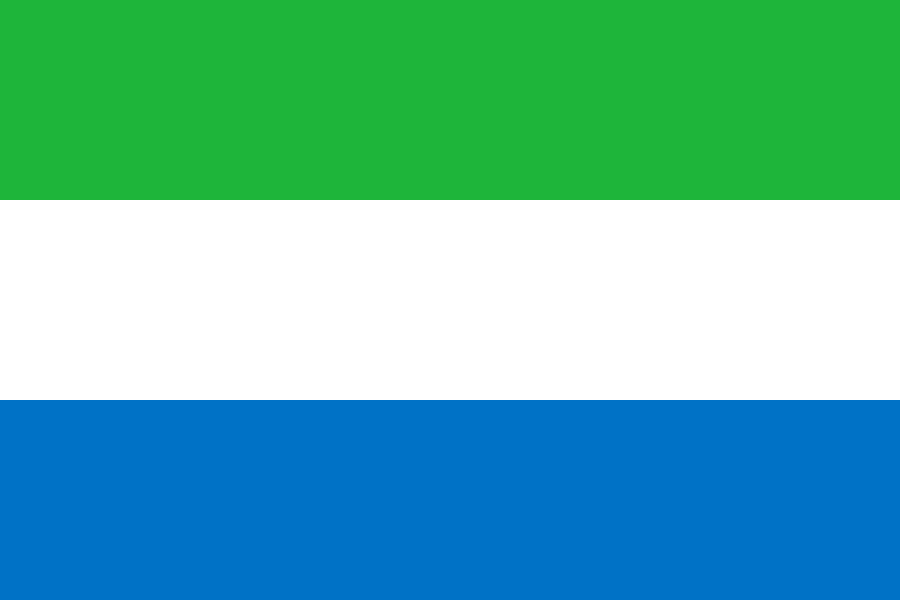
- Capital
- Freetown
- Population
- 9,077,691
- Region
- Africa · Western Africa
- Demonym
- Sierra Leonean
- Currencies
- SLE (Le)
- Languages
- English
- Calling code
- +232
- Drives on
- Right
- Gini
- 35.7 (2018)
- FIFA code
- SLE
- TLD
- .sl
- Timezones
- UTC
- Borders
- GIN, LBR
via REST Countries
Indicators · World Bank
- GDP
- $7B(2024)
- Population
- 8,642,022(2024)
- Life expectancy
- 62 yrs(2024)
- Unemployment
- 3.2 %(2025)
- Urban population
- 45.4 %(2024)
- Internet users
- 25.1 %(2024)
- Forest area
- 34.3 %(2023)
- Renewable energy
- 71.6 %(2022)
via World Bank Open Data · CC BY 4.0
Place details
- Locality
- Morokiebana
- Region
- Tonkolili District
- Country
- Sierra Leone
via OpenStreetMap · GeoNames
Wikipedia views (30d)
87,433 totalvia Wikimedia Pageviews API
Research
5,014 papers- Public health system in post-pandemic Sierra Leone: a scoping review.BMC infectious diseases · 2024Kangbai JB, Sesay U, Kangbai DM et al.DOI: 10.1186/s12879-024-10360-w
- HIV/AIDS in Sierra Leone: Characterizing the Hidden Epidemic.ReviewAIDS reviews · 2018Yendewa GA, Poveda E, Yendewa SA et al.DOI: 10.24875/AIDSRev.M18000022
- Optometric challenges in Sierra Leone.Journal of global health · 2024St Clair B, Otoo MA, Shi ADOI: 10.7189/jogh.14.03038
- Multidrug-resistant tuberculosis in Sierra Leone.The Lancet. Global health · 2022Lakoh S, Yendewa GADOI: 10.1016/S2214-109X(22)00045-6
- Unsalaried health workers in Sierra Leone: a scoping review of the literature to establish their impact on healthcare delivery.International journal for equity in health · 2023Pieterse P, Saracini FDOI: 10.1186/s12939-023-02066-3
- Sierra Leone.Department of State publication. Background notes series · 1986United States. Department of State. Bureau of Public Affairs
- Health sector fragmentation: three examples from Sierra Leone.ReviewGlobalization and health · 2019Barr A, Garrett L, Marten R et al.DOI: 10.1186/s12992-018-0447-5
- [Sierra Leone].Jeune Afrique (Paris, France : 1980) · 1996
via PubMed
Official website
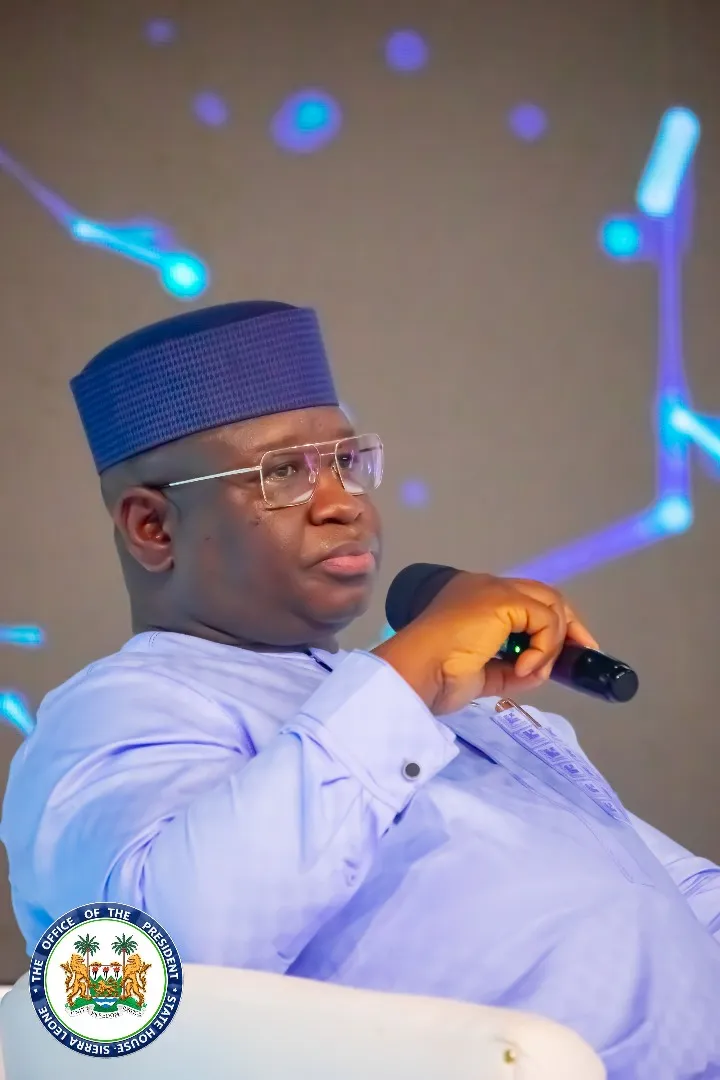
Home - Office of the President of Sierra Leone
statehouse.gov.sl →Link to the official site · 38,703 chars · not written by Vinony
Wikidata facts
- Instance of
- country
- Named after
- Lion Mountains
- Official name
- República de Sierra Leone
- Demonym
- Siarra Leonach
- Country
- Sierra Leone
- Contains
- North West Province
- Continent
- Africa
- Capital
- Freetown
- Official language
- Krio
- Currency
- leone
- Population
- 7557212
- Area
- 71740
- Body of water
- Atlantic Ocean
- Head of government
- David Sengeh
- Head of state
- Julius Maada Bio
- Form of government
- presidential system
- Legislature
- Parliament of Sierra Leone
- Shares border with
- Liberia
- Highest point
- Mount Bintumani
- Official website
- statehouse.gov.sl
- Image
- Sierra Leone-Mappa.gif
- Life expectancy
- 51.835
Show 62 more facts
- Nominal GDP
- 3970343852
- Unemployment rate
- 3
- Calling code
- +232
- Licence plate code
- WAL
- Electrical plug type
- BS 1363
- Mains voltage
- 230
- Motto
- Undeb, Rhyddid, Cyfiawnder
- Coat of arms
- coat of arms of Sierra Leone
- top-level Internet domain
- .sl
- Commons category
- Sierra Leone
- member of
- African Continental Free Trade Area
- topic's main category
- Category:Sierra Leone
- category for people who died here
- Category:Deaths in Sierra Leone
- category for people born here
- Category:Births in Sierra Leone
- category of associated people
- Category:Sierra Leonean people
- IPA transcription
- ˈsɪæɾɑ lɛˈoːnə
- Commons gallery
- Sierra Leone
- mobile country code
- 619
- lowest point
- Atlantic Ocean
- driving side
- right
- geography of topic
- Geography of Sierra Leone
- history of topic
- history of Sierra Leone
- age of majority
- 21
- trunk prefix
- 0
- marriageable age
- 18
- topic's main Wikimedia portal
- Portal:Sierra Leone
- diplomatic relation
- Kosovo
- office held by head of state
- President of Sierra Leone
- located in/on physical feature
- West Africa
- total fertility rate
- 4.626
- maritime identification digits
- 667
- Unicode character
- 🇸🇱
- central bank
- Bank of Sierra Leone
- discoverer or inventor
- Pedro de Sintra
- VAT rate
- 15
- water as percent of area
- 0.2
- native label
- Republic of Sierra Leone
- BTI Status Index
- 5.09
- BTI Governance Index
- 4.78
- economy of topic
- economy of Sierra Leone
- inception
- 1971-04-19
- demographics of topic
- demographics of Sierra Leone
- different from
- Sierra Leone River
- Democracy Index
- 4.86
- Human Development Index
- 0.477
- P11012
- Myanmar
- hashtag
- SierraLeone
- on focus list of Wikimedia project
- Wikipedia:Vital articles/Level/4
- Happy Planet Index score
- 29
- Gini coefficient
- 35.7
- Inequality-adjusted Human Development Index
- 0.309
- P12749
- darmstadtium
- birth rate
- 30.788
- male population
- 4312192
- death rate
- 8.909
- rural population
- 4833746
- female population
- 4293526
- urban population
- 3771972
- P8168
- Araneus ejusmodi
- Commonwealth Sport country code
- SLE
Sources (15)
via Wikidata · CC0
Travel guide
Understand
Sierra Leone was founded as a colony for freed slaves originating in the British Empire.
Sierra Leone achieved its independence from Britain in 1961. Since the end of its civil war in 2002, the government, with considerable international assistance, has made noticeable improvements in the country's infrastructure which should help the tourism sector: most major trunk roads are tarred to a high standard and Bumbuna hydroelectric dam supplies electricity when water levels are high enough (completed in 2009). While the government sector still suffers from chronic shortage of resources, the private sector is booming.
In 2014, the outbreak of Ebola virus, which crossed the border from Guinea threatened to set back the improvements in the countries economy and development. More than a year of development was lost whilst the country focused on the fight against the disease. The country had not recovered fully when it was hit by the global COVID pandemic.
Get in
thumb|375px|A map showing the visa requirements of Sierra Leone, with countries in green having visa-free access thumb|Overloaded car at the border between Sierra Leone and Guinea Yellow Fever vaccination certificates are required for most nationalities. Proof of vaccination might be required to get a visa and is checked at the airport on arrival.
See
thumb|Lumley Beach, Freetown The beaches of the Freetown peninsula are spectacular, and on an average day, deserted. There are at least ten that could be described as world-class.
Bonthe Town, on Sherbro Island, is a former British Colonial Town, with several beautiful stone churches, and a rich culture.
Tiwai Island (in the middle of a river in SE Sierra Leone) is teeming with rare wildlife.
Rural West African villages: experience hospitality and the tranquillity of the bush.
Snorkelling and scuba diving around Banana Island.
The Turtle Islands, difficult to get to, but idyllic.
Outamba-Kilimi National Park is a park consisting of savannas and jungles with diverse wildlife.
Mount Bintumani is the highest mountain in Sierra Leone with excellent views from the summit.
Sierra Leone has vast swathes of rainforests.
Eat
thumb|Rice Akara, Plantains and Beans The main staple of Sierra Leonean food is rice, often accompanied by soup, i.e., stews. These stews may include a delicious and often spicy mix of meat, fish, seasonings, greens, etc., often taking hours to prepare. There are plenty of good quality restaurants offering a variety of local and international dishes.
The diet of Sierra Leoneans like many African countries is very healthy. Many tend to eat some fresh fruit picked from trees growing in their homes or freshly picked by market vendors that very day. They also eat seafood particularly in the capital Freetown which is on the Atlantic coast. It is common to go to areas such as Lumley Beach where one can find local fishermen pulling in nets from the Atlantic filled with fish such as crabs, lobsters, oysters, snappers and many, many more.
The locals of Sierra Leone keep healthy by eating many plant-based dishes which are high in fibre, such as cassava leaves, potato leaves, okra, and more.
Drink
The national brewer Sierra Leone Breweries Limited produces Star beer and the premium Mützig beer. Star is available in small and large 60 cl bottles. Many European beers are imported. As in many African countries Guinness is widely popular. Soft drinks such as Coca Cola and Fanta are locally produced. Wine is available from restaurants and supermarkets, but can be expensive. Local brewed palm wine (called "poyo" in Krio), is very popular throughout Sierra Leone. Beware of spirits (whisky, gin, etc.) which are sold in large plastic containers, as their quality and safety are uncertain.
Sleep
There are some high standard hotels/guesthouses in Freetown, including the 4 star Radisson Blu Mammy Yoko. Facilities are very limited in other cities, although improvements are being made. Makeni now has two good hotels. There are a few nice, very small, resort-style getaways, notably at Banana Island and Bonthe Island.
Overnights in Sierra Leone are quite expensive, and similar to what one might spend in the United States, but with poorer amenities. There are guesthouses to be found in towns of any significant size, usually for US$35-50 for a single room, and will almost always have shared bath/toilet. Average hotels are around US$100-180 for a single room.
The cheapest accommodation in SL is found in the villages—ask for the chief (who should speak some Krio, if not any English), and then request a guest house ("guest house" is the right term in Krio, so you will be understood). There is no formal charge associated with the chief's hospitality, but you should "pay him respects" in the morning to the tune of about US$6-8, and then expect to be handing out 10,000 leone notes to the guesthouse caretaker, the water-fetcher, and at least one other person for some random reason.
Stay safe
Despite the horrific violence of the 1990s—or ironically, because of it—Sierra Leone is a very safe country to visit. While petty pick-pocketing, bag-snatching, and other non-violent crimes are a problem in parts of Freetown (and the police are non-responsive), violent crime is extremely rare throughout the country by any international standards, even in the capital.
Corruption is less of a problem than it once was. There have been somewhat successful campaigns against corruption, with a series of high-level arrests and initiatives to, say, prevent police from charging bogus fines. Freetown (Lungi) airport has been rebuilt and is quite good by any standards.
The usual dangers found in undeveloped sub-Saharan Africa, though, are present: traffic and disease. Traffic accidents are far less common than they have any right to be, but be aware that the overcrowded, barely hanging together poda-podas are physics-defying death-traps. Similarly, moto-taxis love speed, with total disregard to the lurking dangers of broken roads, gaping potholes, charging trucks lurking in the dust. There have been a small number of very serious crashes involving buses in remote areas. Walking around the cities at night is hazardous not so much for fear of crime, but rather because the lack of lighting can cause a fall, or a driver might not see you in the road. Locals carry phones that have flash-lights, if yours does not, always bring a torch.
The dangers associated with tropical disease are basic…
Stay healthy
thumb|Countryside road Water-borne diseases, malaria and other tropical diseases are prevalent. You should consider taking medication to protect against malaria and using insect repellent. Vaccination against yellow fever is now required and against rabies might be recommended. HIV/AIDS is prevalent. Lassa fever can be contracted in Kenema and the east. In 2010, it also spread to the North, resulting in 48 deaths between the start of the year and November. If you have travelled in these regions you should seek urgent medical advice for any fever not positively identified as malaria. As well, 2014-15 saw an outbreak of the often fatal and largely untreatable Ebola viral haemorrhagic fever that had spread from neighbouring Guinea and Liberia.
Medical facilities are very poor, especially outside of Freetown. You should carry basic medical supplies. You should take medical advice before travelling and ensure that all appropriate vaccinations are up to date. Drink only bottled water and be aware of what you eat and how well cooked it is. It is better to eat local food rather than international dishes that may have been stored for longer.
Travel guide from Wikivoyage (CC BY-SA 4.0)
~40 min read
Encyclopedic overview
Sierra Leone, officially the Republic of Sierra Leone, is a country on the west coast of West Africa. It is bordered to the southeast by Liberia and by Guinea to the north. Sierra Leone's land area is 73,252 km (28,283 sq mi). It has a tropical climate and environments ranging from savannas to rainforests. As of the 2023 census, Sierra Leone has a population of 8,460,512. Freetown is its capital and largest city.
Sierra Leone is a presidential republic, with a unicameral parliament and a directly elected president. It is a secular state. Its constitution provides for the separation of state and religion and freedom of conscience. Muslims constitute three-quarters of the population, and there is a significant Christian minority. Religious tolerance is very high.
Excerpted from Wikipedia’s “Sierra Leone” article, available under the CC BY-SA 4.0 licence.
Gallery (17)
On the map
2 mapped locations
Available in 248 languages
- Español
- Français
- Deutsch
- 中文
- 日本語
- Русский
- Português
- Italiano
- العربية
- हिन्दी
- Abkhazian
- abstract
- Achinese
- Afrikaans
- Akan
- Albanian
- Albanian
- Amharic
Show 229 more
- ami
- Angika
- Aragonese
- Armenian
- Arpitan
- Asturian
- azb
- Azerbaijani
- Bahasa Indonesia
- Balinese
- Bambara
- Bangla
- Banjar
- Bashkir
- Basque
- bat_smg
- Bavarian
- be_x_old
- Belarusian
- Betawi
- Bhojpuri
- Bikol
- Bishnupriya
- Bislama
- Bosnian
- Breton
- Bulgarian
- Buriat
- Burmese
- Catalan
- cbk_zam
- cdo
- Cebuano
- Central Kurdish
- Chechen
- Cornish
- Corsican
- Crimean Tatar
- Croatian
- Czech
- dag
- Danish
- Divehi
- dty
- Dzongkha
- Egyptian Arabic
- Esperanto
- Estonian
- Ewe
- Extremaduran
- Faroese
- Fiji Hindi
- Filipino
- Finnish
- fiu_vro
- Fon
- Frafra
- Fula
- Gagauz
- Galician
- Ganda
- gcr
- Georgian
- Gilaki
- gpe
- Greek
- Guarani
- Gujarati
- Haitian Creole
- Hakka Chinese
- Hausa
- Hebrew
- Hungarian
- hyw
- Icelandic
- Ido
- Igbo
- Iloko
- Inari Sami
- Interlingua
- Interlingue
- Irish
- Jamaican Creole English
- Javanese
- Kabyle
- Kannada
- Kanuri
- Kara-Kalpak
- Karachay-Balkar
- Kashmiri
- Kazakh
- kbp
- kge
- Kikuyu
- Kinyarwanda
- Kongo
- Kotava
- Kurdish
- Kyrgyz
- Ladino
- Latin
- Latvian
- Ligurian
- Limburgish
- Lingala
- Lingua Franca Nova
- Lithuanian
- lld
- Lojban
- Lombard
- Low German
- Lower Sorbian
- Luxembourgish
- Macedonian
- Maithili
- Malagasy
- Malay
- Malayalam
- Maltese
- Manipuri
- Manx
- Māori
- Marathi
- Mazanderani
- Minangkabau
- Mingrelian
- Moksha
- Mongolian
- Moroccan Arabic
- N’Ko
- nds_nl
- Nederlands
- Nepali
- Newari
- Nigerian Pidgin
- Northern Frisian
- Northern Sami
- Northern Sotho
- Norwegian
- Norwegian Nynorsk
- Novial
- nup
- Obolo
- Occitan
- Old English
- olo
- Oromo
- Ossetic
- Pampanga
- Papiamento
- Pashto
- Piedmontese
- Polski
- Punjabi
- Quechua
- Romanian
- Samoan
- Sango
- Sanskrit
- Santali
- Sardinian
- Saterland Frisian
- Scots
- Scottish Gaelic
- Serbian
- Serbian (Latin)
- Shan
- Shona
- Sicilian
- Silesian
- simple
- Sindhi
- Sinhala
- Slovak
- Slovenian
- Somali
- Southern Sotho
- Standard Moroccan Tamazight
- Sundanese
- Svenska
- Swahili
- Swati
- szy
- Tajik
- Talysh
- Tamil
- Taroko
- Tatar
- tay
- Telugu
- Tibetan
- Tiếng Việt
- Tok Pisin
- Toki Pona
- Tsonga
- Tswana
- Tumbuka
- Türkçe
- Turkmen
- Tyap
- Udmurt
- Ukrainian
- Upper Sorbian
- Urdu
- Uyghur
- Uzbek
- Venetian
- Veps
- Volapük
- Waray
- Welsh
- Western Frisian
- Western Mari
- Western Panjabi
- Wolof
- Wu Chinese
- Yakut
- Yiddish
- Yoruba
- Zaza
- Zeelandic
- zh_classical
- zh_min_nan
- zh_yue
- Zhuang
- Zulu
- فارسی
- ไทย
- 한국어
via Wikidata sitelinks · CC0