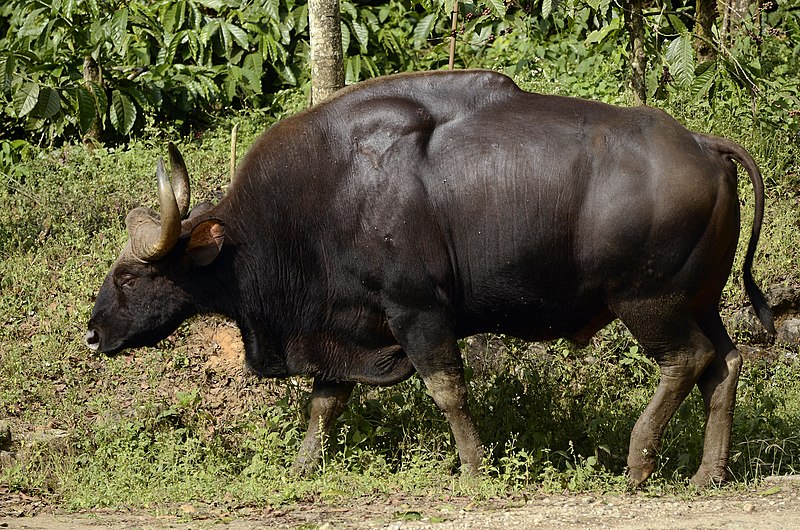
File:Indian_Gaur_from_anaimalai_hills_JEG5290.jpg · Wikimedia Commons · See Wikimedia Commons
Bos gaurus
Sign in to saveAlso known as Indian bison, Gaur
The gaur (Bos gaurus; ), also known as the Indian bison, is a large bovine native to the Indian subcontinent and Southeast Asia, and has been listed as Vulnerable on the IUCN Red List since 1986. The global population was estimated at a maximum of 21,000 mature individuals in 2016, with the majority of those existing in India. It is the largest species among the wild cattle and the Bovidae.
OverviewAI-generated
Bos gaurus, commonly known as the gaur, is a species of mammal in the family Bovidae. It belongs to the kingdom Animalia, phylum Chordata, class Mammalia, and order Artiodactyla. The scientific name was established by C.H.Smith in 1827.
The species is classified as vulnerable by the IUCN Red List, a status recorded in 2016. It is not extinct. Specimens have been recorded in Thailand, India, Vietnam, the United States, and in captive settings, with some locations listed as unknown.
Observations of the gaur number 2,540 on iNaturalist. Scientific occurrence records total 3,188, while iDigBio lists 83 records with six associated media items. The gestation period is 275 days. The taxon is referenced by 1,009 other encyclopedia articles.
Synthesized by Vinony from 28 facts across 7 sources: Wikidata, GBIF, iNaturalist, Gbif Occ, IUCN Red List, iDigBio, Vinony graph. Generated from structured data (not the Wikipedia text) and checked against those facts — may still contain errors.
Species
VulnerableGaur
Bos gaurus
SPECIES
- KingdomAnimalia
- PhylumChordata
- ClassMammalia
- OrderArtiodactyla
- FamilyBovidae
via GBIF · IUCN
Museum specimens
- Specimen records
- 83
- With media
- 6
- Family
- Bovidae
- Collections
- RBINS-SCIENTIFIC HERITAGE, MSB, CMN, FMNH, CAS, UMZC
- Recorded in
- Thailand, India, Vietnam, United States, Unknown, Captive, Malaysia
Wikidata facts
Show 13 more facts
- taxon rank
- species
- IUCN conservation status
- Vulnerable
- Commons category
- Bos gaurus
- taxon name
- Bos gaurus
- taxon synonym
- Bos frontalis
- taxon common name
- gaur
- gestation period
- 275
- different from
- Gauḍa
- CITES Appendix
- Appendix I of CITES
- habitat
- forest
- diel cycle
- diurnality
- on focus list of Wikimedia project
- Wikipedia:Vital articles/Level/4
- short name
- B. gaurus
Sources (3)
via Wikidata · CC0
~19 min read
Encyclopedic overview
16 sectionsContents
- Etymology
- Taxonomy
- Characteristics
- Distribution and habitat
- Ecology and behaviour
- Feeding ecology
- Reproduction
- Natural predators
- Threats
- Conservation
- In captivity
- See also
- References
- Further reading
- External links
- Notes
The gaur (Bos gaurus; ), also known as the Indian bison, is a large bovine native to the Indian subcontinent and Southeast Asia, and has been listed as Vulnerable on the IUCN Red List since 1986. The global population was estimated at a maximum of 21,000 mature individuals in 2016, with the majority of those existing in India. It is the largest species among the wild cattle and the Bovidae.
The domesticated gayal or mithun originated partly from the wild gaur and is most common in the border regions of Northeast India (Assam, Manipur, Nagaland) and Bangladesh with Myanmar and Yunnan, China.
Excerpted from Wikipedia’s “Bos gaurus” article, available under the CC BY-SA 4.0 licence.
Gallery (38)
Available in 73 languages
- Español
- Français
- Deutsch
- 中文
- 日本語
- Русский
- Português
- Italiano
- العربية
- हिन्दी
- Armenian
- Assamese
- Asturian
- Azerbaijani
- Bahasa Indonesia
- Bangla
- Basque
- Belarusian
Show 54 more
- Breton
- Bulgarian
- Burmese
- Catalan
- Czech
- Danish
- Egyptian Arabic
- Esperanto
- Estonian
- Finnish
- Galician
- Georgian
- Hebrew
- Hungarian
- Irish
- Kabyle
- Kannada
- Kazakh
- Kotava
- Kyrgyz
- Latin
- Latvian
- Lithuanian
- Malay
- Malayalam
- Marathi
- Mari
- Navajo
- Nederlands
- Nepali
- Newari
- Norwegian
- Odia
- Polski
- Romanian
- Scots
- Serbian
- Serbian (Latin)
- simple
- Slovenian
- Svenska
- Tamil
- Tatar
- Tiếng Việt
- Türkçe
- Ukrainian
- Urdu
- Uzbek
- Western Panjabi
- Wu Chinese
- zh_yue
- فارسی
- ไทย
- 한국어
via Wikidata sitelinks · CC0