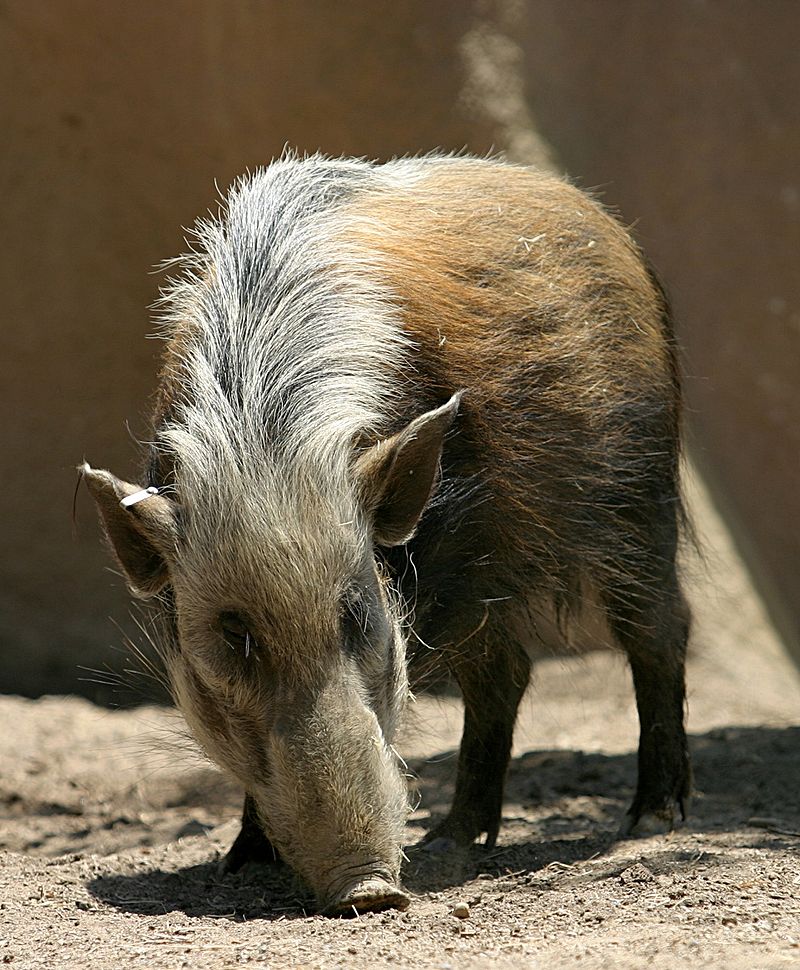
File:Southern_Bush_Pig.jpg · Wikimedia Commons · See Wikimedia Commons
Bushpig
Sign in to saveAlso known as Potamochoerus larvatus
The bushpig (Potamochoerus larvatus) is a member of the pig family that inhabits forests, woodland, riverine vegetation and cultivated areas in East and Southern Africa. Introduced populations are also probably present in Madagascar. There have also been unverified reports of their presence on the Comoro island of Mayotte. Bushpigs are mainly nocturnal. There are several subspecies.
Species
Least ConcernObservations: One captive specimen lived for 16.1 years (Richard Weigl 2005). Maximum longevity is likely underestimated, though. Probably these animals can live for more than 20 years as it happens in the better studied bush pig (*Potamochoerus porcus*).
via IUCN
Wikidata facts
- Instance of
- taxon
- Parent taxon
- Potamochoerus
- Image
- African bush pigs, Mapungubwe National Park (35884241784).jpg
Show 6 more facts
- taxon rank
- species
- IUCN conservation status
- Least Concern
- Commons category
- Potamochoerus larvatus
- taxon name
- Potamochoerus larvatus
- taxon common name
- zakrinkana svinja
- described by source
- Encyclopædia Britannica 11th edition
Sources (1)
via Wikidata · CC0
~13 min read
Encyclopedic overview
8 sectionsContents
- Description
- Distribution
- Taxonomy
- Ecology
- Diet and relation to humans
- Conservation
- References
- External links
The bushpig (Potamochoerus larvatus) is a member of the pig family that inhabits forests, woodland, riverine vegetation and cultivated areas in East and Southern Africa. Introduced populations are also probably present in Madagascar. There have also been unverified reports of their presence on the Comoro island of Mayotte. Bushpigs are mainly nocturnal. There are several subspecies.
The vernacular name 'bushpig' may be used for either Potamochoerus species.
Excerpted from Wikipedia’s “Bushpig” article, available under the CC BY-SA 4.0 licence.