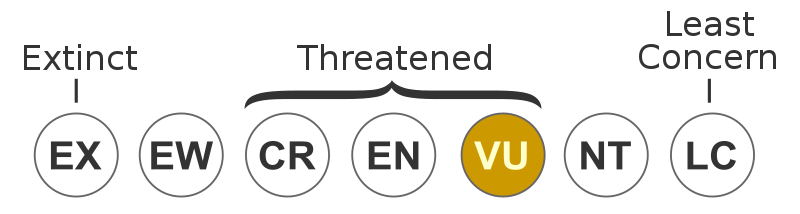
File:Status_iucn3.1_VU.svg · Wikimedia Commons · See Wikimedia Commons
Panthera pardus
Sign in to saveAlso known as panther, leopard
The leopard (Panthera pardus) is one of the five extant cat species in the genus Panthera. It has a pale yellowish to dark golden fur with dark spots grouped in rosettes. Its body is slender and muscular, reaching a length of with a long tail and a shoulder height of . Males typically weigh , and females .
OverviewAI-generated
Panthera pardus, commonly known as the leopard, is a species within the genus Panthera and the family Felidae. Classified as a big cat, it belongs to the kingdom Animalia and order Carnivora. The organism produces a roar and exhibits diurnality. Its habitat includes shrubland and forest environments.
The species is listed as Vulnerable by the IUCN Red List as of 2025 and is included in Appendix I of CITES. Main food sources consist of impala, Eudorcas thomsonii, common warthog, and Papio. Biological records indicate a gestation period of 91 days, a litter size of 5, and a longest observed lifespan of 27.3 years. The bite force quotient is 94.
Occurrences of the species have been recorded in countries including the Democratic Republic of the Congo, United States, Tanzania, Rwanda, and Zimbabwe. Media and records are held by institutions such as RBINS-SCIENTIFIC HERITAGE, UWBM, MSB, UWZM, and MVZ. The taxon is referenced by 2,312 other encyclopedia articles.
Synthesized by Vinony from 40 facts across 6 sources: Wikidata, GBIF, Gbif Occ, IUCN Red List, iDigBio, Vinony graph. Generated from structured data (not the Wikipedia text) and checked against those facts — may still contain errors.
Species
VulnerablePanthera pardus
SPECIES
- KingdomAnimalia
- PhylumChordata
- ClassMammalia
- OrderCarnivora
- FamilyFelidae
本文介紹的是特定物種Panthera pardus。關於其它稱為「豹」的貓科動物,請見「豹 (消歧義)」。 本条目需要更新。(2018年4月24日) 請更新本文以反映近況和新增内容。完成修改時,請移除本模板。 豹(学名:Panthera pardus)是貓科豹屬下的一種動物。广泛分布于非洲和亚洲的各个国家和地区。[2]环境适应能力强,行踪隐秘,总体生存状况好于它的猫科亲戚狮和虎,但是有些豹亚种的现状并不容乐观。[2][3] 不同亚种的豹毛色有浅黄,金黄,黄褐等不同。因为其浑身布满圆形斑纹,所以又名金钱豹[4]或花豹。花豹有時會有黑化現象,即為黑豹,皮膚及毛髮上出現大量黑色素,但還是可隱約見到斑點。[5] 目录 1 特征 2 进化 3 区分 4 生態 4.1 领地 4.2 捕猎 4.3 繁殖 4.4 共存 5 分布 6 亚种 6.1 分类 6.2 欧洲豹 6.3 黑豹 7 疾病 8 杂交 9 现状 9.1 估计数量 9.2 濒危因素 9.3 保护措施 9.4 保护区 10 豹和人类 10.1 臂章 10.2 观赏 10.3 吃人 10.4 文化 11 标誌 12 注释 13 参考资料 14 外部链接 特征 豹的头骨 相比豹屬的其他大型貓科動物獅、虎及美洲豹体型最小,略大于雪豹。[6]肩高约0.9米,体长约0.9至1.9米,体重约30至91公斤。尾长60至110厘米。雄性个体大于雌性。[來源請求] 头圆,颈短,耳背黑色,上有明显白斑,耳尖黄色。四肢强壮前足五趾后足四趾,具有可伸缩角质化灰白色锐爪。[7]头部毛短,鼻部毛极短。鼻端裸露。颈背部黄色稍深上有黑斑点和黑斑环。嘴侧上方各有两排斜形白色胡须。分布在不同地域的豹金黄色毛皮颜色深浅不尽相同,背部黄色最深。腹部毛长色乳白或者淡黄。尾巴背部毛色深黄,靠近基部黑斑成黑环状。尾巴端部呈黑色,上有数道窄白环。尾下乳白色,有黑斑,尾下部顶端为白色。[7]眼睛虹膜成黄色,强光下瞳孔收缩成小孔状,夜视力强,月光下眼内会有磷光闪耀。[7] 头骨光滑而略长,(长190到237毫米)[8]鼻骨较长上凸,额头较宽,中部有凹陷。下颌下沿略成弧形。[7][9] 门齿横列,中央一对门齿较小,往外第二列门齿稍大,最外侧门齿大而尖,犬齿发达锋利。齿式为[7] 3.1.3.1 3.1.2.1 进化 根据线粒体DNA基因序列研究表明,在大约1130万年前猫科中的豹亚科和另一支同属于猫科的猫亚科开始分裂并进行独立的演化。大约866万年前豹亚科里又分裂出云豹属和豹属两支。而豹属中现存的成员就包括虎,狮,美洲豹,雪豹[註 1]和豹这五个物种。之后在这五个“大猫”中最先独立出来的是虎这一支,虽然缺少化石证据支撑,但是通常认为这发生在大约655万年前。[10]豹从这里分化出来的时间约为436万年前,现存最早豹(或者狮)化石是从坦桑尼亚出土的牙齿碎片,经鉴定时
via GBIF · IUCN
Museum specimens
- Specimen records
- 1,276
- With media
- 44
- Family
- Felidae
- Collections
- RBINS-SCIENTIFIC HERITAGE, UWBM, MSB, UWZM, MVZ
- Recorded in
- Dr Congo, United States, Tanzania, Rwanda, Zimbabwe, Chad, Uganda
Bird sounds
- call· Botswana· quality A
- call· Zambia· quality A
- call· Zambia· quality A
- call· South Africa· quality B
via Xeno-canto
Wikidata facts
Show 22 more facts
- Unicode character
- 🐆
- taxon rank
- species
- IUCN conservation status
- Vulnerable
- taxon name
- Panthera pardus
- topic's main category
- Category:Leopards
- Commons gallery
- Panthera pardus
- taxon common name
- leopard
- gestation period
- 91
- bite force quotient
- 94
- produced sound
- roar
- described by source
- Encyclopædia Britannica 11th edition
- litter size
- 5
- longest observed lifespan
- 27.3
- Commons category
- Panthera pardus
- CITES Appendix
- Appendix I of CITES
- sequenced genome URL
- www.ensembl.org/Panthera_pardus
- habitat
- forest
- diel cycle
- diurnality
- main food source
- Eudorcas thomsonii
- on focus list of Wikimedia project
- Wikipedia:Vital articles/Level/4
- taxon range
- Nanling Mountains
- short name
- P. pardus
Sources (6)
via Wikidata · CC0
~31 min read
Encyclopedic overview
23 sectionsContents
- Etymology
- Taxonomy
- Living subspecies
- Evolution
- Hybrids
- Characteristics
- Size
- Distribution and habitat
- Behaviour and ecology
- Social spacing
- Hunting and diet
- Enemies and competitors
- Reproduction and life cycle
- Conservation
- Threats
- Human relations
- Cultural significance
- Attacks on people
- In captivity
- See also
- References
- Further reading
- External links
The leopard (Panthera pardus) is one of the five extant cat species in the genus Panthera. It has a pale yellowish to dark golden fur with dark spots grouped in rosettes. Its body is slender and muscular, reaching a length of with a long tail and a shoulder height of . Males typically weigh , and females .
The leopard was first described in 1758, and several subspecies were proposed in the 19th and 20th centuries. Today, eight subspecies are recognised in its wide range in Africa and Asia. It initially evolved in Africa during the Early Pleistocene, before migrating into Eurasia around the Early–Middle Pleistocene transition. Leopards were formerly present across Europe, but became extinct in the region at around the end of the Late Pleistocene-early Holocene.
Excerpted from Wikipedia’s “Panthera pardus” article, available under the CC BY-SA 4.0 licence.
Gallery (49)
Available in 177 languages
- Español
- Français
- Deutsch
- 中文
- 日本語
- Русский
- Português
- Italiano
- العربية
- हिन्दी
- Afrikaans
- Albanian
- Amharic
- Aragonese
- Aramaic
- Armenian
- Assamese
- Asturian
Show 158 more
- azb
- Azerbaijani
- Bahasa Indonesia
- Balinese
- Bambara
- Bangla
- Basque
- be_x_old
- Belarusian
- Bikol
- Bosnian
- Breton
- Bulgarian
- Buriat
- Burmese
- Catalan
- cdo
- Cebuano
- Central Kurdish
- Cherokee
- Church Slavic
- Chuvash
- Cornish
- Corsican
- Croatian
- Czech
- dag
- Danish
- Dinka
- Egyptian Arabic
- eml
- Esperanto
- Estonian
- Ewe
- Faroese
- Fijian
- Filipino
- Finnish
- Fon
- Friulian
- Fula
- Gagauz
- Galician
- Georgian
- Greek
- Guarani
- Gujarati
- Haitian Creole
- Hakka Chinese
- Hausa
- Hebrew
- Hungarian
- hyw
- Icelandic
- Ido
- Igbo
- Ingush
- Interlingua
- Irish
- Javanese
- Jju
- Kabardian
- Kabyle
- Kannada
- Kashmiri
- Kazakh
- Kongo
- Kotava
- Kurdish
- Kyrgyz
- Latgalian
- Latin
- Latvian
- lbe
- Lingala
- Lingua Franca Nova
- Lithuanian
- Macedonian
- Maithili
- Malagasy
- Malay
- Malayalam
- Manipuri
- Māori
- Marathi
- Mazanderani
- Minangkabau
- Mingrelian
- Mongolian
- Moroccan Arabic
- Navajo
- Nederlands
- Nepali
- Nigerian Pidgin
- Northern Frisian
- Northern Sotho
- Norwegian
- Norwegian Nynorsk
- Occitan
- Odia
- Old English
- Oromo
- Ossetic
- Pashto
- Polski
- Punjabi
- Quechua
- Romanian
- Romansh
- Sanskrit
- Scots
- Scottish Gaelic
- Serbian
- Serbian (Latin)
- Shona
- Sicilian
- simple
- Sinhala
- Slovak
- Slovenian
- Somali
- Southern Sotho
- Standard Moroccan Tamazight
- Sundanese
- Svenska
- Swahili
- Tajik
- Tamil
- Tatar
- Tibetan
- Tiếng Việt
- Tok Pisin
- Tulu
- Tumbuka
- Türkçe
- Turkmen
- Tyap
- Ukrainian
- Urdu
- Uyghur
- Uzbek
- Venda
- Venetian
- Veps
- Waray
- Welsh
- Western Frisian
- Western Panjabi
- Wu Chinese
- Yiddish
- Yoruba
- Zaza
- zh_min_nan
- zh_yue
- Zhuang
- فارسی
- ไทย
- 한국어
via Wikidata sitelinks · CC0