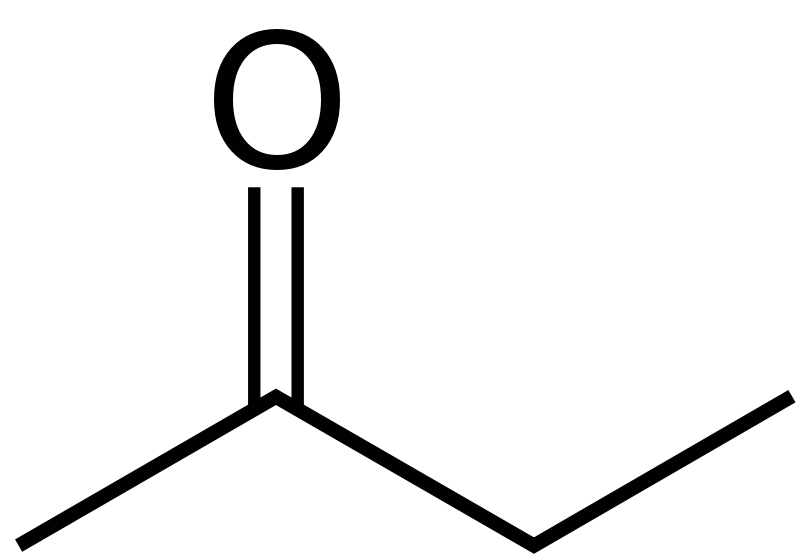
File:Butanone-skeletal-structure.svg · Wikimedia Commons · See Wikimedia Commons
butanone
Sign in to saveAlso known as MEK, methylethyl ketone, oxobutane, 3-butanone, methylacetone, C2H5COCH3, methyl(ethyl) ketone, ethyl(methyl) ketone
Butanone, also known as methyl ethyl ketone (MEK) or ethyl methyl ketone, is an organic compound with the formula CH3C(O)CH2CH3. This colorless liquid ketone has a sharp, sweet odor reminiscent of acetone. It is produced industrially on a large scale, but occurs in nature only in trace amounts. It is partially soluble in water, and is commonly used as an industrial solvent. It is an isomer of another solvent, tetrahydrofuran.
Chemical data
- Formula
- C4H8O
- Molecular weight
- 72.11 g/mol
- IUPAC name
- butan-2-one
- SMILES
- CCC(=O)C
- InChIKey
- ZWEHNKRNPOVVGH-UHFFFAOYSA-N
- XLogP
- 0.3
- Polar surface area
- 17.1 Ų
- H-bond donors
- 0
- H-bond acceptors
- 1
- Formal charge
- 0
via PubChem
Drug data · ChEMBL
- Molecule type
- Small molecule
via ChEMBL · EBI
Wikidata facts
- Has part
- carbon
- Mass
- 72.058
Show 18 more facts
- Commons category
- Butanone
- density
- 0.81
- canonical SMILES
- CCC(=O)C
- chemical formula
- C₄H₈O
- vapor pressure
- 78
- NIOSH Pocket Guide ID
- 0069
- flash point
- 16
- immediately dangerous to life or health
- 8850
- melting point
- -86.67
- boiling point
- 79.59
- found in taxon
- Fragaria
- solubility
- 28
- lower flammable limit
- 1.4
- upper flammable limit
- 11.4
- ionization energy
- 9.51
- time-weighted average exposure limit
- 590
- short-term exposure limit
- 885
- electric dipole moment
- 2.78
via Wikidata · CC0
~6 min read
Encyclopedic overview
12 sectionsContents
- Production
- Applications
- Solvent
- Other uses
- Safety
- Flammability
- Health effects
- Regulation
- See also
- Notes
- References
- External links
Butanone, also known as methyl ethyl ketone (MEK) or ethyl methyl ketone, is an organic compound with the formula CH3C(O)CH2CH3. This colorless liquid ketone has a sharp, sweet odor reminiscent of acetone. It is produced industrially on a large scale, but occurs in nature only in trace amounts. It is partially soluble in water, and is commonly used as an industrial solvent. It is an isomer of another solvent, tetrahydrofuran.
==Production== Butanone may be produced by oxidation of 2-butanol. The dehydrogenation of 2-butanol is catalysed by copper, zinc, or bronze: CH3CH(OH)CH2CH3 → CH3C(O)CH2CH3 + H2
Excerpted from Wikipedia’s “butanone” article, available under the CC BY-SA 4.0 licence.