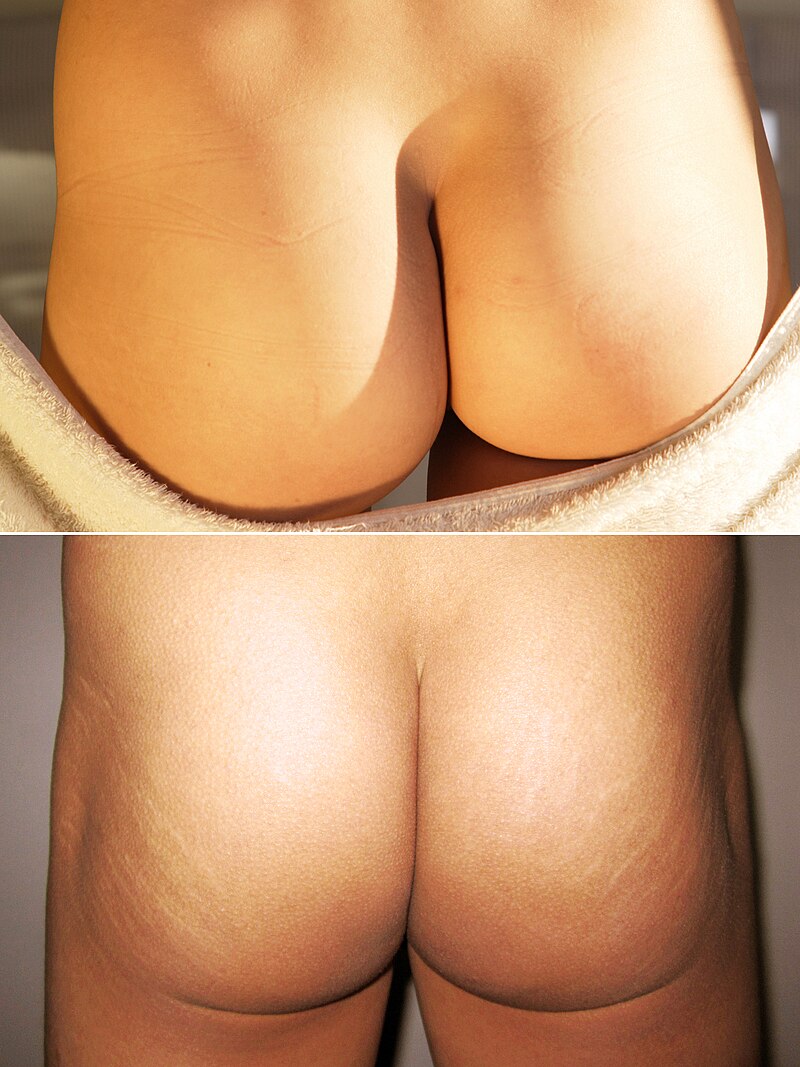
File:Human_buttocks.jpg · Wikimedia Commons · See Wikimedia Commons
buttocks
Sign in to saveAlso known as butt, booty, ass, bum, bottom, rear end, posteriors, buttcheeks
The buttocks (: buttock) are two rounded portions of the exterior anatomy of humans, located on the posterior of the pelvic region. The buttocks are located between the lower back and the perineum. They are composed of a layer of exterior skin and underlying subcutaneous fat superimposed on a left and right gluteus maximus and gluteus medius muscles. The two gluteus maximus muscles are the largest muscles in the human body. They are responsible for movements such as straightening the body into the upright (standing) posture when it is bent at the waist; maintaining the body in the upright post
The buttocks are two rounded portions of the exterior anatomy located on the posterior of the pelvic region between the lower back and the perineum, composed of skin, subcutaneous fat, and underlying gluteus maximus and gluteus medius muscles. They are important because the gluteus maximus muscles—the largest muscles in the human body—are responsible for key movements like straightening the body into an upright standing posture and maintaining that upright position.
AI-generated from the Wikipedia summary — may contain errors.
Key facts
- Anatomy.Name
- Buttocks
- Anatomy.Latin
- clunis
- Anatomy.Image
- Human buttocks.jpg
- Anatomy.Caption
- Buttocks of a human female (upper) and a human male (lower)
- Anatomy.Artery
- Superior gluteal artery, inferior gluteal artery
- Anatomy.Nerve
- Superior gluteal nerve, inferior gluteal nerve, superior cluneal nerves, medial cluneal nerves, inferior cluneal nerves
via Wikipedia infobox
Research
13,089 papers- Defining the Ideal Male Buttocks.Plastic and reconstructive surgery · 2023Kollu T, Giutashvili T, Bhat D et al.DOI: 10.1097/PRS.0000000000010378
- Deep Gluteal Syndrome: A Pain in the Buttock.ReviewCurrent sports medicine reports · 2021Hu YE, Ho GWK, Tortland PDDOI: 10.1249/JSR.0000000000000848
- Buttocks Volume Augmentation with Submuscular Implants: 100 Cases Series.Plastic and reconstructive surgery · 2022Petit F, Colli M, Badiali V et al.DOI: 10.1097/PRS.0000000000008885
- Eye-Tracking Insights into the Perception of Buttocks.Aesthetic plastic surgery · 2024Zeng R, Glaue E, Moellhoff N et al.DOI: 10.1007/s00266-024-04257-x
- Superior and Middle Cluneal Nerve Entrapment: A Cause of Low Back and Radicular Pain.ReviewPain physician · 2022Karl HW, Helm S, Trescot AM
- Submuscular Gluteal Augmentation.ReviewClinics in plastic surgery · 2018Hidalgo JEDOI: 10.1016/j.cps.2017.12.003
- [Skin Metastasis to the Buttocks of MSI-High Sigmoid Colon Cancer-A Case Report].Gan to kagaku ryoho. Cancer & chemotherapy · 2025Asako K, Asada Y, Fujikura M et al.
- Aesthetic Preferences for Beautiful Buttocks in Female: A Study on the Chinese Population.Aesthetic plastic surgery · 2024Cao S, Zhu M, Mu LDOI: 10.1007/s00266-024-04158-z
via PubMed
Wikidata facts
- Image
- 1ssfele.png
Show 6 more facts
- Commons category
- Buttocks
- topic's main category
- Category:Buttocks
- arterial supply
- inferior gluteal artery
- Commons gallery
- Buttocks
- innervates
- inferior gluteal nerve
- studied by
- rumpology
via Wikidata · CC0
~5 min read
Encyclopedic overview
7 sectionsContents
- Structure
- Names
- Gallery of art
- Gallery
- See also
- References
- External links
The buttocks (: buttock) are two rounded portions of the exterior anatomy of humans, located on the posterior of the pelvic region. The buttocks are located between the lower back and the perineum. They are composed of a layer of exterior skin and underlying subcutaneous fat superimposed on a left and right gluteus maximus and gluteus medius muscles. The two gluteus maximus muscles are the largest muscles in the human body. They are responsible for movements such as straightening the body into the upright (standing) posture when it is bent at the waist; maintaining the body in the upright posture by keeping the hip joints extended; and propelling the body forward via further leg (hip) extension when walking or running.
In many cultures, the buttocks play a role in sexual attraction. Many cultures have also used the buttocks as a primary target for corporal punishment, as the buttocks' layer of subcutaneous fat offers protection against injury while still allowing for the infliction of pain.
Excerpted from Wikipedia’s “buttocks” article, available under the CC BY-SA 4.0 licence.
Gallery (14)
Available in 124 languages
- Español
- Français
- Deutsch
- 中文
- 日本語
- Русский
- Português
- Italiano
- العربية
- हिन्दी
- Albanian
- Albanian
- Aragonese
- Aramaic
- Armenian
- Aymara
- azb
- Azerbaijani
Show 105 more
- Bahasa Indonesia
- Bangla
- Banjar
- Basque
- bat_smg
- Bavarian
- be_x_old
- Belarusian
- Betawi
- Bikol
- Bosnian
- Breton
- Bulgarian
- Catalan
- cdo
- Cebuano
- Chechen
- Chuvash
- Colognian
- Croatian
- Czech
- Danish
- Egyptian Arabic
- eml
- Erzya
- Esperanto
- Estonian
- Fijian
- Filipino
- Finnish
- Galician
- Gan Chinese
- Greek
- Guarani
- Haitian Creole
- Hakka Chinese
- Hebrew
- Iban
- Icelandic
- Ido
- Javanese
- Kannada
- Kashmiri
- kge
- Latin
- Latvian
- Lingua Franca Nova
- Lithuanian
- Lombard
- Low German
- Luxembourgish
- Malagasy
- Malay
- Malayalam
- Marathi
- Mazanderani
- Minangkabau
- Moroccan Arabic
- Nederlands
- Nepali
- Newari
- Nias
- Norwegian
- Norwegian Nynorsk
- Pangasinan
- Pennsylvania German
- Polski
- Quechua
- Romanian
- Rundi
- Scots
- Serbian
- Shona
- Sicilian
- simple
- Sinhala
- Slovenian
- Somali
- Standard Moroccan Tamazight
- Svenska
- Swahili
- szy
- Tachelhit
- Tamil
- Telugu
- Tiếng Việt
- Türkçe
- Tyap
- Ukrainian
- Urdu
- Uyghur
- Uzbek
- Walloon
- Welsh
- Western Frisian
- Western Panjabi
- Wu Chinese
- Xhosa
- Yiddish
- zh_min_nan
- zh_yue
- Zhuang
- Zulu
- فارسی
- 한국어
via Wikidata sitelinks · CC0