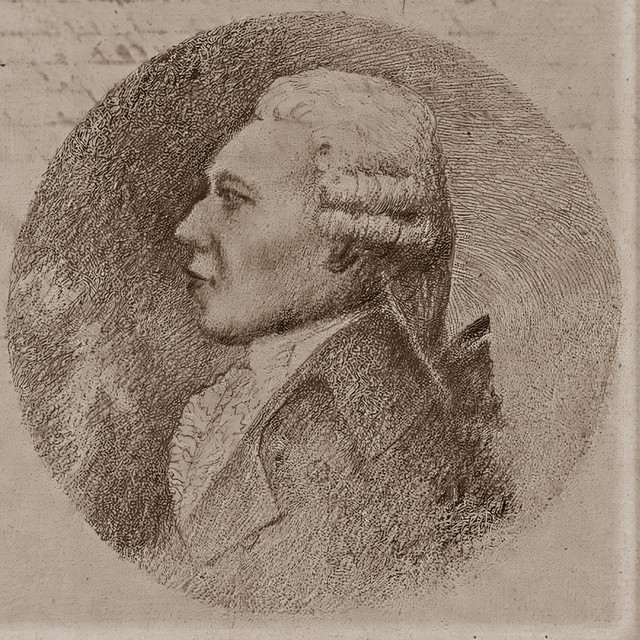
Carl Stamitz · Spotify · Courtesy of Spotify
Carl Stamitz
Sign in to saveGerman composer of partial Czech ancestry
OverviewAI-generated
Carl Stamitz was a composer, conductor, violinist and musician born on 7 May 1745 in Mannheim and died on 9 November 1801 in Jena. His father, Johann Stamitz, was also among his teachers, alongside Ignaz Holzbauer, Franz Xaver Richter and Christian Cannabich; Stamitz in turn taught Anton Stamitz.
He was a member of the Mannheim school and worked in classical music, playing the violin. Eleven of his works are catalogued, and he held German citizenship, writing and speaking German.
Synthesized by Vinony from 24 facts across 4 sources: Wikidata, MusicBrainz, Last.fm, Europeana Sparql. Generated from structured data (not the Wikipedia text) and checked against those facts — may still contain errors.
Music · MusicBrainz
- Type
- Person
- Gender
- Male
- Country
- Germany
- Active from
- 1745
- Active to
- 1801
Discography
- Clarinet Concerto / Flute Concerto / Bassoon Concerto1966
- Stamitz: Flute Concerto in G major / Benda: Flute Concerto in E minor1986
- Wind Symphonies1990
- Carl Stamitz: Concerto for Clarinet no. 3 B-flat major / Sinfonia in C major / Concerto for Two Flutes and Orchestra G major / Johann Stamitz: Sinfonia B-flat major1992
- Clarinet Concertos, Vol. 11992
- Flute Concertos1992
- Cello Concertos nos. 1-31993
- Klarinettenkonzerte, Vol. 21993
- Clarinet Concertos Vol. II1995
- Concertos1995
via MusicBrainz · CC0
Listeners · Last.fm
- Listeners
- 45,458
- Total plays
- 209,516
Tags
Karl Stamitz (May 7, 1745 - November 9, 1801) was a Bohemian composer, violin, viola and viola d'amore virtuoso. He was the most prominent of the second generation of the so-called Mannheim school. Stamitz was born in Mannheim and was first taught music by Johann Stamitz, his father and founder of the Mannheim school. He played in the orchestra at Mannheim from 1762 and in 1770 moved to Paris where he became known as a violinist. He later lived in a number of places, including Prague and Londo
Wikidata facts
- Instance of
- human
- Given name
- Karel
- Gender
- male
- Citizenship
- Germany
- Place of birth
- Mannheim
- Place of death
- Jena
- Father
- Johann Stamitz
- Occupation
- violinist
- Languages spoken
- German
- Student of
- Christian Cannabich
- Field of work
- music
- Genre
- classical music
- Instrument
- violin
- Image
- Karl Stamitz.jpg
Show 5 more facts
- date of birth
- 1745-05-07
- date of death
- 1801-11-09
- Commons category
- Carl Stamitz
- student
- Anton Stamitz
- member of
- Mannheim school
Sources (2)
via Wikidata · CC0
Works in European collections
11 objects attributed to Carl Stamitz, held across European museums, libraries & archives · via Europeana
Six quartettos for two violins, a tenor & violoncello obligato, op. 4 [Música notada]
Concierto de clarinete, dos violines, dos flautas, dos trompas, viola i bajo
Duo à ún violon et alto viola [Música notada]
Six duos pour deux violons [Música notada]
Messa a quattro voci con istrumenti. Partit. e parti
Untitled
Untitled
Untitled
Untitled
Untitled
Untitled
~11 min read
Encyclopedic overview
Carl Stamitz Carl Philipp Stamitz (Czech: Karel Stamic; born in Mannheim and baptized 8 May 1745 – 9 November 1801), was a German composer of partial Czech ancestry of the Classical era. He was the most prominent representative of the second generation of the Mannheim School.
He was the eldest son of Johann Stamitz, a violinist and composer of the early classical period. He received lessons from his father and Christian Cannabich, his father's successor as leader of the Mannheim orchestra. As a youth, Stamitz was employed as a violinist in the court orchestra at Mannheim. In 1770, he began travelling as a virtuoso, accepting short-term engagements, but never managing to gain a permanent position. He visited a number of European cities, living for a time in Strasbourg and London. In 1794, he gave up travelling and moved with his family to Jena in central Germany. His circumstances deteriorated and he descended into debt and poverty, dying in 1801. Many tracts on alchemy were found in his library after his death.
Excerpted from Wikipedia’s “Carl Stamitz” article, available under the CC BY-SA 4.0 licence.