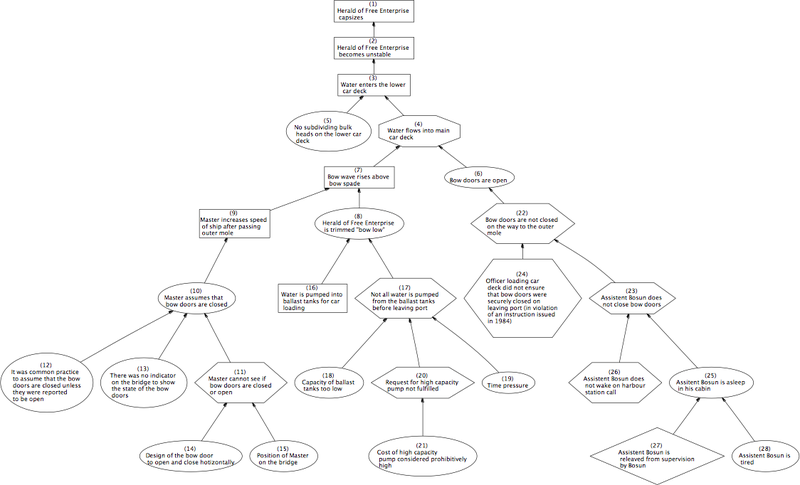
File:Herald_of_Free_Enterprise_WBG.png · Wikimedia Commons · See Wikimedia Commons
causalidad
Sign in to saveAlso known as causation, cause and effect, causal mechanism
relación que se establece entre causa y efecto
Causality is the relationship where one thing directly influences and helps bring about another thing—for example, how a cause produces an effect and bears at least some responsibility for it. Understanding causality matters because it helps us identify the reasons behind events and processes, allowing us to make sense of how things happen in the world.
AI-generated from the Wikipedia summary — may contain errors.
Research
11,693,199 papers- Mendelian Randomization as an Approach to Assess Causality Using Observational Data.ReviewJournal of the American Society of Nephrology : JASN · 2016Sekula P, Del Greco M F, Pattaro C et al.DOI: 10.1681/ASN.2016010098
- Focus on Causality in ESC/iPSC-Based Modeling of Psychiatric Disorders.ReviewCells · 2020Hoffmann A, Ziller M, Spengler DDOI: 10.3390/cells9020366
- [Causality: risk factors and interventions].ReviewNederlands tijdschrift voor geneeskunde · 2013Dekkers OM, Vandenbroucke JP
- Prediction or causality? A scoping review of their conflation within current observational research.European journal of epidemiology · 2021Ramspek CL, Steyerberg EW, Riley RD et al.DOI: 10.1007/s10654-021-00794-w
- Causal relationship between gut microbiota and cancers: a two-sample Mendelian randomisation study.BMC medicine · 2023Long Y, Tang L, Zhou Y et al.DOI: 10.1186/s12916-023-02761-6
- The ASCOD phenotyping of ischemic stroke (Updated ASCO Phenotyping).Cerebrovascular diseases (Basel, Switzerland) · 2013Amarenco P, Bogousslavsky J, Caplan LR et al.DOI: 10.1159/000352050
- How and why to focus on causality in teaching human physiology.Advances in physiology education · 2025Silldorff EP, Robinson GDDOI: 10.1152/advan.00186.2025
- How to establish causality in epilepsy surgery.ReviewBrain & development · 2013Asano E, Brown EC, Juhász CDOI: 10.1016/j.braindev.2013.04.004
via PubMed
Wikidata facts
Show 7 more facts
- opposite of
- prevention
- studied by
- Buddhist logico-epistemology
- Commons category
- Causality
- topic's main category
- Category:Causality
- described by source
- Encyclopædia Britannica 11th edition
- on focus list of Wikimedia project
- Wikipedia:Vital articles/Level/4
- Stack Exchange tag
- stats.stackexchange.com/tags/causality
Sources (2)
via Wikidata · CC0
Article · Español
La causalidad es la "relación necesaria existente entre causa y efecto. Se puede hablar de esa relación entre acontecimientos, procesos, regularidad de los fenómenos y la producción de algo". No existe una única definición comúnmente aceptada del término "causa". En su acepción más amplia, se dice que algo es causa de un efecto, cuando el último depende del primero tanto lógicamente, como cronológicamente; o, en otras palabras, la causa es aquello que hace que el efecto sea lo que es. Esto se puede dar de muchos modos diversos y, por ello, no es extraño que a un efecto correspondan multitud de causas. Dos condiciones necesarias pero no suficientes para que A sea causa de B son: * Que A preceda a B en el tiempo. * Que A y B estén relativamente próximos en el espacio y en el tiempo.
Abstract from DBpedia / Wikipedia · CC BY-SA
Gallery (9)
Available in 63 languages
- Español
- Français
- Deutsch
- 中文
- 日本語
- Русский
- Português
- Italiano
- العربية
- हिन्दी
- Afrikaans
- Albanian
- Armenian
- Azerbaijani
- Bahasa Indonesia
- Bangla
- Basque
- Bosnian
Show 44 more
- Bulgarian
- Catalan
- Central Kurdish
- Chuvash
- Croatian
- Czech
- Danish
- Esperanto
- Estonian
- Finnish
- Galician
- Greek
- Hebrew
- Hungarian
- Ido
- Latin
- Latvian
- Lithuanian
- Macedonian
- Malay
- Mazanderani
- Nederlands
- Norwegian
- Norwegian Nynorsk
- Piedmontese
- Polski
- Punjabi
- Romanian
- Serbian
- Serbian (Latin)
- simple
- Slovak
- Svenska
- Tamil
- Tiếng Việt
- Türkçe
- Ukrainian
- Urdu
- Welsh
- Wu Chinese
- zh_yue
- فارسی
- ไทย
- 한국어
via Wikidata sitelinks · CC0