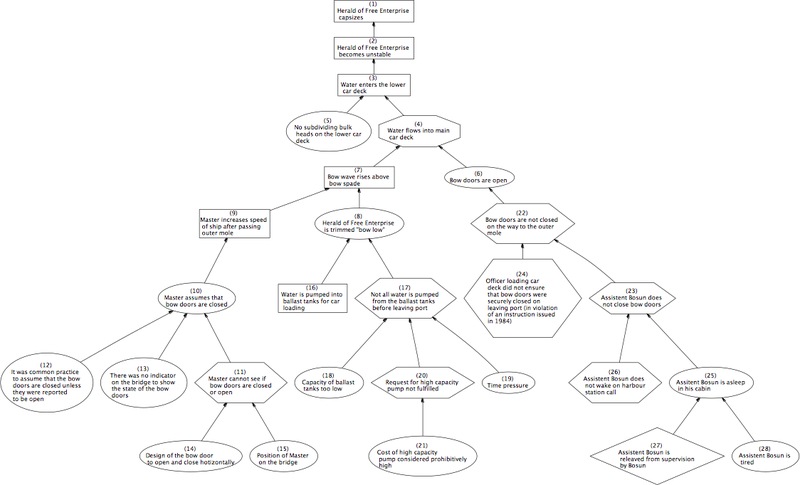
File:Herald_of_Free_Enterprise_WBG.png · Wikimedia Commons · See Wikimedia Commons
Causality is the relationship where one thing directly influences and helps bring about another thing—for example, how a cause produces an effect and bears at least some responsibility for it. Understanding causality matters because it helps us identify the reasons behind events and processes, allowing us to make sense of how things happen in the world.
AI-generated from the Wikipedia summary — may contain errors.
Research
11,693,199 papers- Mendelian Randomization as an Approach to Assess Causality Using Observational Data.ReviewJournal of the American Society of Nephrology : JASN · 2016Sekula P, Del Greco M F, Pattaro C et al.DOI: 10.1681/ASN.2016010098
- Focus on Causality in ESC/iPSC-Based Modeling of Psychiatric Disorders.ReviewCells · 2020Hoffmann A, Ziller M, Spengler DDOI: 10.3390/cells9020366
- [Causality: risk factors and interventions].ReviewNederlands tijdschrift voor geneeskunde · 2013Dekkers OM, Vandenbroucke JP
- Prediction or causality? A scoping review of their conflation within current observational research.European journal of epidemiology · 2021Ramspek CL, Steyerberg EW, Riley RD et al.DOI: 10.1007/s10654-021-00794-w
- Causal relationship between gut microbiota and cancers: a two-sample Mendelian randomisation study.BMC medicine · 2023Long Y, Tang L, Zhou Y et al.DOI: 10.1186/s12916-023-02761-6
- The ASCOD phenotyping of ischemic stroke (Updated ASCO Phenotyping).Cerebrovascular diseases (Basel, Switzerland) · 2013Amarenco P, Bogousslavsky J, Caplan LR et al.DOI: 10.1159/000352050
- How and why to focus on causality in teaching human physiology.Advances in physiology education · 2025Silldorff EP, Robinson GDDOI: 10.1152/advan.00186.2025
- How to establish causality in epilepsy surgery.ReviewBrain & development · 2013Asano E, Brown EC, Juhász CDOI: 10.1016/j.braindev.2013.04.004
via PubMed
Wikidata facts
Show 7 more facts
- opposite of
- prevention
- studied by
- Buddhist logico-epistemology
- Commons category
- Causality
- topic's main category
- Category:Causality
- described by source
- Encyclopædia Britannica 11th edition
- on focus list of Wikimedia project
- Wikipedia:Vital articles/Level/4
- Stack Exchange tag
- stats.stackexchange.com/tags/causality
Sources (2)
via Wikidata · CC0
Article · 中文
因果关系(英語:causality 或 causation),又称为 因果性,简称 因果,是一個事件(即“因”)和第二個事件(即“果”)之間的作用關係,其中後一事件被認為是前一事件的結果。一般來說,一個事件是很多原因綜合產生的結果,而且原因都發生在較早時間點,而該事件又可以成為其他事件的原因。 一般來說,因果還可以指一系列因素(因)和一個现象(果)之間的關係。對某个结果產生影響的任何事件都是该结果的一个因素。直接因素是直接影响结果的因素,也即无需任何介入因素(介入因素有时又称中介因素)。从这个角度来讲,因果之间的关系也可以称为因果关联(causal nexus)。 原因和结果通常和变化或事件有关,还包括客体、过程、性质、变量、事实、状况;概括因果关系争议很多。对因果关系的哲学研究历史悠久,佛教和西方哲學家如亞里士多德在2000多年前就已經提出因果,该问题仍是现代哲学的重要课题。
Abstract from DBpedia / Wikipedia · CC BY-SA
Gallery (9)
Available in 63 languages
- Español
- Français
- Deutsch
- 中文
- 日本語
- Русский
- Português
- Italiano
- العربية
- हिन्दी
- Afrikaans
- Albanian
- Armenian
- Azerbaijani
- Bahasa Indonesia
- Bangla
- Basque
- Bosnian
Show 44 more
- Bulgarian
- Catalan
- Central Kurdish
- Chuvash
- Croatian
- Czech
- Danish
- Esperanto
- Estonian
- Finnish
- Galician
- Greek
- Hebrew
- Hungarian
- Ido
- Latin
- Latvian
- Lithuanian
- Macedonian
- Malay
- Mazanderani
- Nederlands
- Norwegian
- Norwegian Nynorsk
- Piedmontese
- Polski
- Punjabi
- Romanian
- Serbian
- Serbian (Latin)
- simple
- Slovak
- Svenska
- Tamil
- Tiếng Việt
- Türkçe
- Ukrainian
- Urdu
- Welsh
- Wu Chinese
- zh_yue
- فارسی
- ไทย
- 한국어
via Wikidata sitelinks · CC0