Encyclopedia of Life · EOL (see source)
Species
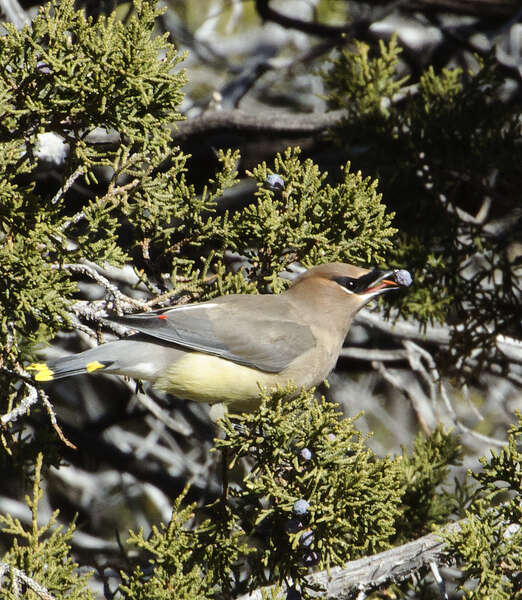
Least ConcernVerbreitung des Zedernseidenschwanzes: gelb: Brutgebiet grün: Vorkommen als Standvogel blau: Überwinterungsgebiet Der Zedernseidenschwanz (Bombycilla cedrorum) ist ein Singvogel aus der Familie der Seidenschwänze. Inhaltsverzeichnis 1 Merkmale 2 Vorkommen 3 Nahrung 4 Fortpflanzung 5 Weblinks Merkmale Der 15 cm lange Zedernseidenschwanz ist ein mittelgroßer Vogel mit schlichtem graubraunem Gefieder. Wie der altweltliche (paläarktische) Seidenschwanz besitzt er eine aufrichtbare Federhaube, eine schwarze Kehle, eine schwarze Augenbinde mit weißen Rändern und eine gelbe Schwanzspitze. Anders als beim Seidenschwanz sind beim Zedernseidenschwanz der Bauch gelb und die Unterschwanzdecken weiß. Vorkommen Der Zedernseidenschwanz brütet in offenen Waldgebieten in Nordamerika, vor allem im südlichen Kanada und den nördlichen USA. Er lebt in lichten Wäldern, Farmen, Parks und Gärten am Stadtrand. Wenn im Winter die Nahrung knapp wird, wandern die Vögel als Invasionsvögel in den Süden. In Großbritannien wurde der Vogel zweimal gesichtet. Nahrung Zedernseidenschwänze ernähren sich von Früchten und Beeren, inklusive der Beeren von Eiben. Allerdings ist der Vogel anfällig für Alkoholvergiftung un
via IUCN
Wikidata facts
- Instance of
- taxon
- Parent taxon
- Bombycilla
- Image
- Cedar Waxwing August 14 2012 Newfoundland PA.jpg
Show 9 more facts
- taxon rank
- species
- IUCN conservation status
- Least Concern
- Commons category
- Bombycilla cedrorum
- taxon name
- Bombycilla cedrorum
- Commons gallery
- Bombycilla cedrorum
- taxon common name
- tagarela-americano
- diel cycle
- diurnality
- short name
- B. cedrorum
- taxon range
- Kansas
via Wikidata · CC0
~11 min read
Encyclopedic overview
The cedar waxwing (Bombycilla cedrorum) is a member of the family Bombycillidae or waxwing family of passerine birds. It is a medium-sized bird that is mainly brown, gray, and yellow. Some of the wing feathers have red tips, which resemble sealing wax, giving the bird its common name. It is a native of North and Central America, breeding in open wooded areas in southern Canada and wintering in the southern half of the United States, Central America, and the far northwest of South America. Its diet includes cedar cones, fruit, holly berries, and insects. The cedar waxwing is listed as least concern on the IUCN Red List.
Taxonomy
Excerpted from Wikipedia’s “Cedar Waxwing” article, available under the CC BY-SA 4.0 licence.