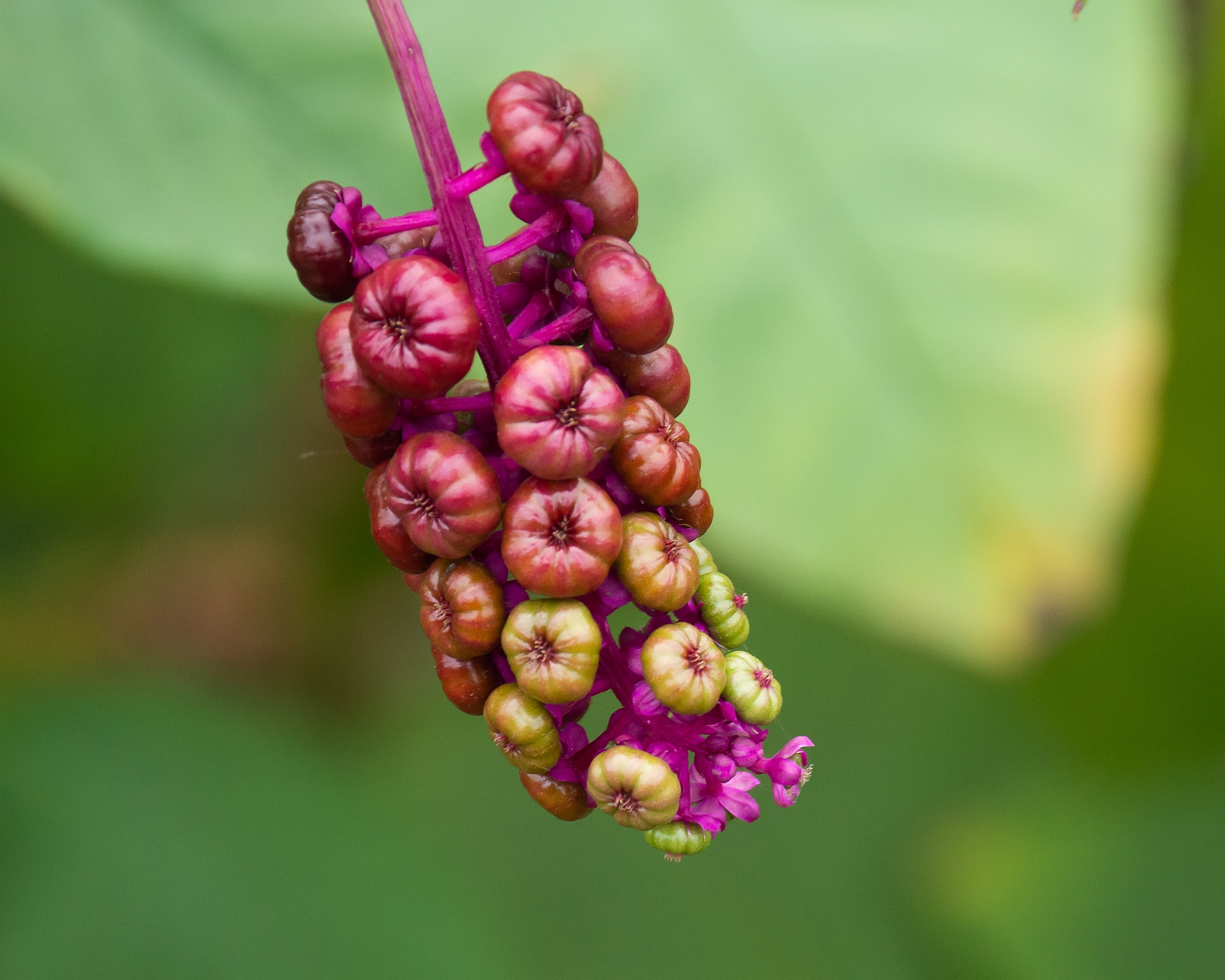
Image from GBIF · CC BY-NC
OverviewAI-generated
Phytolacca americana, commonly known as American pokeweed or American Nightshade, is a species of perennial plant in the family Phytolaccaceae. It belongs to the order Caryophyllales within the class Magnoliopsida and phylum Tracheophyta. The species is classified under the genus Phytolacca and is described in the Encyclopædia Britannica 11th edition.
The taxon range includes Shanghai, Beijing, Tianjin, and China, where it is noted as invasive to Shanghai. The plant produces berries and is utilized as a medicinal plant. Records of the species are held by institutions such as CICY, INECOL, IEA-UAT, TEX, and CIBYC-UAEM, with occurrences documented in Mexico.
Synthesized by Vinony from 43 facts across 8 sources: Wikidata, GBIF, PubMed, iNaturalist, Gbif Occ, Plants of the World, iDigBio, Vinony graph. Generated from structured data (not the Wikipedia text) and checked against those facts — may still contain errors.
Species
American pokeweed
SPECIES
- KingdomPlantae
- PhylumTracheophyta
- ClassMagnoliopsida
- OrderCaryophyllales
- FamilyPhytolaccaceae
Common Name: schebti
via GBIF · Kew POWO
Museum specimens
- Specimen records
- 9,194
- With media
- 7,388
- Family
- Phytolaccaceae
- Collections
- CICY, INECOL, IEA-UAT, TEX, CIBYC-UAEM
- Recorded in
- Mexico
Research
405 papers- Human exposures to Phytolacca americana in Kentucky.Toxicon : official journal of the International Society on Toxinology · 2022
- Seed Germination of Invasive Phytolacca americana and Potentially Invasive P. acinosa.Plants (Basel, Switzerland) · 2023
- Phytolacca americana extract as a quality-enhancing factor for biodegradable double-layered films based on furcellaran and gelatin - Property assessment.International journal of biological macromolecules · 2024
- Aromatic O-glycosylation.Carbohydrate research · 2006
- An Ambidextrous Polyphenol Glycosyltransferase PaGT2 from Phytolacca americana.Biochemistry · 2020
via PubMed
Wikidata facts
- Instance of
- taxon
- Subclass of
- perennial plant
- Parent taxon
- Phytolacca
- Image
- Phytolacca americana - Museo Tazzetti Herbarium 229-2024.tif
- Has use
- medicinal plant
Show 13 more facts
- taxon rank
- species
- taxon name
- Phytolacca americana
- Commons category
- Phytolacca americana
- taxon common name
- navadna barvilnica
- Commons gallery
- Phytolacca americana
- has fruit type
- berry
- described by source
- Encyclopædia Britannica 11th edition
- invasive to
- Shanghai
- taxon range
- Guangdong
- short name
- P. americana
- taxon author citation
- L.
- PAEnflowered taxon URL
- www.paenflowered.org/apgii/caryophyllales/phytolaccaceae/phytolacca/phytolacca-americana
via Wikidata · CC0
~16 min read
Encyclopedic overview
Phytolacca americana, also known as American pokeweed, pokeweed, poke sallet, pokeberry, dragonberries, pigeonberry weed, and inkberry, is a poisonous, herbaceous perennial plant in the pokeweed family Phytolaccaceae. This pokeweed grows 1 to 3 metres (4 to 10 ft). It has simple leaves on green to red or purplish stems and a large white taproot. The flowers are green to white, followed by berries which ripen through red to purple to almost black which are a food source for songbirds such as gray catbird, northern mockingbird, northern cardinal, and brown thrasher, as well as other birds and some small non-avian animals (i.e., for species that are unaffected by its mammalian toxins).
American pokeweed (lat. Phytolacca americana) Pokeweed is native to eastern North America, the Midwest, and the South, with more scattered populations in the far West where it was introduced. It is also naturalized in parts of Europe and Asia. It is considered a pest species by farmers. Pokeweed is poisonous to humans, dogs, and livestock. In spring and early summer, shoots and leaves (not the root) are edible with proper cooking (hence the common name "poke sallet"), but later in the summer they become poisonous, and the berries are also poisonous. It is used as an ornamental in horticulture, and it provokes interest for the variety of its natural products (toxins and other classes), for its ecological role, its historical role in traditional medicine, and for some utility in biomedical research (e.g., in studies of pokeweed mitogen). In the wild, it is easily found growing in pastures, recently cleared areas, and woodland openings, edge habitats such as along fencerows, and in wastelands.
Excerpted from Wikipedia’s “Phytolacca americana” article, available under the CC BY-SA 4.0 licence.