
Central African Republic
Sign in to saveAlso known as Central Africa, CAR, cf, CAF
The Central African Republic (CAR) is a landlocked country located in Central Africa. It is bordered by Chad to the north, Sudan to the northeast, South Sudan to the east, the Democratic Republic of the Congo to the south, the Republic of the Congo to the southwest, and Cameroon to the west. The Central African Republic covers a land area of about 620,000 square kilometres (240,000 sq mi). As of 2024, it has a population of 5,357,744, consisting of about 80 ethnic groups. Having been a French colony under the name Ubangi-Shari, French is its official language, with Sango, a Ngbandi-based creole language, as the national and co-official language. Its capital and largest city is Bangui, which is on the southern border with the Democratic Republic of the Congo.
OverviewAI-generated
The Central African Republic is a sovereign state and landlocked republic located in Middle Africa. Its capital is Bangui. The country shares borders with Chad, Sudan, Cameroon, and the Republic of the Congo. It has an area of 622984 and an elevation of 525. The highest point is Mont Ngaoui. The official languages are French and Sango. The currency is the Central African CFA franc.
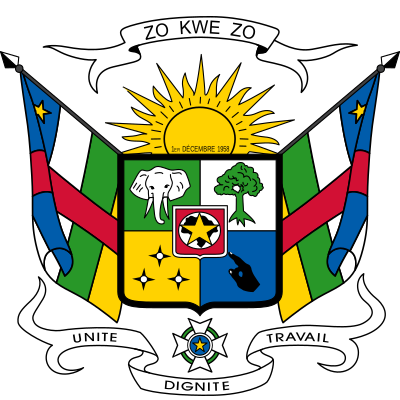
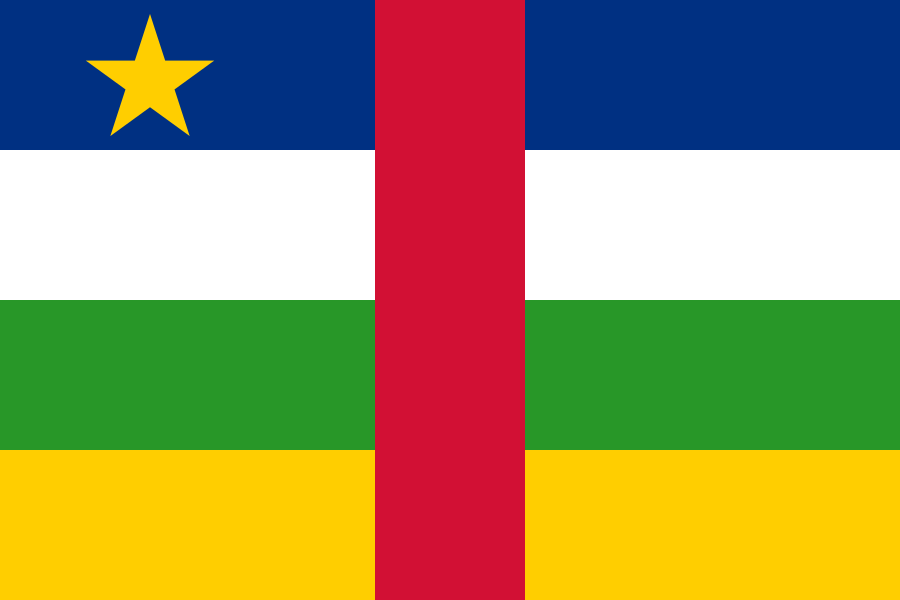
The population is reported as 5330690 or 6470307. The top-level Internet domain is .cf, and the telephone country code is 236. The anthem is La Renaissance. The country is a member of the United Nations, African Union, World Trade Organization, and International Bank for Reconstruction and Development. It contains administrative entities such as Bamingui-Bangoran Prefecture and Haute-Kotto Prefecture. The flag is the flag of the Central African Republic, and the coat of arms is the coat of arms of the Central African Republic.
Synthesized by Vinony from 67 facts across 9 sources: Wikidata, Open Meteo, Openweathermap, World Bank, OpenStreetMap, REST Countries, PubMed, Vinony graph, Geo. Generated from structured data (not the Wikipedia text) and checked against those facts — may still contain errors.
Weather now
cached 18h ago7-day forecast
via Open-Meteo
Country
- Capital
- Bangui
- Population
- 6,470,307
- Region
- Africa · Middle Africa
- Demonym
- Central African
- Currencies
- XAF (Fr)
- Languages
- French, Sango
- Calling code
- +236
- Drives on
- Right
- Gini
- 56.2 (2008)
- FIFA code
- CTA
- TLD
- .cf
- Timezones
- UTC+01:00
- Borders
- CMR, TCD, COD, COG, SSD, SDN
via REST Countries
Indicators · World Bank
- GDP
- $2.8B(2024)
- Population
- 5,330,690(2024)
- Life expectancy
- 57.7 yrs(2024)
- Unemployment
- 6.3 %(2025)
- Urban population
- 44.1 %(2024)
- Internet users
- 13.8 %(2024)
- Forest area
- 35.7 %(2023)
- Renewable energy
- 90.9 %(2022)
via World Bank Open Data · CC BY 4.0
Place details
- Region
- Ouaka
- Country
- Ködörösêse tî Bêafrîka / République centrafricaine
via OpenStreetMap · GeoNames
Wikipedia views (30d)
74,376 totalvia Wikimedia Pageviews API
Research
2,976 papersvia PubMed
Wikidata facts
- Instance of
- republic
- Official name
- Central African Republic
- Demonym
- وسط إفريقيات
- Country
- Central African Republic
- Contains
- Bangui
- Continent
- Africa
- Capital
- Bangui
- Official language
- Sango
- Currency
- Central African CFA franc
- Population
- 5152421
- Area
- 622984
- Head of government
- Henri-Marie Dondra
- Head of state
- David Dacko
- Legislature
- National Assembly
- Anthem
- La Renaissance
- Shares border with
- League of Arab States
- Highest point
- Mont Ngaoui
- Life expectancy
- 52.171
- Nominal GDP
- 2382618615
- Unemployment rate
- 7
- Calling code
- +236
- Licence plate code
- RCA
- Mains voltage
- 220
- Motto
- Единство, достоинство, труд
Show 57 more facts
- Coat of arms
- coat of arms of the Central African Republic
- top-level Internet domain
- .cf
- Commons category
- Central African Republic
- topic's main category
- Category:Central African Republic
- category for people who died here
- Category:Deaths in the Central African Republic
- category for people born here
- Category:Births in the Central African Republic
- topic's main Wikimedia portal
- Portal:Central African Republic
- category of associated people
- Category:Central African Republic people
- diplomatic relation
- North Korea
- IPA transcription
- dən sɛnˈtrɑːlɑfɾɪkɑːnskə rɛpʉˈblɪk
- Commons gallery
- République centrafricaine
- mobile country code
- 623
- lowest point
- Ubangi River
- driving side
- right
- geography of topic
- Geography of the Central African Republic
- marriageable age
- 18
- short name
- RĊA
- office held by head of government
- Prime Minister of the Central African Republic
- number of out-of-school children
- 703669
- office held by head of state
- President of the Central African Republic
- located in/on physical feature
- Central Africa
- total fertility rate
- 4.286
- maritime identification digits
- 612
- native label
- Ködörösêse tî Bêafrîka
- inception
- 1960-01-01
- Unicode character
- 🇨🇫
- category for films shot at this location
- Category:Films shot in the Central African Republic
- language used
- Vale
- suicide rate
- 8.8
- history of topic
- history of the Central African Republic
- VAT rate
- 19
- different from
- Central Africa
- BTI Status Index
- 3.11
- BTI Governance Index
- 3.81
- economy of topic
- economy of the Central African Republic
- replaces
- Central African Empire
- demographics of topic
- demographics of the Central African Republic
- Democracy Index
- 1.32
- Human Development Index
- 0.404
- P11012
- computer hardware
- central bank
- Bank of Central African States
- hashtag
- CentralAfricanRepublic
- on focus list of Wikimedia project
- Wikipedia:Vital articles/Level/4
- Gini coefficient
- 56.2
- Happy Planet Index score
- 25.2
- Inequality-adjusted Human Development Index
- 0.240
- P12749
- Giuseppe Saragat
- official observer status in organization
- Organisation of Islamic Cooperation
- birth rate
- 42.344
- male population
- 2788352
- death rate
- 11.003
- rural population
- 3173417
- female population
- 2790791
- urban population
- 2405727
- P8168
- Nikunau
Sources (15)
via Wikidata · CC0
Travel guide
Get around
thumbnail|Travelling by ferry in CAR Getting around in the capital is easy with taxis, which make large parts of the city accessible. The fare must be negotiated before departure, there are no taximeters. To get to the provinces, you have to stick to buses that offer appropriate tours. You will need to plan a lot of time and some difficulties, especially during the rainy season. It is advisable to have an off-road vehicle and an experienced tour guide.
You have to organize rides in minibuses yourself and negotiate prices.
See
thumb|Chutes de Boali The Musée Ethnograhique Barthélémy Boganda in Bangui is the country's national museum and has a decent collection of local instruments, weapons, tools, and displays about local traditions, religion, and architecture.
Prehistoric rock paintings can be found in several locations, but some of the best can be found in Bambari.
The Chutes de Boali, 2 hours from the capital, are a rather picturesque series of waterfalls, which are even more impressive in the rainy season. Taxi drivers will charge XAF 70,000 for the half-day trip. There is an entrance fee of XAF 5000.
Megaliths near the town of Bouar are positioned in concentric circles and are remnants of the CAR's ancient peoples.
As with most of Africa, local markets can be a feast for the eyes, offering a wide arrangement of crafts. Just be vigilant, as markets in the CAR are rife with petty and violent theft.
The country is made up of vast swathes of tropical rainforest that make it popular for exploring.
Do
Visits and stays with the Pygmy communities are probably the biggest attraction for the country's few tourists. Possible activities include: hunting with traditional weapons/devices, gathering medicinal plants with the women of the village, participating in a night of music & dance.
thumb|200px|Forest elephants in Dzangha-Sangha Special Reserve. Visit the Dzanga Sangha Special Reserve to trek through the jungle in search of gorillas, elusive forest elephants, chimpanzees, & more. A visit to the reserve is often combined with a stay in a Pygmy village. The reserve is part of larger protected area, with Dzanga-Ndoki National Park (which consists of two noncontinuous parts: "Dzanga Park" & "Ndoki Park") flanking Dzanga-Sangha Special Reserve on two sides and which in turn is part of a larger, tri-national protected area including Lobéké National Park in Cameroon & Nouabalé-Ndoki National Park in Congo-Brazzaville.
Should the CAR ever emerge from the grip of conflict & dysfunctional government, the country would be an appealing ecotourism destination similar to Gabon. Bamingui-Bangoran National Park and Manovo-Gounda St Floris National Park are promising wildlife reserves that are in insecure regions and without facilities.
Eat
thumbnail|Vegetable seller in CAR
There is a wide diversity of food in Bangui, including Chinese, Lebanese, French, local food and so forth. Food in restaurants owned by foreigners are very expensive and can be US$10–20 per dish (or more). Local food, however, may also be expensive depending upon the restaurant and its location. There are abundant French bakeries in the downtown area in the centre of Bangui with moderate prices for baked goods as well as meals. Food in supermarkets is very expensive, although cheaper food can be purchased at local markets and from sellers in the street.
Drink
Local beer ("33", Mocaf, Crystal) and soft drink (Mocaf is a major producer) is similarly priced to products in Europe and the United States. Wine is available in some French wine shops but can be very expensive. Palm wine is common. Water is produced in Cameroon and Central African Republic and can be purchased in all of the local supermarkets. Imported products such as Coca-Cola and Fanta are also available.
Sleep
Outside the capital and the Dzanga-Sangha nature reserve, there is almost no tourist infrastructure.
Stay safe
The Central African Republic is a volatile country. Since the early 2000s, recurrent civil conflicts and political unrest have adversely affected the country's overall state of security.
Hot, dry, dusty harmattan winds affect northern areas. Floods are common.
Police manning checkpoints will demand bribes; expect no less than US$5. There are many reports that a trip from the Cameroon border to Bangui will cost hundreds of US dollars or euros in bribes. Police will often confiscate an item (passport, camera, watch) and demand money for it. Armed robberies on roads in the country are common. Violent crime in the capital is common even in daylight, particularly around the "kilometre 5" bus station. Alcoholism is a major problem with city-dwellers, so be wary of drunks and do not even think about drinking with locals (you will be out-drunk).
Stay healthy
Some areas of Bangui have clean and filtered drinking water, so it is safe to drink water served at some restaurants and bars. However, the purity of the water is not reliable and thus it is safer to buy bottled water, or boil or filter water. Outside the capital there is no guarantee of water purity. All food should be cooked or peeled prior to being served, particularly food purchased at local markets, where hygiene is a concern. If illness should arise, it is better to seek counsel with one of the doctors at an embassy (the French embassy and US embassy both have fine doctors) or at a clinic at an organisation like Institut Pasteur. The local clinics and hospitals sometimes have a limited supply of necessary resources such as syringes, medicine, etc.
Respect
The locals often eat with their hands. If you are eating with them, and using your hands as well, eat with your right hand. The left is generally used for lavatory purposes, and therefore it is rude or unappealing to them if you eat with your left hand.
Travel guide from Wikivoyage (CC BY-SA 4.0)
~40 min read
Encyclopedic overview
The Central African Republic (CAR) is a landlocked country located in Central Africa. It is bordered by Chad to the north, Sudan to the northeast, South Sudan to the east, the Democratic Republic of the Congo to the south, the Republic of the Congo to the southwest, and Cameroon to the west. The Central African Republic covers a land area of about 620,000 square kilometres (240,000 sq mi). As of 2024, it has a population of 5,357,744, consisting of about 80 ethnic groups. Having been a French colony under the name Ubangi-Shari, French is its official language, with Sango, a Ngbandi-based creole language, as the national and co-official language. Its capital and largest city is Bangui, which is on the southern border with the Democratic Republic of the Congo.
The Central African Republic mainly consists of Sudano-Guinean savanna, but the country also includes a Sahelo-Sudanian zone in the north and an equatorial forest zone in the south. Two-thirds of the country is within the basin of the Ubangi River (which flows into the Congo River), while the remaining third lies in the basin of the Chari River, which flows into Lake Chad.
Excerpted from Wikipedia’s “Central African Republic” article, available under the CC BY-SA 4.0 licence.
Gallery (16)
On the map
2 mapped locations
Available in 252 languages
- Español
- Français
- Deutsch
- 中文
- 日本語
- Русский
- Português
- Italiano
- العربية
- हिन्दी
- Abkhazian
- abstract
- Achinese
- Adyghe
- Afrikaans
- Albanian
- Albanian
- Amharic
Show 233 more
- ami
- Angika
- Aragonese
- Aramaic
- Armenian
- Arpitan
- Asturian
- azb
- Azerbaijani
- Bahasa Indonesia
- Balinese
- Bambara
- Bangla
- Banjar
- Bashkir
- Basque
- bat_smg
- Batak Toba
- Bavarian
- be_x_old
- Belarusian
- Betawi
- Bhojpuri
- Bikol
- Bishnupriya
- Bislama
- Bosnian
- Breton
- Bulgarian
- Buriat
- Burmese
- Catalan
- cbk_zam
- cdo
- Cebuano
- Central Kurdish
- Chechen
- Cherokee
- Cornish
- Corsican
- Crimean Tatar
- Croatian
- Czech
- dag
- Danish
- Dinka
- Divehi
- dty
- Dzongkha
- Egyptian Arabic
- Esperanto
- Estonian
- Ewe
- Extremaduran
- Faroese
- Fiji Hindi
- Filipino
- Finnish
- fiu_vro
- Frafra
- Fula
- Gagauz
- Galician
- Ganda
- gcr
- Georgian
- Gilaki
- gpe
- Greek
- Guarani
- Haitian Creole
- Hakka Chinese
- Hausa
- Hebrew
- Hungarian
- hyw
- Icelandic
- Ido
- Igbo
- Iloko
- Inari Sami
- Interlingua
- Interlingue
- Irish
- Jamaican Creole English
- Javanese
- Kabyle
- Kannada
- Kara-Kalpak
- Karachay-Balkar
- Kashmiri
- Kashubian
- Kazakh
- kbp
- Khmer
- Kikuyu
- Kinyarwanda
- Kongo
- Kotava
- Kurdish
- Kyrgyz
- Ladino
- Lao
- Latin
- Latvian
- Lezghian
- Ligurian
- Limburgish
- Lingala
- Lingua Franca Nova
- Lithuanian
- lld
- Lombard
- Low German
- Lower Sorbian
- Luxembourgish
- Macedonian
- Madurese
- Malagasy
- Malay
- Malayalam
- Maltese
- Manx
- Māori
- map_bms
- Marathi
- Mazanderani
- Minangkabau
- Mingrelian
- Mirandese
- Moksha
- Mongolian
- Moroccan Arabic
- Navajo
- nds_nl
- Nederlands
- Nepali
- Northern Frisian
- Northern Sami
- Northern Sotho
- Norwegian
- Norwegian Nynorsk
- Novial
- Obolo
- Occitan
- Odia
- Old English
- olo
- Oromo
- Ossetic
- Pampanga
- Papiamento
- Pashto
- Piedmontese
- Polski
- Punjabi
- Quechua
- roa_rup
- Romanian
- Rusyn
- Samoan
- Sango
- Sanskrit
- Santali
- Sardinian
- Saterland Frisian
- Scots
- Scottish Gaelic
- Serbian
- Serbian (Latin)
- Shan
- Shona
- Sicilian
- Silesian
- simple
- Sindhi
- Sinhala
- Slovak
- Slovenian
- Somali
- Southern Sotho
- Standard Moroccan Tamazight
- Sundanese
- Svenska
- Swahili
- Swati
- szy
- Tachelhit
- Tajik
- Talysh
- Tamil
- Taroko
- Tatar
- tay
- Telugu
- Tibetan
- Tiếng Việt
- Tigrinya
- Toki Pona
- Tsonga
- Tumbuka
- Türkçe
- Turkmen
- Udmurt
- Ukrainian
- Upper Sorbian
- Urdu
- Uyghur
- Uzbek
- Venetian
- Veps
- Volapük
- Waray
- Welsh
- Western Frisian
- Western Mari
- Western Panjabi
- Wolof
- Wu Chinese
- Xhosa
- Yakut
- Yiddish
- Yoruba
- Zaza
- Zeelandic
- zh_classical
- zh_min_nan
- zh_yue
- Zhuang
- Zulu
- فارسی
- ไทย
- 한국어
via Wikidata sitelinks · CC0