
Orta Afrika Cumhuriyeti
Also known as Central Africa, CAR, cf, CAF
Orta Afrika ülkesi
AI overview
The Central African Republic is a landlocked country in Central Africa with a population of over 5 million people divided among approximately 80 ethnic groups, bordered by six nations including Chad, Sudan, and Cameroon. As a former French colony, it uses French as its official language alongside Sango, and its capital is the city of Bangui located on its southern border.
AI-generated from the Wikipedia summary — may contain errors.
Weather now
cached 3h ago23°scattered clouds
89% 1.6 m/s OpenWeatherMap
7-day forecast
via Open-Meteo
Country
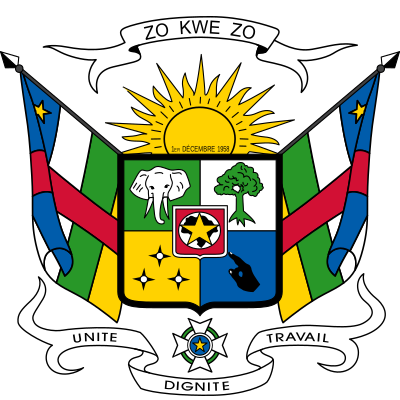
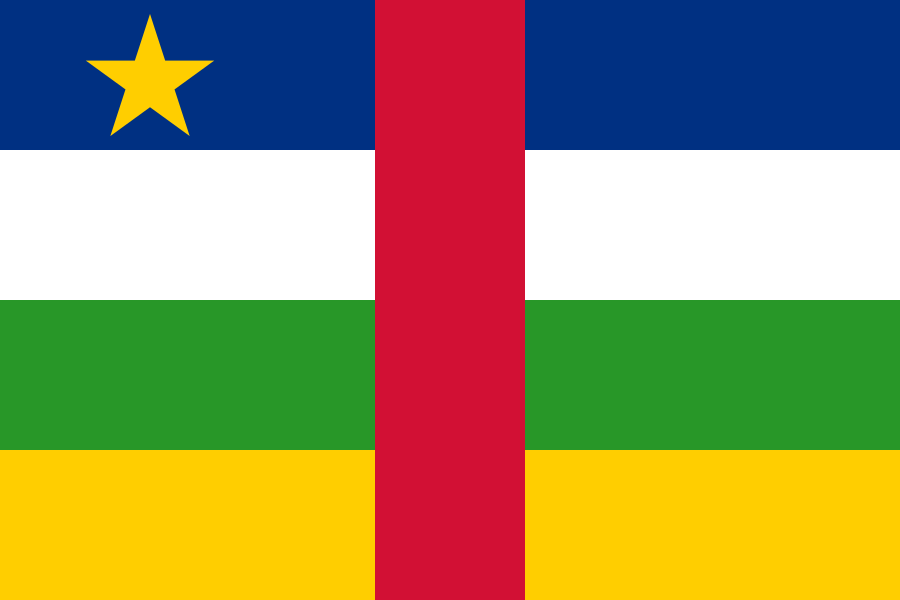
- Capital
- Bangui
- Population
- 6,470,307
- Region
Travel guide
Get around
thumbnail|Travelling by ferry in CAR Getting around in the capital is easy with taxis, which make large parts of the city accessible. The fare must be negotiated before departure, there are no taximeters. To get to the provinces, you have to stick to buses that offer appropriate tours. You will need to plan a lot of time and some difficulties, especially during the rainy season. It is advisable to have an off-road vehicle and an experienced tour guide.
You have to organize rides in minibuses yourself and negotiate prices.
See
thumb|Chutes de Boali The Musée Ethnograhique Barthélémy Boganda in Bangui is the country's national museum and has a decent collection of local instruments, weapons, tools, and displays about local traditions, religion, and architecture.
Prehistoric rock paintings can be found in several locations, but some of the best can be found in Bambari.
The Chutes de Boali, 2 hours from the capital, are a rather picturesque series of waterfalls, which are even more impressive in the rainy season. Taxi drivers will charge XAF 70,000 for the half-day trip. There is an entrance fee of XAF 5000.
Megaliths near the town of Bouar are positioned in concentric circles and are remnants of the CAR's ancient peoples.
As with most of Africa, local markets can be a feast for the eyes, offering a wide arrangement of crafts. Just be vigilant, as markets in the CAR are rife with petty and violent theft.
The country is made up of vast swathes of tropical rainforest that make it popular for exploring.
Do
Visits and stays with the Pygmy communities are probably the biggest attraction for the country's few tourists. Possible activities include: hunting with traditional weapons/devices, gathering medicinal plants with the women of the village, participating in a night of music & dance.
thumb|200px|Forest elephants in Dzangha-Sangha Special Reserve. Visit the Dzanga Sangha Special Reserve to trek through the jungle in search of gorillas, elusive forest elephants, chimpanzees, & more. A visit to the reserve is often combined with a stay in a Pygmy village. The reserve is part of larger protected area, with Dzanga-Ndoki National Park (which consists of two noncontinuous parts: "Dzanga Park" & "Ndoki Park") flanking Dzanga-Sangha Special Reserve on two sides and which in turn is part of a larger, tri-national protected area including Lobéké National Park in Cameroon & Nouabalé-Ndoki National Park in Congo-Brazzaville.
Gallery (16)
On the map
2 mapped locations
Connections
Categories
1960 establishments in the Central African RepublicCentral African RepublicCountries and territories where French is an official languageCountries in AfricaCountries in Central AfricaLandlocked countriesLeast developed countriesMember states of the African UnionMember states of the Organisation internationale de la FrancophonieMember states of the United NationsObserver states of the Organisation of Islamic Cooperation