Schmidt, C. A.;Shattuck, S. O.
Centromyrmex
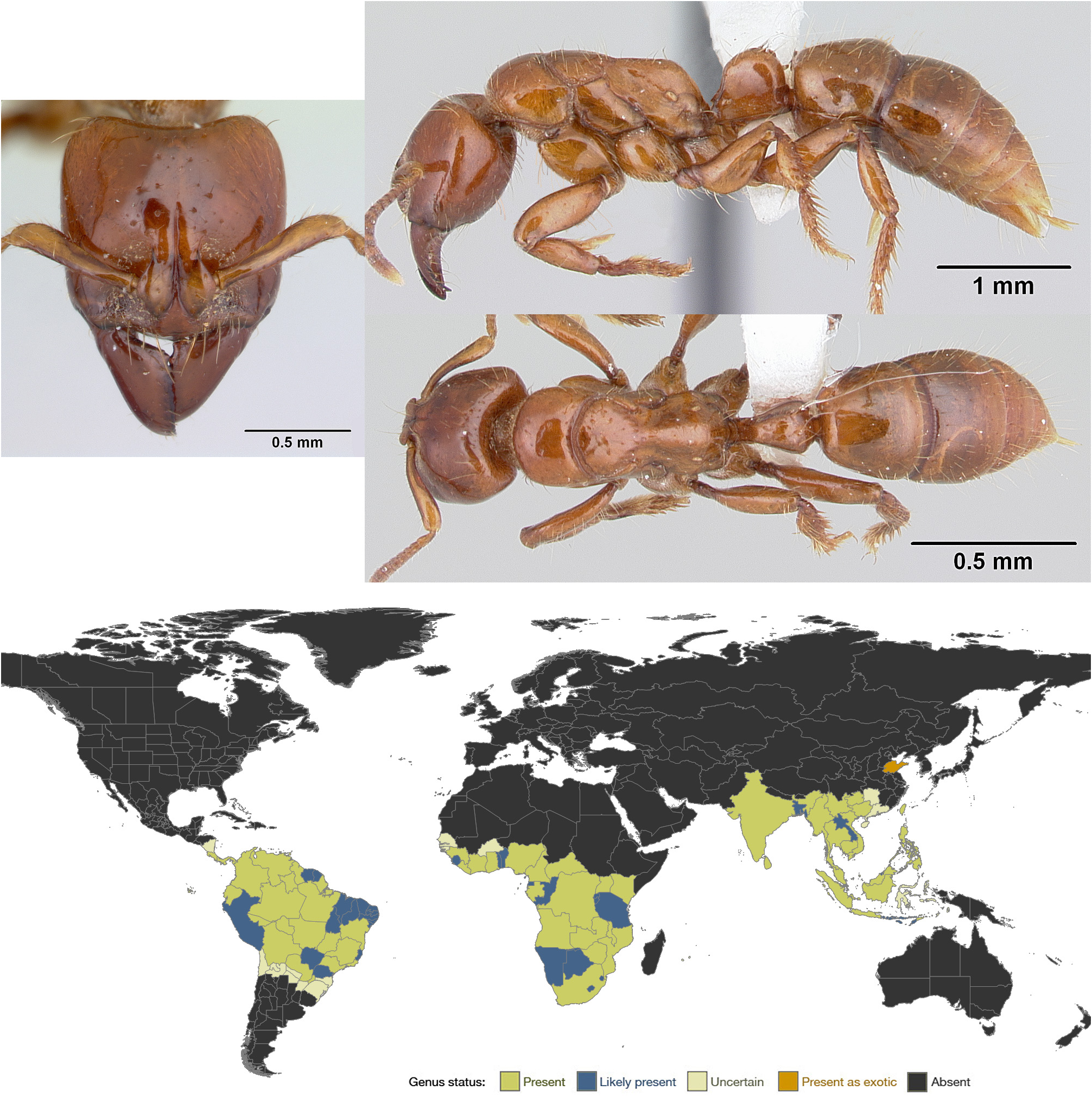
Sign in to saveCentromyrmex is a pantropical, though mainly Afrotropical, genus of ants in the subfamily Ponerinae. This ponerine ant was recorded for the first time in French Guiana and the most northerly point of recording was in Costa Rica. The specimens reported here were collected in a region of Amazon Forest with flight interception traps.
Species
GENUS
- KingdomAnimalia
- PhylumArthropoda
- ClassInsecta
- OrderHymenoptera
- FamilyFormicidae
via GBIF
Museum specimens
- Specimen records
- 11
- With media
- 7
- Family
- Formicidae
- Collections
- USNM, NHMUK, UA, INSTITUTO NACIONAL DE PESQUISAS DA AMAZÔNIA (INPA)
- Recorded in
- Trinidad And Tobago, Guyana, Congo, The Democratic Republic Of The, Philippines, Angola, Brasil
Wikidata facts
Show 4 more facts
- Commons category
- Centromyrmex
- taxon name
- Centromyrmex
- taxon rank
- genus
- topic's main category
- Category:Centromyrmex
Sources (1)
via Wikidata · CC0
~1 min read
Encyclopedic overview
4 sectionsContents
- Biology
- Species
- References
- External links
Centromyrmex is a pantropical, though mainly Afrotropical, genus of ants in the subfamily Ponerinae. This ponerine ant was recorded for the first time in French Guiana and the most northerly point of recording was in Costa Rica. The specimens reported here were collected in a region of Amazon Forest with flight interception traps.
==Biology== They are predatory on termites, where a group hunting strategy may be employed, or may prey more generally on invertebrates in the upper soil layer of forests. Little is known about their biology, but workers lack eyes and are well adapted to a subterranean lifestyle by way of burrowing. They also are equipped with short, spiny, and powerful legs. Nest sites are usually found near or even inside of termite nests.
Excerpted from Wikipedia’s “Centromyrmex” article, available under the CC BY-SA 4.0 licence.