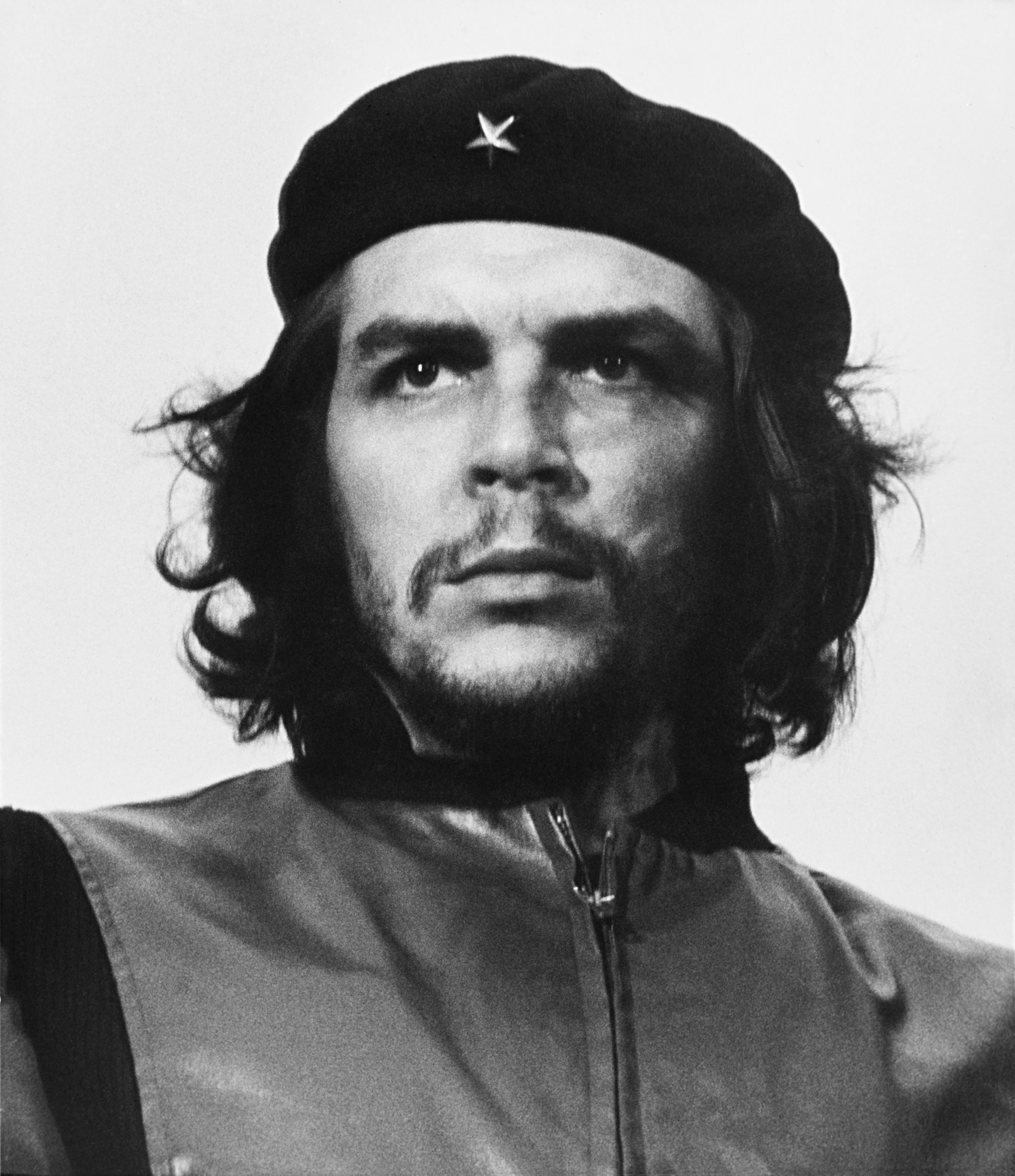
Che Guevara
Sign in to saveAlso known as Ernesto Guevara, El Che, Che, Ernesto Guevara de la Serna
Ernesto "Che" Guevara de la Serna was an Argentine Marxist revolutionary, author, guerrilla leader, diplomat, politician, and military theorist. A major figure of the Cuban Revolution, his stylized visage has become a countercultural symbol of rebellion and global insignia in popular culture.
OverviewAI-generated
Ernesto Guevara, also known by the pseudonym Che Guevara, was an Argentine and Cuban politician, physician, poet, and diplomat. Born in Rosario on 14 June 1928, he attended the University of Buenos Aires. He was a member of the 26th of July Movement and the Communist Party of Cuba. His residences included Argentina, Cuba, Bolivia, and Guatemala. He suffered from asthma.
Guevara participated in the Cuban Revolution, the Ñancahuazú Guerrilla, the Congo Crisis, and the Battle of Santa Clara. He received the Order of the Republic, the Order of the White Lion, and the Order of the Southern Cross. His notable works include *La guerre de guérrilla*, *Diario de campaña del comandante Ernesto "Che" en Bolivia*, *Obras completas*, and the *Bolivian diary*. He was married to Hilda Gadea and Aleida March, with whom he had a child, Aleida Guevara.
He died by homicide in La Higuera on 9 October 1967. He is buried at the Che Guevara Mausoleum. His name in his native language is Ernesto Guevara. He is described by the Armenian Soviet Encyclopedia.
Synthesized by Vinony from 27 facts across 2 sources: Wikidata, Open Library. Generated from structured data (not the Wikipedia text) and checked against those facts — may still contain errors.
In the Vinony graph
Vinony's link graph records 2,219 inbound references to Che Guevara, and connects out to guerrilla warfare, Jacobo Árbenz and Félix Rodríguez.
It sits within the topics 1928 births, 1967 deaths and 20th-century Argentine essayists.
Vinony links it to 175 Wikipedia language editions.
Person · Open Library
- Born
- 14 June 1928
- Died
- 9 October 1967
- Works
- 241
Top works
- Carta del Che a Fidel
- Le socialisme et l'homme à Cuba
- Obras escogidas
- A collection of speeches, 1961-1965
- Guerrilla Warfare
via Open Library + Wikidata
Film & TV
Rosario, Argentina
Ernesto Rafael "Che" Guevara de la Serna (14 June 1928 – 9 October 1967) was an Argentine Marxist revolutionary, physician, author, guerrilla leader, diplomat and military theorist. A major figure of the Cuban Revolution, his stylized visage has become a ubiquitous countercultural symbol of rebellion and global insignia in popular culture. As a young medical student, Guevara traveled throughout…
Known for
- História do Comunismo — Self2024
- The Century of Icons — Self (archive footage)2022
- A History of an Assignment — Self (archive footage)2021
- Laboratory Greece — Self (archive footage)2019
- Che, Memórias de um Ano Secreto — Self (archive footage)2018
- El Che — Self (archive footage)2017
- Che Guevara, naissance d'un mythe2017
- Код доступа — Self2017
- Algiers, the Mecca of Revolutionaries (1962-1974) — Self2016
- Cuba, l'histoire secrète2016
via TMDB
Wikipedia views (30d)
347,752 totalvia Wikimedia Pageviews API
Wikidata facts
- Instance of
- human
- Given name
- Ernesto
- Gender
- male
- Citizenship
- Argentina
- Place of birth
- Rosario
- Place of death
- La Higuera
- Spouse
- Aleida March
- Child
- Aleida Guevara
- Occupation
- opinion journalist
- Educated at
- University of Buenos Aires
- Political party
- Communist Party of Cuba
- Languages spoken
- Spanish
- Native language
- Spanish
- Hair colour
- brown hair
- Sport
- rugby union
- Conflict
- Bay of Pigs invasion
- Military rank
- Major
- Image
- Che Guevara - Guerrillero Heroico by Alberto Korda.jpg
- Height
- 176
- Number of children
- 5
- Residence
- Guatemala
Show 22 more facts
- medical condition
- asthma
- place of burial
- Che Guevara Mausoleum
- Commons category
- Che Guevara
- date of birth
- 1928-05-14
- date of death
- 1967-10-09
- topic's main category
- Category:Che Guevara
- Commons gallery
- Che Guevara
- member of
- 26th of July Movement
- manner of death
- homicide
- name in native language
- Ernesto Guevara
- pseudonym
- Fernando Sacamuelas
- interested in
- reading
- on focus list of Wikimedia project
- Wikipedia:Vital articles/Level/4
- nickname
- Che
- birth name
- Ernesto Guevara
- allegiance
- Cuba
- influenced by
- Vladimir Lenin
- cause of death
- gunshot wound
- killed by
- Mario Terán
- topic has template
- Template:Che Guevara
- has works in the collection
- Memoria Chilena
- P8168
- Two Oceans Aquarium
Sources (9)
via Wikidata · CC0
~40 min read
Encyclopedic overview
Ernesto "Che" Guevara de la Serna (14 May 1928 – 9 October 1967) was an Argentine Marxist revolutionary, author, guerrilla leader, diplomat, politician, and military theorist. A major figure of the Cuban Revolution, his stylized visage has become a countercultural symbol of rebellion and global insignia in popular culture.
As a young medical student, Guevara travelled throughout South America and was appalled by the poverty, hunger, and disease he witnessed. His burgeoning desire to help overturn what he saw as the capitalist exploitation of Latin America by the US prompted his involvement in Guatemala's social reforms under President Jacobo Árbenz, whose CIA-assisted overthrow at the behest of the United Fruit Company solidified Guevara's political ideology. In Mexico City, Guevara met Raúl and Fidel Castro, joined their 26th of July Movement, and sailed to Cuba aboard the yacht Granma with the intention of overthrowing US-backed dictator Fulgencio Batista. Guevara rose to prominence among the insurgents, was promoted to second-in-command, and played a pivotal role in the two-year guerrilla campaign which deposed the Batista regime.
Excerpted from Wikipedia’s “Che Guevara” article, available under the CC BY-SA 4.0 licence.
Gallery (14)
Available in 175 languages
- Español
- Français
- Deutsch
- 中文
- 日本語
- Русский
- Português
- Italiano
- العربية
- हिन्दी
- Abkhazian
- abstract
- Afrikaans
- Albanian
- Albanian
- Amharic
- Aragonese
- Armenian
Show 156 more
- Assamese
- Asturian
- Aymara
- azb
- Azerbaijani
- Bahasa Indonesia
- Balinese
- Bangla
- Bashkir
- Basque
- bat_smg
- Bavarian
- be_x_old
- Belarusian
- Bosnian
- Breton
- btm
- Bulgarian
- Buriat
- Burmese
- Catalan
- cdo
- Central Kurdish
- Chechen
- Chuvash
- Cornish
- Croatian
- Czech
- Danish
- Egyptian Arabic
- eml
- Esperanto
- Estonian
- Faroese
- Fiji Hindi
- Filipino
- Finnish
- fiu_vro
- Friulian
- Galician
- Georgian
- Gilaki
- Greek
- Guarani
- Gujarati
- Haitian Creole
- Hebrew
- Hungarian
- Icelandic
- Ido
- Iloko
- Ingush
- Interlingua
- Irish
- Javanese
- Kannada
- Kanuri
- Kashmiri
- Kazakh
- Khmer
- Kurdish
- Kyrgyz
- Lao
- Latin
- Latvian
- Lezghian
- Limburgish
- Lithuanian
- Lojban
- Lombard
- Low German
- Lower Sorbian
- Luxembourgish
- Macedonian
- Madurese
- Maithili
- Malagasy
- Malay
- Malayalam
- Maltese
- Marathi
- Mazanderani
- Minangkabau
- Mingrelian
- Mirandese
- Mongolian
- Moroccan Arabic
- Nederlands
- Nepali
- Newari
- Northern Frisian
- Norwegian
- Norwegian Nynorsk
- Occitan
- Oromo
- Ossetic
- Pashto
- Piedmontese
- Polski
- ppl
- Punjabi
- Quechua
- Romanian
- Romansh
- Romany
- Rusyn
- Sanskrit
- Santali
- Sardinian
- Scots
- Scottish Gaelic
- Serbian
- Serbian (Latin)
- Sicilian
- Silesian
- simple
- Sindhi
- Sinhala
- Slovak
- Slovenian
- Somali
- Sundanese
- Svenska
- Swahili
- Tachelhit
- Tajik
- Talysh
- Tamil
- Tatar
- Telugu
- Tiếng Việt
- Toki Pona
- Türkçe
- Ukrainian
- Upper Sorbian
- Urdu
- Uzbek
- Venetian
- Veps
- Volapük
- Waray
- Welsh
- Western Frisian
- Western Mari
- Western Panjabi
- Wu Chinese
- Yakut
- Yiddish
- Yoruba
- Zaza
- Zeelandic
- zh_min_nan
- zh_yue
- فارسی
- ไทย
- 한국어
via Wikidata sitelinks · CC0