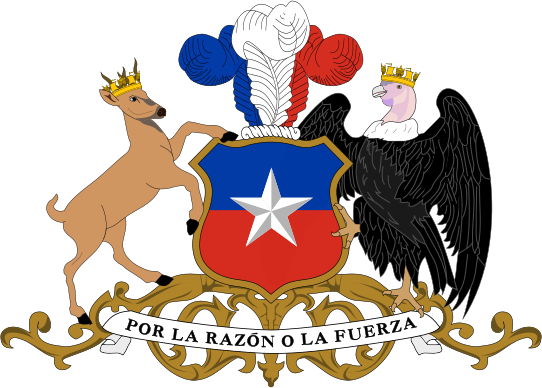
Also known as Republic of Chile, República de Chile, CHI
país de América del Sur y Oceanía con una reclamación antártica
Chile is a long, narrow country on the western edge of South America, stretching from Peru in the north to the southernmost tip of the continent near Antarctica, with a population of 18.5 million people. It matters as a significant South American nation that borders multiple countries and administers Pacific island territories, positioned between the Andes Mountains and the Pacific Ocean.
AI-generated from the Wikipedia summary — may contain errors.
via Open-Meteo
Chile borders Peru to the north and Argentina and Bolivia to the east. Chile has over 5,000 km (3,100 miles) of coast on the South Pacific Ocean.
thumb|Cycling in Las Torres del Paine
thumb|Miscanti lagoon near [[San Pedro de Atacama]]
Stretching from 17°S in the north to 55°S in the south, Chile is latitude-wise among the longest countries in the world, with several climate zones and types of nature. High mountains are present everywhere in the country. On the Chilean mainland you can visit three UNESCO World Heritage Sites: Old Valparaíso, the Sewell mining town in Rancagua and the Humberstone and Santa Laura Saltpeter Works outside Iquique. Just off the coast are the churches of Chiloé Island, and five and a half hours by plane across the Pacific Ocean will get you to maybe the most famous "Off the Beaten Path" destination in the world: Easter Island.
Chiloé Island and its beautiful coastal national park with mostly flat hikes Valdivia, the Reserva Costera Valdiviana and many other destinations around Valdivia with flat to rolling hills Cochamó Valley, the Yosemite of Chile and the huge area south of it, even into Argentina, for medium to advanced hikers Talca and everything to its east, for advanced hikers Torres del Paine National Park, impressive, touristy and expensive Skiing and snowboarding draw an international crowd between June and October. While northern countries bake under a hot northern summer sun, Chilean mountain resorts experience southern hemisphere winter. Ski resorts in the Andean highlands provide challenging terrain and some of the most beautiful mountain views in the world. Chilean ski resorts include: Valle Nevado Portillo El Colorado La Parva Chile is home to the second largest recreational pool in the world (the largest until its builder finished an even larger pool in Egypt in 2015) at the San Alfonso del Mar resort in Algarrobo. You will want a sailboat to complete its 2 km length.
Chilean cuisine has a wide variety of dishes that emerged from the amalgamation of indigenous tradition and Spanish colonial contribution, combining their food, customs and culinary habits. Influences from German, Italian and French cuisines are thanks to immigrants who arrived during the nineteenth and twentieth centuries.
Chile, oficialmente República de Chile, es un país soberano ubicado en el extremo sur de América del Sur. Adopta la forma de gobierno republicana, democrática, unitaria y presidencialista. Su capital es la ciudad de Santiago. Está constituido por tres zonas geográficas. La primera de ellas, Chile continental, comprende una franja en la costa occidental del Cono Sur que se extiende entre los paralelos 17°29′57″ S y 56°32′12″ S, mayormente desde la ribera sudoriental del océano Pacífico hasta las cumbres más altas divisorias de aguas de la cordillera de los Andes. Alcanza un largo de 4270 km, un ancho máximo de 445 km en los 52°21′ S y un mínimo de 90 km en los 31°37′ S. Limita con Perú al norte, Bolivia al nordeste y Argentina al este, totalizando 7801 km de fronteras terrestres, y el pasaje de Drake al sur. La segunda, Chile insular, corresponde a un conjunto de islas de origen volcánico en el océano Pacífico Sur: el archipiélago Juan Fernández y las islas Desventuradas, pertenecientes a Sudamérica, así como la isla Salas y Gómez y la isla de Pascua, ubicadas en Oceanía. La tercera, el Territorio Chileno Antártico, es una zona del continente antártico de 1 250 257,6 km² entre los meridianos 53° O y 90° O sobre la cual hay reclamaciones territoriales argentinas y británicas, prolongándose hasta el polo sur, pero está supeditada a lo estipulado en el Tratado Antártico, del que es signataria. Debido a lo mencionado, se define como un país tricontinental. Tiene una costa de 6435 km de longitud y ejerce derechos exclusivos, reclamaciones de diverso grado y soberanía sobre su espacio marítimo, llamado mar chileno. Este comprende cuatro zonas: el mar territorial (120 827 km²), la zona contigua (131 669 km²), la zona económica exclusiva (3 681 989 km²) y la plataforma continental (161 338 km²). Chile cuenta con un índice de desarrollo humano «muy alto» y es considerado uno de los países más desarrollados de América Latina, caracterizado por tener una economía sólida, una democracia estable y altos niveles de progreso social en comparación al resto de la región.Es clasificado como un país de ingresos altos por el Banco Mundial. Sus más de 19 millones de habitantes promedian índices de alfabetización, crecimiento económico, esperanza de vida, calidad de vida, globalización y PIB per cápita que están entre los más altos del continente.
Abstract from DBpedia / Wikipedia · CC BY-SA
60 mapped locations
Discovered by embedding cosine similarity (sentence-transformers MiniLM, 384-dim).
via REST Countries
via World Bank Open Data · CC BY 4.0
via OpenStreetMap · GeoNames
via Wikimedia Pageviews API
via Wikipedia infobox
via PubMed
via Wikidata · CC0
Chilean food in general is presented as a mixture of the meat and agricultural products of each area. In the north and south fishing is a major economic activity and this is reflected in the variety of dishes: the desert area's ceviche (fish seasoned with lemon and onions) and curanto (cooked seafood, meat, sausages and potatoes made in a hole in the ground) are the ultimate expression of chilota kitchen. The potato is also key in other chilota preparations as milcao and chapaleles. The central area uses corn (maize) and beef for foods such as tamales. Pie pine casserole and charquicán are some of the most recognized within the region. The roast, meanwhile, stands as the main preparation for informal gatherings and family; take this opportunity to learn more about Chilean society. Desserts include alfajores and Curicó cakes, while German immigrants introduced the kuchen and strudel pastry.
Chile's extensive geography allows development on its shores of several varieties of seafood: the top highlights are the croaker, pomfret, conger eel and salmon, which is produced industrially in the south of the country. For shellfish: oysters, as well as certain crus…
thumb|Chilean beaches can get rather crowded in summer.
Chile has many types of hotels in the cities: some of the most prevalent chains are Sheraton, Kempinsky, Ritz, Marriott, Hyatt, and Holiday Inn.
There are also hostels of varying quality. On the backpacker trail, a local hostel version can be found in every small city residential. However, as soon as you are off the backpacker trail, you will find it hard to find hostels, which unfortunately is true for many nice and interesting places around Chile. Contrary to the believe of locals and common marking of accommodations (e.g. on OpenStreetMap), hospedaje and hostal is not to not be confused with hostel, i.e. they do not offer dormitories. If a generalisation is possible, hospedaje generally means guest house, and hostals are small hotels. Hence, the frequency of real hostels is very low.
There is also a variety of accommodations in the mountain ski centers, such as the world-class resort Portillo, 80 km (49 mi) north of Santiago; Valle Nevado in the mountains approximately 35 km (22 mi) away from Santiago, and the Nevados de Chillan ski resort and hot springs, which lies about 450 km (280 mi) south of Santiago.
Many camping places are available officially with amenities, and backcountry along the coast or near hiking trails. So, if you bring a tent the scarcity of hostels can be dealt with in this way. Consult OpenStreetMap, which many mobile Apps like OsmAnd or Mapy.cz use, to find sites which have been tagged by other people as possible campi…
thumb|The [[Atacama Desert is a prime place for astronomical observations.]] thumb|Chile offers some pretty extreme hiking and climbing experiences. If you're interested, make sure to come prepared. thumb|Volcano activity warning sign
Chile usually ranks as one of the safest countries on the continent. In the early 2020s though, gun violence and car hijacking have increased. Cartels from Mexico, Venezuela and Colombia have established themselves in the country. The police were not prepared for this and it has worried a lot of locals and sometimes caused resentment against foreigners.
Pickpocketing and muggings occur, so it's better to go out in a group. Most thieves tend to target people walking alone. Be cautious at night, take a taxi, and avoid seedy neighbourhoods like Bellavista. If robbed, do as you are told and if you don't speak Spanish, avoid eye contact and give them your valuables.
Do not show expensive-looking jewelry or watches, laptops or the newest mobile phones, even during the day. Stay alert and be especially careful in all crowded areas in Santiago, Viña del mar, Valparaíso and Antofagasta. It is recommended to wear your backpack at the front of your body in crowded areas or use a fannypack.
For tourists or other "beginners" lacking experience in over-the-counter transactions with hard Chilean currency, you can reduce the chance of your wallet getting stolen by following some advice:
Separate coins and bills. Coins are frequently used when paying for pu…
thumb|Chile is home to a number of impressive waterfalls.
Having relatively good standards in medicine throughout the country, it is not difficult to stay healthy. However, one will usually find more refined resources at a private medical facility. In case of emergency, call 131, but don't expect an operator fluent in English.
Hepatitis A vaccine is recommended for all travelers. Other potential vaccines, depending on your travel situation include: Hepatitis B, Typhoid, Rabies and Influenza.
Tap water is safe to drink. Just know that water is produced from the mountains, so it might be harder for foreigners. In that case, it is advisable to buy bottled water. Locals in Santiago, the north, and rural areas also tend to buy bottled water for drinking for the same reason, as well as due to the use of chlorine and other chemicals to disinfect tap water.
The atmospheric ozone layer in Chile has thinned considerably, so the ultraviolet radiation, which is harmful to health, is very strong. The ozone problem is at its worst during midday and afternoon hours in spring from September to November and in summer from Christmas to March. Use sunscreen and wear long-seeved tops, hats and sunglasses.
Although the Roman Catholic Church has historically played a major role in Chilean society, Chile has become increasingly secular since the mid-20th century. For example, divorce was legalized in the mid-2000s, the Catholic church was separated from the state in the mid-1920s, and an increasing number of Chileans identify as irreligious. When visiting sites of religious importance, you should always act and dress respectfully. As is the case everywhere, proselytizing, or anything hinting at it, is neither welcomed nor appreciated.
Chilean politics are highly polarising and emotive; there have been a lot of protests against the Chilean government since 2019 and a lot of ordinary Chileans tend to express feelings of anger and frustration with the government. As is the case anywhere, stay neutral and listen carefully if and when people discuss politics, even if you happen to know a thing or two about Chile's politics.
The Pinochet military regime, which ruled the country from 1973 to 1990, is very much an open wound in Chile's national consciousness and discussions about it should be approached with absolute respect and caution. The regime tortured, imprisoned, executed, and mistreated thousands of Chileans, and many others had to flee the country for their safety. That being said, do not assume that every Chilean views Pinochet with disdain and contempt; some Chileans (emphasis on some) feel there was more stability under his rule and may be offended by negative remarks about…
Travel guide from Wikivoyage (CC BY-SA 4.0)
via Wikidata sitelinks · CC0