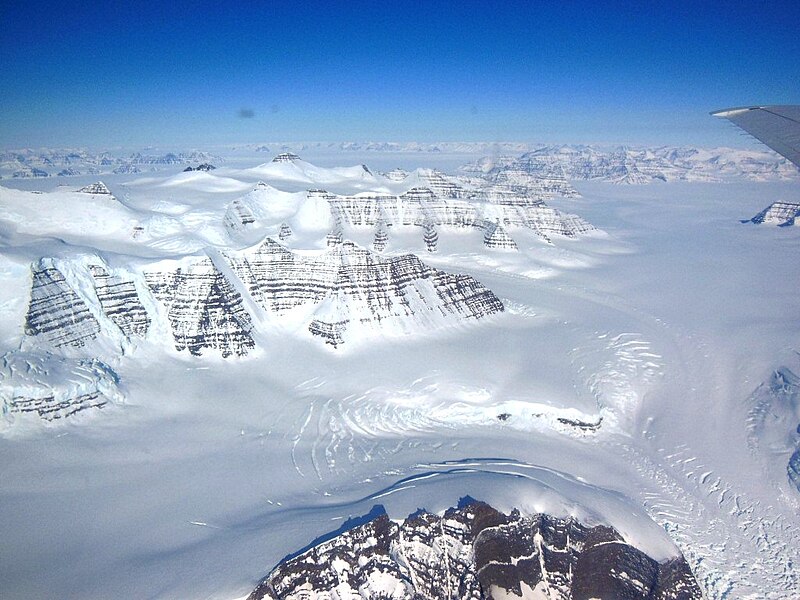
File:Geikie_Plateau_Glacier.JPG · Wikimedia Commons · See Wikimedia Commons
glacier
Sign in to savethumb|upright=1.2|Glacier of the Geikie Plateau in Greenland thumb|upright=1.2|The Taschachferner in the Ötztal Alps in [[Austria. The mountain to the left is the Wildspitze (3.768 m), second highest in Austria]] thumb|upright=1.2|With 7,253 known glaciers, Pakistan contains more glaciers than any other country on Earth outside the polar regions. At in length, the pictured [[Baltoro Glacier is the fifth longest alpine glacier in the world.]] A glacier (; or ) is a persistent body of natural ice, a form of rock, that is constantly moving under its own weight. A glacier forms where the accumulat
A glacier is a large, persistent body of natural ice that slowly moves under its own weight across land. Glaciers are important because they cover vast areas of Earth, store significant amounts of fresh water, and their movement shapes landscapes over time.
AI-generated from the Wikipedia summary — may contain errors.
Wikidata facts
- Part of
- mountain
- Has part
- glacier terminus
- Material used
- ice
- Image
- Perito Moreno Glacier Patagonia Argentina Luca Galuzzi 2005.JPG
Show 13 more facts
- OpenStreetMap tag
- natural=glacier
- Commons category
- Glaciers
- studied by
- glaciology
- topic's main category
- Category:Glaciers
- equivalent class
- dbpedia.org/ontology/Glacier
- Commons gallery
- Glacier
- topic has template
- Template:Glaciers
- model item
- ice cap
- on focus list of Wikimedia project
- WikiProject Climate change
- exact match
- purl.obolibrary.org/obo/ENVO_00000133
- has list
- list of glaciers
- facet of
- glaciation
- maintained by WikiProject
- WikiProject Climate change
Sources (9)
via Wikidata · CC0
~46 min read
Encyclopedic overview
34 sectionsContents
- Etymology and terminology
- Types
- Classification by size, shape and behavior
- Classification by thermal state
- Formation
- Color
- Structure
- Structural glaciology
- Motion
- Fracture zone and cracks
- Subglacial processes
- Basal melting and sliding
- Speed
- Ogives
- Geography
- Glacial geology
- Erosion
- Moraines
- Drumlins
- {{anchor|Glacial valleys}}Glacial valleys, cirques, arêtes, and pyramidal peaks
- Roches moutonnées
- Alluvial stratification
- Glacial deposits
- Loess deposits
- Retreat of glaciers due to climate change
- Glaciers as climate monitors
- Isostatic rebound
- On other planets
- See also
- References
- Bibliography
- General references
- Further reading
- External links
thumb|upright=1.2|Glacier of the Geikie Plateau in Greenland thumb|upright=1.2|The Taschachferner in the Ötztal Alps in [[Austria. The mountain to the left is the Wildspitze (3.768 m), second highest in Austria]] thumb|upright=1.2|With 7,253 known glaciers, Pakistan contains more glaciers than any other country on Earth outside the polar regions. At in length, the pictured [[Baltoro Glacier is the fifth longest alpine glacier in the world.]] A glacier (; or ) is a persistent body of natural ice, a form of rock, that is constantly moving under its own weight. A glacier forms where the accumulation of snow exceeds its ablation over many years, often centuries. It slowly flows and deforms under stresses induced by gravity, undergoing both ductile and brittle deformation, and acquiring distinguishing surface features, such as crevasses and seracs. As a glacier moves, it abrades underlying rock and debris to create glacial landforms, such as cirques, moraines, and fjords. Although a glacier may flow into a body of water, and can include ice shelves and ice tongues, it originates only on land and is distinct from the much thinner sea ice and lake ice that form on the surface of freezing bodies of water.
On Earth, 99% of glacial ice is contained within vast ice sheets (also known as "continental glaciers") in the polar regions, but glaciers may be found in mountain ranges on every continent other than the Australian mainland, including Oceania's high-latitude oceanic island countries such as New Zealand. Between latitudes 35°N and 35°S, glaciers occur only in the Himalayas, Andes, and a few high mountains in East Africa, Mexico, New Guinea and on Zard-Kuh in Iran. With more than 7,000 known glaciers, Pakistan has more glacial ice than any other country outside the polar regions. Glaciers cover about 10% of Earth's land surface. Continental glaciers cover nearly or about 98% of Antarctica's , with an average thickness of ice . Greenland and Patagonia also have huge expanses of continental glaciers. The volume of glaciers, not including the ice sheets of Antarctica and Greenland, has been estimated at 170,000 km3.
Excerpted from Wikipedia’s “glacier” article, available under the CC BY-SA 4.0 licence.
Gallery (52)
Available in 138 languages
- Español
- Français
- Deutsch
- 中文
- 日本語
- Русский
- Português
- Italiano
- العربية
- हिन्दी
- Afrikaans
- Albanian
- Albanian
- Aragonese
- Armenian
- Arpitan
- Assamese
- Asturian
Show 119 more
- azb
- Azerbaijani
- Bahasa Indonesia
- Bangla
- Basque
- Bavarian
- be_x_old
- Belarusian
- Bhojpuri
- Bosnian
- Breton
- Bulgarian
- Burmese
- Catalan
- Central Kurdish
- Chuvash
- Cornish
- Croatian
- Czech
- Danish
- Erzya
- Esperanto
- Estonian
- Filipino
- Finnish
- Galician
- Gan Chinese
- gcr
- Georgian
- Greek
- Guarani
- Haitian Creole
- Hausa
- Hebrew
- Hungarian
- Icelandic
- Ido
- Interlingua
- Irish
- Jamaican Creole English
- Javanese
- Kannada
- Kara-Kalpak
- Kashmiri
- Kashubian
- Kazakh
- kbp
- Kyrgyz
- Latgalian
- Latin
- Latvian
- Limburgish
- Lithuanian
- lld
- Lombard
- Luxembourgish
- Macedonian
- Maithili
- Malagasy
- Malay
- Malayalam
- Manx
- Marathi
- Mari
- Mingrelian
- Mongolian
- nds_nl
- Nederlands
- Nepali
- Newari
- Northern Frisian
- Norwegian
- Norwegian Nynorsk
- Occitan
- Ossetic
- Pashto
- Polski
- Punjabi
- Quechua
- Romanian
- Romansh
- Saterland Frisian
- Scots
- Scottish Gaelic
- Serbian
- Serbian (Latin)
- Sicilian
- simple
- Sindhi
- Slovak
- Slovenian
- Svenska
- Swahili
- Tajik
- Tamil
- Tatar
- Telugu
- Tiếng Việt
- Türkçe
- Ukrainian
- Urdu
- Uyghur
- Uzbek
- Venetian
- Walloon
- Waray
- Welsh
- West Flemish
- Western Frisian
- Western Panjabi
- Wu Chinese
- Yakut
- Yiddish
- zh_min_nan
- zh_yue
- Zulu
- فارسی
- ไทย
- 한국어
via Wikidata sitelinks · CC0