(c) Shaway Liu, some rights reserved (CC BY-NC), uploaded by Shaway Liu · cc-by-nc
Chinese Moccasin
Sign in to saveAlso known as Deinagkistrodon acutus, Kamanian, Sharp-snouted pitviper, amani, palada, kaviaz
Deinagkistrodon is a monotypic genus created for the pit viper species, Deinagkistrodon acutus, which is endemic to Southeast Asia. No subspecies are currently recognized.
Species
VulnerableChinese Moccasin
species
二名法 Deinagkistrodon acutusGünther,1888 尖吻蝮屬(學名:Deinagkistrodon)是蛇亞目蝰蛇科蝮亞科下的一個有毒單型蛇屬,屬下只有尖吻蝮(D. acutus)一種排毒量大,攻击性强,毒性亦较强的大型蛇类,又名百步蛇。尖吻蝮俗名甚多,又稱白花蛇、百花蛇、五步蛇、七步蛇、蘄蛇、山谷虌、中華蝮等,中醫《開寶本草》命其名為勝褰鼻蛇,是亞洲地區及東南亞地區內相當著名的蛇種,尤其在華南一帶更是自古已備受重視的蛇類,為台灣六大毒蛇之一。[2][3]目前未有任何亞種被確認。[4][5] 目录 1 特徵 2 地理分布 3 習性 4 毒性 5 大眾文化 5.1 臺灣 5.2 中國 6 中醫藥用途 7 備註 8 外部連結 特徵 成年的尖吻蝮能達91至121公分長,目前最長紀錄是154.5公分。[2][6]牠們的頭部尖端呈突出狀,被形容為短小的鱗角,這枚鱗角根據各蛇體質之異而長度不一。尖吻蝮的头部长有颊窝,即红外线感受器。[2] 紋理結構方面,尖吻蝮的身體多以灰色或棕色為主要基調,再配合較淺色的呈三角形棕灰色紋案,深淺各異的三角紋錯落相繼,組成節理分明的軀體。[2]尖吻蝮具备大而长,且形状倒钩的管狀毒牙。 地理分布 尖吻蝮主要分布於中國南方,大巴山-大别山以南一线直到越南-两广北部、台湾的广大山区都有活动,在极少数地区,它也出现在低丘平原地带,比如湖南南部,及越南北部和寮國。其標準產地未有明確的記載,但學者皮禮特(Pratt)及邦普(Pope)曾先後提出應為「中國湖北省」。在大英自然歷史博物館的目錄中,則列明此蛇種的產地為「九江廬山」。[1] 習性 尖吻蝮多出沒於山坡地帶,喜歡棲息於多岩石的地貌之中,能存活於海拔100米至1,400米之間[2][3]。 牠們多於晚間或清晨活動,其它時候則會蜷伏於岩石縫或樹葉堆裡,以其狀似亂石的體紋掩藏自己的行蹤。受到攻擊或騷擾時,牠們的反應一般比較遲緩,但仍能對敵人施以準確的咬擊。[2][3]尖吻蝮主要以小型的哺乳類動物、鳥類及蛙類為食糧。 繁殖方面,尖吻蝮屬於卵生蛇種,母蛇每次能誕下多至24枚的蛇卵,並會對蛇卵進行孵育的工作(以身體磨擦蛇卵以提升溫度)。尖吻蝮的幼蛇顏色明顯較淺,紋理比較明亮清晰,不過在其成長的過程中其紋理將會逐漸變暗。[2] 毒性 是亞洲最危险的毒蛇之一,主要是因为毫无先兆的攻击性,其它毒蛇如眼镜蛇和眼镜王蛇,银环蛇和龜殼花、圆斑蝰在发起攻击前都会做出醒目的动作来警示,然而五步蛇不一样,攻击前没有任何警告動作。而且五步蛇巨大的注毒量,即使被咬伤的人幸免不死,强烈的血循毒素能溶解肌肉和血管,造成组织细胞大面积坏死,结果常是残废或截肢。 尖吻蝮其中一個為人熟知的名字是「百步蛇」,意指人類只要曾被尖吻蝮所咬,腳下踏出一百步內血循毒素造成的伤口剧痛而让人难以站立移动从而不能求生获救。有些地方
via IUCN
Wikidata facts
- Instance of
- taxon
- Image
- Deinagkistrodon acutus 295892035.jpg
Show 8 more facts
- taxon rank
- species
- taxon name
- Deinagkistrodon acutus
- Commons category
- Deinagkistrodon acutus
- taxon common name
- 尖吻蝮
- IUCN conservation status
- Vulnerable
- short name
- D. acutus
- taxon author citation
- Günther, 1888
- taxon range
- China
Sources (1)
via Wikidata · CC0
~8 min read
Encyclopedic overview
13 sectionsContents
- Description
- Common names
- In culture
- Geographic range
- Habitat
- Diet
- Reproduction
- Venom
- Venom use in research and medicine
- Venom and traditional Chinese medicine
- References
- Further reading
- External links
Deinagkistrodon is a monotypic genus created for the pit viper species, Deinagkistrodon acutus, which is endemic to Southeast Asia. No subspecies are currently recognized.
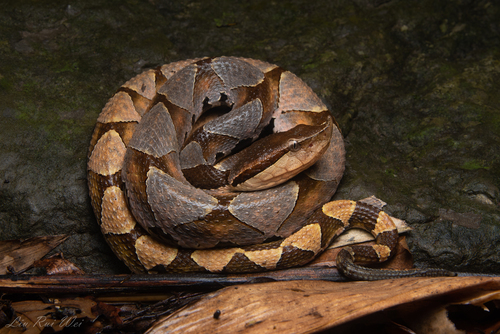
==Description== Deinagkistrodon acutus is light brown or greyish brown dorsally, with a series of dark brown lateral triangles on each side. The two pointed tops of the two opposite triangles meet each other at the mid-line, forming a series of about 20 light brown, squarish blotches on the back. A row of large black spots extends along each side near the belly. The top and upper sides of the head are uniformly black, with a black streak from the eye to the angle of the mouth. D. acutus is yellowish ventrally, spotted with dark brown. The young are much lighter than the adults with essentially the same pattern. The head is large, triangular, with an upturned snout. The body is very stout. The tail is short, ending in a compressed, pointed slightly curved cornified scale. The top of the head is covered with nine large shields. The dorsal scales are strongly and tubercularly keeled. The subcaudals are mostly in pairs, some of the anterior ones are single. This stout snake, usually between in total length (including tail), reaches a maximum total length of in males and in females. The largest specimen on record measured approximately .
Excerpted from Wikipedia’s “Chinese Moccasin” article, available under the CC BY-SA 4.0 licence.
Gallery (2)
Available in 21 languages
- Español
- Français
- Deutsch
- 中文
- 日本語
- Armenian
- Azerbaijani
- Basque
- Cebuano
- Estonian
- Hebrew
- Lithuanian
- Navajo
- Nederlands
- Svenska
- Tiếng Việt
- Türkçe
- Waray
Show 2 more
via Wikidata sitelinks · CC0