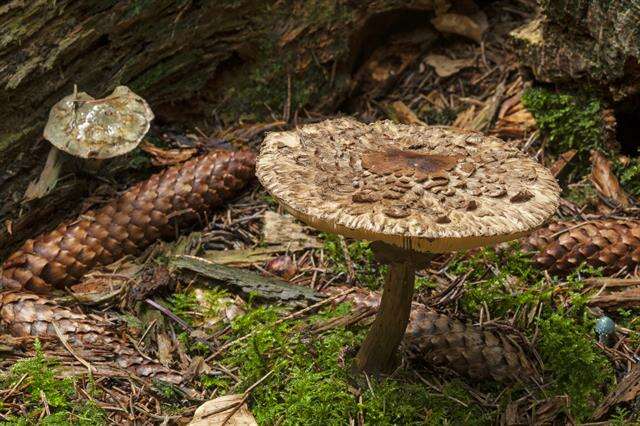
Encyclopedia of Life · EOL (see source)
Chlorophyllum
Sign in to saveChlorophyllum is a genus of large toadstools that are similar in appearance to the true parasol mushroom (Macrolepiota). The genus Chlorophyllum was originally created in 1898, a time when spore color was the deciding factor for differentiating genera. It was termed in order to describe the poisonous green-spored C. molybdites which shared many characteristics of the mushrooms within the genus Lepiota but lacked the all-important white spores. The name derives from Greek Chloro meaning green and phyllo meaning leaf (or gill in this case). It remained as a monotypic genus until recently wh
Species
Die Safran- oder Grünsporschirmlinge (Chlorophyllum) sind eine mit den Riesenschirmlingen (Macrolepiota) nah verwandte Gattung aus der Familie der Champignonverwandten (Agaricaceae). Der Name „Safranschirmlinge“ bezieht sich auf das orangerötlich verfärbende Fleisch der Fruchtkörper bei Kontakt mit Luftsauerstoff. Die Bezeichnung „Grünsporschirmlinge“ leitet sich vom wissenschaftlichen Namen Chlorophyllum ab, der übersetzt „Grünblättler“ bedeutet und auf den Lamellen der Typusart Chlorophyllum molybdites basiert, die sich bei Reife durch die grünlichen Sporen entsprechend verfärben.
via
Museum specimens
- Specimen records
- 64
- With media
- 17
- Family
- Agaricaceae
- Collections
- UFRGS, UFPB, INSTITUTO NACIONAL DE PESQUISAS DA AMAZÔNIA (INPA), FH, WTU, NCU
- Recorded in
- Brasil, Pakistan, United States, Argentina, Australia, Sweden
Wikidata facts
- Instance of
- taxon
- Parent taxon
- Agaricaceae
- Image
- Chlorophyllum rhacodes LC0093.jpg
Show 5 more facts
- topic's main category
- Category:Chlorophyllum
- Commons category
- Chlorophyllum
- taxon rank
- genus
- taxon name
- Chlorophyllum
- taxon author citation
- Massee
Sources (2)
via Wikidata · CC0
~2 min read
Encyclopedic overview
5 sectionsContents
- Gallery
- List of species
- See also
- References
- External links
Chlorophyllum is a genus of large toadstools that are similar in appearance to the true parasol mushroom (Macrolepiota). The genus Chlorophyllum was originally created in 1898, a time when spore color was the deciding factor for differentiating genera. It was termed in order to describe the poisonous green-spored C. molybdites which shared many characteristics of the mushrooms within the genus Lepiota but lacked the all-important white spores. The name derives from Greek Chloro meaning green and phyllo meaning leaf (or gill in this case). It remained as a monotypic genus until recently when modern DNA analyses concluded that many of the mushrooms contained in the genus Macrolepiota actually had more in common genetically with the Chlorophyllum molybdites than with the other members of the Macrolepiota. The genus has a widespread distribution, with many species found in tropical regions. The best known members are the edible shaggy parasol, a name applied to three very similar species Chlorophyllum rhacodes, C. olivieri and C. brunneum, and the poisonous C. molybdites, which is widespread in subtropical regions around the world.
== Gallery ==
Excerpted from Wikipedia’s “Chlorophyllum” article, available under the CC BY-SA 4.0 licence.