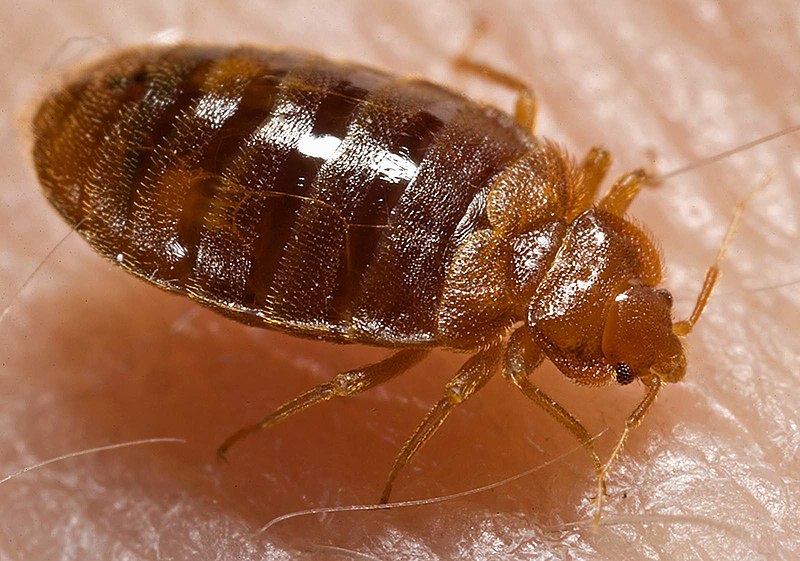
File:Bed_bug,_Cimex_lectularius.jpg · Wikimedia Commons · See Wikimedia Commons
Cimicidae
Sign in to saveAlso known as Bed bug
The Cimicidae are a family of small parasitic bugs that feed exclusively on the blood of warm-blooded animals. They are called cimicids or, loosely, bed bugs, though the latter term properly refers to the most well-known member of the family, Cimex lectularius, the common bed bug, and its tropical relation Cimex hemipterus. The family contains over 100 species. Cimicids appeared in the fossil record in the Cretaceous period. When bats evolved in the Eocene, Cimicids switched hosts and now feed mainly on bats or birds. Members of the group have colonised humans on three occasions.
OverviewAI-generated
Cimicidae is a family of insects within the order Hemiptera, class Insecta, and phylum Arthropoda. The taxon, which has the common name Bed Bugs, belongs to the superfamily Cimicoidea. Its scientific name was established by Latreille in 1802, and the family is currently accepted in taxonomic records.
Specimens of this family are held by institutions including YPM, UMNH, CHAS, LCDI, and UCSB. Records indicate occurrences in the United States and Mexico. The family has been the subject of 1,107 publications in PubMed and is associated with 6,287 occurrence records in the Global Biodiversity Information Facility.
Synthesized by Vinony from 30 facts across 7 sources: Wikidata, GBIF, PubMed, Gbif Occ, WoRMS, iDigBio, Vinony graph. Generated from structured data (not the Wikipedia text) and checked against those facts — may still contain errors.
Species
FAMILY
- KingdomAnimalia
- PhylumArthropoda
- ClassInsecta
- OrderHemiptera
- FamilyCimicidae
Die Plattwanzen (Cimicidae), auch als Bettwanzen bezeichnet, sind eine Familie der Wanzen. Alle Plattwanzen leben ektoparasitisch auf Säugetieren und Vögeln, deren Blut sie saugen. Die Larven und die erwachsenen Tiere halten sich in der Regel nur zur Nahrungsaufnahme am Wirt auf. Der bekannteste Vertreter dieser Familie ist die Bettwanze (Cimex lectularius, lectus lateinisch für Lager, Bett bzw. in den Tropen auch Cimex hemipterus), die unter anderem auch am Menschen saugt. In der Wanzenfauna Europas sind sie die einzigen Ektoparasiten. Inhaltsverzeichnis 1 Äußere Gestalt 2 Lebensweise 2.1 Ernährung 2.2 Fortpflanzung 3 Mensch und Plattwanzen 4 Taxonomie und Artenzahlen 5 Literatur 6 Weblinks 7 Einzelnachweise Äußere Gestalt Plattwanzen erreichen Körperlängen zwischen 4 und 12 Millimeter. Ihr Körper ist bei Aufsicht eiförmig-oval, er ist stark abgeplattet. Der Kopf trägt kleine Komplexaugen mit nur wenigen Ommatidien, die seitlich aus der Kopfkontur vorragen. Die Ocellen fehlen. Der Saugrüssel ist relativ kurz und erreicht in Ruhelage nur die Basis der Vorderhüften, das erste Segment des Labiums ist stark verkürzt, die anderen etwa gleich lang. Das Pronotum des Rumpfabschnitts ist v
via GBIF
Museum specimens
- Specimen records
- 91
- With media
- 7
- Family
- Cimicidae
- Collections
- YPM, UMNH, CHAS, LCDI, UCSB, LACM
- Recorded in
- United States, Mexico
Research
1,107 papers- Bed Bugs (Hemiptera, Cimicidae): Overview of Classification, Evolution and Dispersion.International journal of environmental research and public health · 2020
- Bedbugs.The New England journal of medicine · 2020
- Bedbugs.Current biology : CB · 2019
- Biology of the bed bugs (Cimicidae).Annual review of entomology · 2007
- Bedbugs.CMAJ : Canadian Medical Association journal = journal de l'Association medicale canadienne · 2023
via PubMed
Wikidata facts
- Instance of
- taxon
- Parent taxon
- Cimicoidea
- Image
- Bed bug, Cimex lectularius.jpg
Show 5 more facts
- Commons category
- Cimicidae
- taxon rank
- family
- taxon name
- Cimicidae
- topic's main category
- Category:Cimicidae
- taxon common name
- zajedavske stenice
Sources (2)
via Wikidata · CC0
~12 min read
Encyclopedic overview
7 sectionsContents
- Biology
- Behavior
- Hosts
- Effects on hosts
- Evolution
- References
- External links
The Cimicidae are a family of small parasitic bugs that feed exclusively on the blood of warm-blooded animals. They are called cimicids or, loosely, bed bugs, though the latter term properly refers to the most well-known member of the family, Cimex lectularius, the common bed bug, and its tropical relation Cimex hemipterus. The family contains over 100 species. Cimicids appeared in the fossil record in the Cretaceous period. When bats evolved in the Eocene, Cimicids switched hosts and now feed mainly on bats or birds. Members of the group have colonised humans on three occasions.
Cimicids usually feed on their host's blood every three to seven days, crawling away from the host and hiding while they digest the blood, which may take several days. This means that they specialise in vertebrate hosts that return regularly to particular sites to nest, roost or sleep. Birds and bats suit these specific requirements, as do humans now that they live in dwellings, and these are the main hosts used by the bugs. Most cimicids are able to go for long periods without feeding, over a year in some instances.
Excerpted from Wikipedia’s “Cimicidae” article, available under the CC BY-SA 4.0 licence.