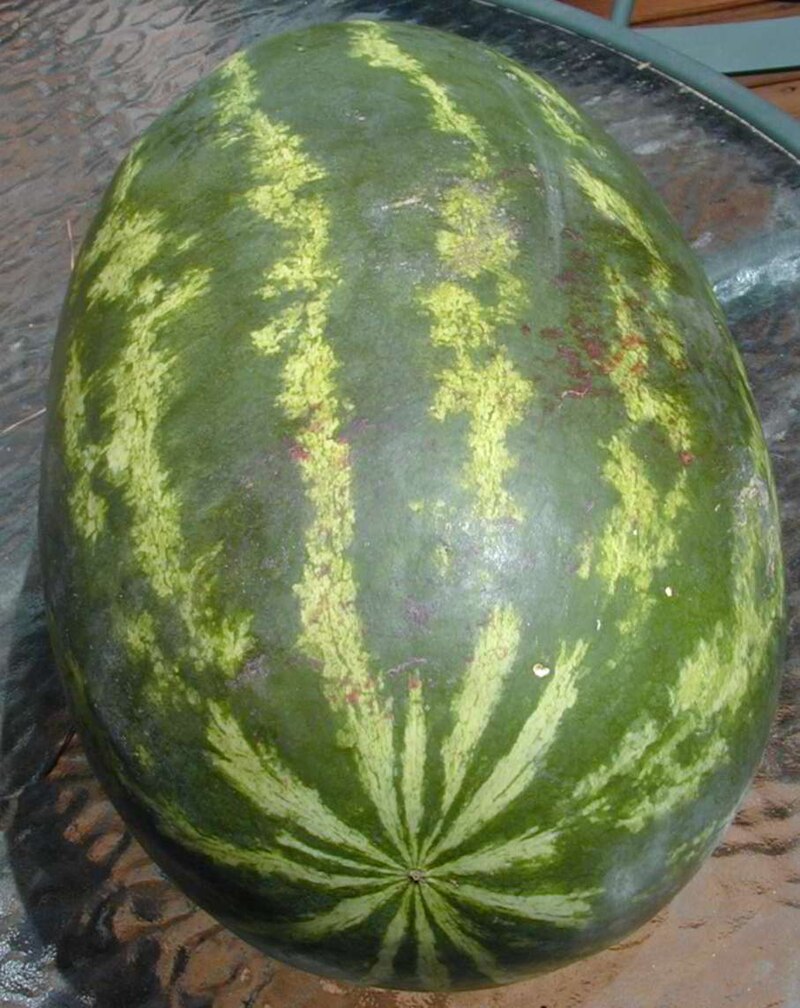
File:Vampire_watermelon.jpg · Wikimedia Commons · See Wikimedia Commons
Citrullus
Sign in to saveCitrullus is a genus of seven species of desert vines, among which Citrullus lanatus (the watermelon) is an important crop.
OverviewAI-generated
Citrullus is a genus within the plant family Cucurbitaceae. It belongs to the order Cucurbitales, class Magnoliopsida, and phylum Tracheophyta in the kingdom Plantae. The genus is part of the tribe Benincaseae. Common names for this taxon include watermelon, حنظل, Qarpız, and Кавун. It is identified as a source of melon.
The native range of Citrullus includes Afghanistan, Algeria, Angola, Assam, Bangladesh, Benin, Botswana, Burkina, the Canary Islands, Cape Provinces, Cape Verde, and Chad. Specimens have been recorded in Mexico, Afghanistan, Brasil, Tanzania, and the United States. Institutions holding records include INECOL, RSA, IAP, MO, and CAS.
Synthesized by Vinony from 30 facts across 7 sources: Wikidata, GBIF, PubMed, Gbif Occ, Plants of the World, iDigBio, Vinony graph. Generated from structured data (not the Wikipedia text) and checked against those facts — may still contain errors.
Species
GENUS
- KingdomPlantae
- PhylumTracheophyta
- ClassMagnoliopsida
- OrderCucurbitales
- FamilyCucurbitaceae
Wassermelone (Citrullus lanatus var. lanatus), Früchte Citrullus (deutsch Zitrulle) ist eine kleine Pflanzengattung aus der Familie der Kürbisgewächse (Cucurbitaceae). Ihre sieben Arten haben natürliche Verbreitungsgebiete in Afrika und im tropischen Asien. Am bekanntesten ist die Wassermelone (Citrullus lanatus). Molekulare Daten, insbesondere DNA-Sequenzen der Typus-Aufsammlung von Citrullus lanatus, entdeckt von Thunberg 1773 nahe Kapstadt, zeigen, dass diese Pflanze eine Bittermelone war und nicht nahe mit der heutigen Wassermelone verwandt ist (Chomicki und Renner, 2014). Die Schwesterart von Citrullus lanatus ist Citrullus mucosospermus (Fursa) Fursa aus Westafrika, während die Schwesterart von Citrullus colocynthis die südafrikanische Citrullus ecirrhosus Cogn. ist. Inhaltsverzeichnis 1 Beschreibung 2 Systematik 3 Literatur 4 Weblinks 5 Einzelnachweise Beschreibung Die Citrullus-Arten sind kriechende bis kletternde, einjährige oder mehrjährige krautige Pflanzen. Die Stängel sind behaart. Ihre wechselständigen, gestielten, einfachen Laubblätter sind drei- bis fünflappig, tief eingeschnitten und häufig weiter unterteilt. Nebenblätter fehlen. Es werden einfache oder verzweigte
via GBIF · Kew POWO
Museum specimens
- Specimen records
- 82
- With media
- 43
- Family
- Cucurbitaceae
- Collections
- INECOL, RSA, IAP, MO, CAS, UFPE
- Recorded in
- Mexico, Afghanistan, Brasil, Tanzania, United States, Benin, Ethiopia, Sri Lanka
Research
1,947 papers- Citrullus lanatus.Trends in genetics : TIG · 2020
- Citrullus colocynthis (L.) Schrad.: A Promising Pharmaceutical Resource for Multiple Diseases.Molecules (Basel, Switzerland) · 2023
- Telomere-to-telomere Citrullus super-pangenome provides direction for watermelon breeding.Nature genetics · 2024
- Citrullus colocynthis (L.) Schrad (bitter apple fruit): a review of its phytochemistry, pharmacology, traditional uses and nutritional potential.Journal of ethnopharmacology · 2014
- Current Evidence of Watermelon (Citrullus lanatus) Ingestion on Vascular Health: A Food Science and Technology Perspective.Nutrients · 2022
via PubMed
Wikidata facts
- Instance of
- taxon
- Parent taxon
- Benincaseae
- Image
- Vampire watermelon.jpg
Show 8 more facts
- taxon rank
- genus
- taxon name
- Citrullus
- Commons category
- Citrullus
- topic's main category
- Category:Citrullus
- taxon common name
- 西瓜属
- different from
- watermelon
- this taxon is source of
- melon
via Wikidata · CC0
~2 min read
Encyclopedic overview
4 sectionsContents
- Taxonomy
- Species
- References
- External links
Citrullus is a genus of seven species of desert vines, among which Citrullus lanatus (the watermelon) is an important crop.
==Taxonomy== Molecular data, including sequences from the original collection of Momordica lanata made near Cape Town by C. P. Thunberg in 1773, show that what Thunberg collected is not what has been called Citrullus lanatus, the domesticated watermelon, since the 1930s. Although this error only occurred in 1930 (Bailey, Gentes Herbarum 2: 180–186), it has been perpetuated in hundreds of papers on the watermelon. In addition, there is an older name for the watermelon, Citrullus battich Forssk. (Fl. Aegypt.-Arab.: 167. Jun 1775), which would normally have the precedence over Momordica lanata Thunberg (Prodr. Pl. Cap.: 13. 1794). To solve this problem, it has been proposed to conserve the name Citrullus lanatus with a new type to preserve the current sense of the name
Excerpted from Wikipedia’s “Citrullus” article, available under the CC BY-SA 4.0 licence.