Encyclopedia of Life · EOL (see source)
Cliffortia
Sign in to saveAlso known as Caperose
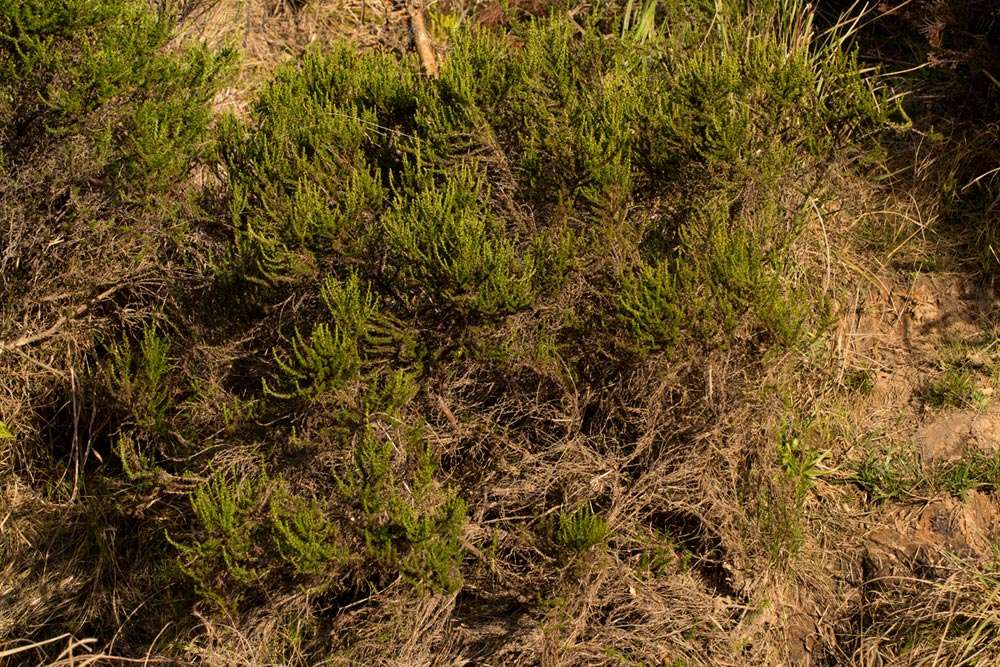
Cliffortia, or Caperose is a genus of plants that has been assigned to the rose family, with currently 132 known species. Its species can be found in southern Africa, particularly in the Cape Floristic Region (CFR) where 124 of the species can be found, 109 of which are endemic to the CFR. Most species are ericoid shrubs, some small trees up to 5 m (16 ft) high, others more or less herbaceous groundcover. All are wind pollinated and have separate male and female flowers in the axils of the leaves, mostly individually, sometimes grouped, which may be on the same plant or on separate plants.
Species
GENUS
- KingdomPlantae
- PhylumTracheophyta
- ClassMagnoliopsida
- OrderRosales
- FamilyRosaceae
Pokrój Cliffortia dichotoma Cliffortia – rodzaj roślin należących do rodziny różowatych. Obejmuje 117 gatunków. Te wrzosopodobne krzewy są typowe dla formacji fynbos w południowej części Afryki Południowej, przy czym aż 104 z nich są endemitami państwa przylądkowego (Capensis), znacznie mniej liczne centrum endemizmu rodzaju znajduje się w prowincji KwaZulu-Natal, pojedyncze gatunki występują poza granicami Afryki Południowej. Rodzaj ten jest najbardziej zróżnicowanym gatunkowo przedstawicielem różowatych w południowej Afryce.
via GBIF · Kew POWO
Museum specimens
- Specimen records
- 361
- With media
- 235
- Family
- Rosaceae
- Collections
- CAS, RSA, MO, ANSP
- Recorded in
- South Africa, Tanzania, Malawi
Wikidata facts
Show 5 more facts
- taxon name
- Cliffortia
- taxon rank
- genus
- topic's main category
- Category:Cliffortia
- Commons category
- Cliffortia
Sources (1)
via Wikidata · CC0
~6 min read
Encyclopedic overview
6 sectionsContents
- Description
- Taxonomy
- Ecology
- Distribution and habitat
- References
- External links
Cliffortia, or Caperose is a genus of plants that has been assigned to the rose family, with currently 132 known species. Its species can be found in southern Africa, particularly in the Cape Floristic Region (CFR) where 124 of the species can be found, 109 of which are endemic to the CFR. Most species are ericoid shrubs, some small trees up to 5 m (16 ft) high, others more or less herbaceous groundcover. All are wind pollinated and have separate male and female flowers in the axils of the leaves, mostly individually, sometimes grouped, which may be on the same plant or on separate plants.
== Description == Cliffortia species are mostly upright shrubs, but some species develop into small trees of up to 5 m (16 ft) high, are more or less herbaceous groundcover or grow in a dense tangle. The stipules have merged with the base of the leaf and form a sheath around the branch. The leaves are alternately arranged along the stems, and may consist of three, two or only one leaflet with one or several main veins, seated or on a leaf stalk. Leaflets may be thin or leathery, broad to needle-shaped, with the margin serrated or entire, and may have a spiny tip. Cliffortia has separate male and female flowers in the leaf axils, which are mostly set individually but sometimes in clusters. Some species have both male and female flowers on the same plant (and are monoecious), while other species have plants of separate gender (or are dioecious). The flowers never have petals, which in other plant species predominantly function to attract pollinators, but that function is of cause unnecessary in wind-pollinated taxa, such as in the entire genus Cliffortia. 3-merous flowers almost certainly represent the ancestral state, and it has been suggested that 4-merous flowers have arisen at four independent occasions. Trimerous flowers have three sepals of variable size, and in male flowers six to many stamens. Tetramerous flowers have four sepals of 5 mm long at most and either four or eight stamens. In female flowers the sepals are united at their base to form a calyx tube, and have one or two styles, that are finely divided like an ostridge feather. One or two achenes may develop in each flower, within the inflating calyx.
Excerpted from Wikipedia’s “Cliffortia” article, available under the CC BY-SA 4.0 licence.