File:Hymen_en.svg · Wikimedia Commons · See Wikimedia Commons
hymen
Sign in to saveAlso known as hymenal membrane, maidenhead, virginal membrane
The hymen is a thin piece of mucosal tissue that surrounds or partially covers the vaginal opening. A small percentage of females are born with hymens that are imperforate and completely obstruct the vaginal canal. It forms part of the vulva and is similar in structure to the vagina. The word is from the Greek ὑμήν meaning a thin skin or membrane. Many mammals possess hymens due to similar reproductive development.
The hymen is a thin piece of tissue that surrounds or partially covers the vaginal opening and forms part of the vulva. In rare cases, a person may be born with a hymen that completely blocks the vaginal canal, which requires medical attention, but otherwise the hymen's biological role is not well established.
AI-generated from the Wikipedia summary — may contain errors.
Key facts
- Anatomy.Name
- Hymen
- Anatomy.Latin
- hymen
- Anatomy.Greek
- ὑμήν
- Anatomy.Image
- Hymen en.svg
- Anatomy.Caption
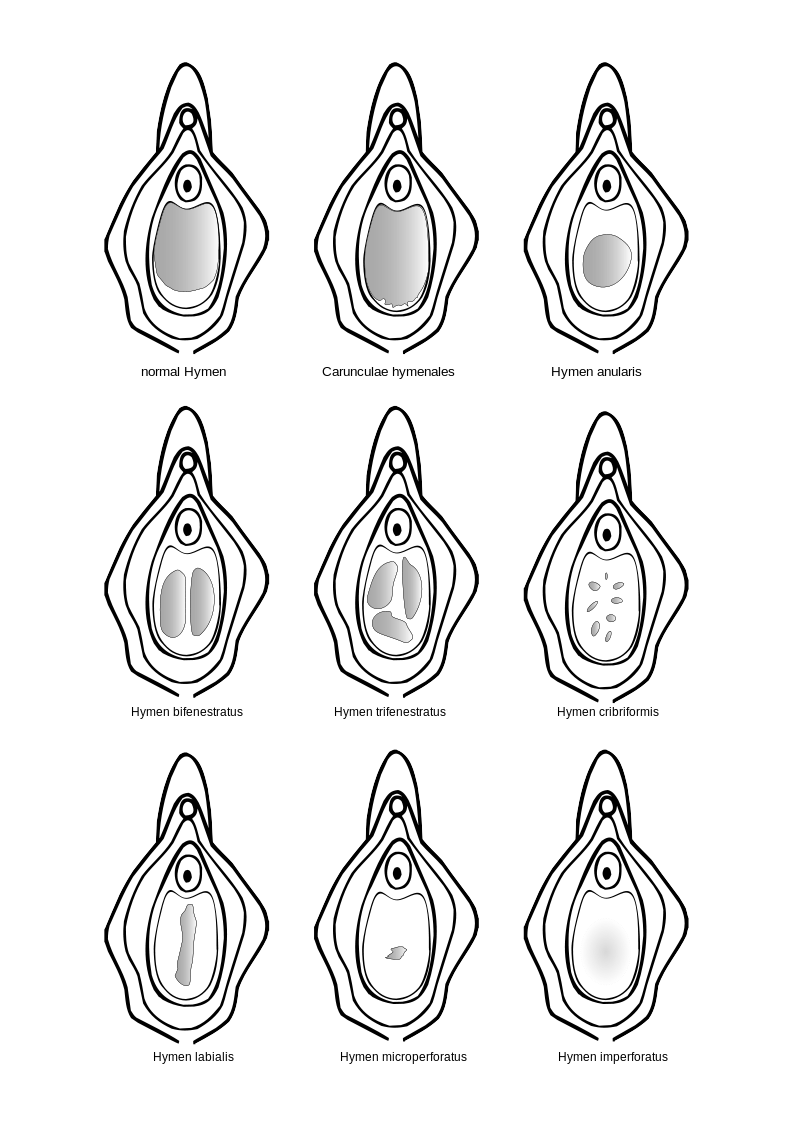
- Various hymen defects (the shaded areas represent the vaginal opening)
- Anatomy.Image2
- Haultain_and_Ferguson_-_external_female_genital_organs.svg
- Anatomy.Caption2
- External genitals of a human female
via Wikipedia infobox
Research
1,744 papers- The adolescent hymen.ReviewThe Journal of reproductive medicine · 2002Edgardh K, Ormstad K
- The prepubertal hymen.ReviewAustralian family physician · 2011Smith A
- Hymen Restoration: An Experience From a Moroccan Center.Aesthetic surgery journal · 2021Lahlali A, Sawan D, SidAhmed-Mezi M et al.DOI: 10.1093/asj/sjab276
- Hymen and virginity: What every paediatrician should know.Journal of paediatrics and child health · 2022Moussaoui D, Abdulcadir J, Yaron MDOI: 10.1111/jpc.15887
- Medico-legal study of the hymen.Journal of forensic and legal medicine · 2023Al-Khateeb NGH, Al-Tameemi NMA, Jebur RM et al.DOI: 10.1016/j.jflm.2023.102579
- Hematocolpos due to imperforate hymen: a case report and literature systematic review.International urogynecology journal · 2023Marino G, Alfieri N, Tessitore IV et al.DOI: 10.1007/s00192-022-05270-x
- Microperforate Hymen and Pyocolpos: A Case Report and Review of the Literature.ReviewJournal of pediatric and adolescent gynecology · 2018Tardieu SC, Appelbaum HDOI: 10.1016/j.jpag.2017.08.006
- Imperforate Hymen: Clinical Pearls and Implications of Management.Clinical obstetrics and gynecology · 2022Hamouie A, Dietrich JEDOI: 10.1097/GRF.0000000000000703
via PubMed
Wikidata facts
Show 2 more facts
- Commons category
- Hymen
- topic's main category
- Category:Hymen
Sources (7)
via Wikidata · CC0
~10 min read
Encyclopedic overview
9 sectionsContents
- Development and histology
- Anatomic variations
- Trauma
- Cultural and religious significance
- Womb fury
- Other animals
- See also
- References
- External links
The hymen is a thin piece of mucosal tissue that surrounds or partially covers the vaginal opening. A small percentage of females are born with hymens that are imperforate and completely obstruct the vaginal canal. It forms part of the vulva and is similar in structure to the vagina. The word is from the Greek ὑμήν meaning a thin skin or membrane. Many mammals possess hymens due to similar reproductive development.
In children, a common appearance of the hymen is crescent-shaped, although many shapes are possible. Each shape in the natural range has a Latinate name. During puberty, estrogen causes the hymen to change in appearance and become very elastic. Normal variations of the post-pubertal hymen range from thin and stretchy to thick and somewhat rigid. Very rarely, it may be completely absent.
Excerpted from Wikipedia’s “hymen” article, available under the CC BY-SA 4.0 licence.
Gallery (6)
Available in 74 languages
- Español
- Français
- Deutsch
- 中文
- 日本語
- Русский
- Português
- Italiano
- العربية
- हिन्दी
- Afrikaans
- Albanian
- Armenian
- Azerbaijani
- Bahasa Indonesia
- Bangla
- Basque
- be_x_old
Show 55 more
- Belarusian
- Bosnian
- Breton
- Bulgarian
- Burmese
- Catalan
- Central Kurdish
- Croatian
- Czech
- Danish
- Divehi
- Egyptian Arabic
- Esperanto
- Estonian
- Finnish
- Galician
- Georgian
- Greek
- Hebrew
- Hungarian
- Ido
- Kashmiri
- Kinyarwanda
- Kurdish
- Latvian
- Lithuanian
- Low German
- Malayalam
- Mazanderani
- Nederlands
- Nepali
- Norwegian
- Pashto
- Polski
- Romanian
- Santali
- Serbian
- Serbian (Latin)
- Shona
- simple
- Sinhala
- Slovak
- Slovenian
- Svenska
- Tamil
- Telugu
- Tiếng Việt
- Türkçe
- Ukrainian
- Wu Chinese
- zh_classical
- zh_yue
- فارسی
- ไทย
- 한국어
via Wikidata sitelinks · CC0