
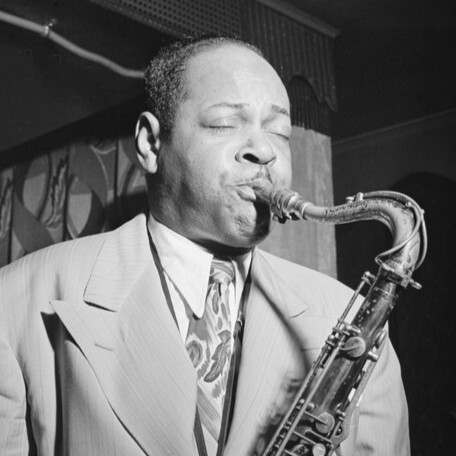
File:Coleman_Hawkins.jpg · Wikimedia Commons · See Wikimedia Commons
Coleman Hawkins
Sign in to saveAlso known as Coleman Randolph Hawkins, Hawk, Coleman Randolf Hawkins
American jazz saxophonist (1904–1969)
OverviewAI-generated
Coleman Randolph Hawkins, also known as Hawk or Bean, was an American jazz musician and saxophonist. Born in St. Joseph, Missouri, on November 21, 1904, he began his work period in 1921. He was an African American composer and musician who played the saxophone, with genres including jazz, bebop, swing, and tenor sax. He spoke English and was affiliated with the record label Candid Records.
Hawkins died of pneumonia on May 19, 1969, in New York City due to natural causes. He is buried at Woodlawn Cemetery.
Synthesized by Vinony from 30 facts across 4 sources: Wikidata, MusicBrainz, Last.fm, TMDb. Generated from structured data (not the Wikipedia text) and checked against those facts — may still contain errors.
Film & TV
St. Joseph, Missouri, U.S.
Coleman Randolph Hawkins (November 21, 1904 – May 19, 1969), nicknamed "Hawk" and sometimes "Bean", was an American jazz tenor saxophonist. One of the first prominent jazz musicians on his instrument, as Joachim E. Berendt explained: "There were some tenor players before him, but the instrument was not an acknowledged jazz horn". Hawkins biographer John Chilton described the prevalent styles of…
Known for
- Jazz Icons - Coleman Hawkins Live in '62 & '642009
- Coleman Hawkins – In Europe, London, Paris & Brussels — Lui-même2008
- Improvisation — Self2004
- Kid Dynamite — Archive footage2001
- After Hours — Himself1961
- The Sound of Jazz1957
- Improvisation — Self1950
- The Crimson Canary — Coleman Hawkins1945
- Stormy Weather — Saxophonist (uncredited)1943
via TMDB
Listeners · Last.fm
- Listeners
- 546,755
- Total plays
- 4,427,483
Tags
Coleman Randolph Hawkins (November 21, 1904 – May 19, 1969), nicknamed Hawk and sometimes "Bean", was an American jazz tenor saxophonist. While Hawkins is strongly associated with the swing music and big band era, he had a role in the development of bebop in the 1940s. Fellow saxophonist Lester Young, known as "Pres", commented in a 1959 interview with The Jazz Review: "As far as I'm concerned, I think Coleman Hawkins was the President first, right? As far as myself, I think I'm the second one.
Key facts
- Also known as
- "Bean", "Hawk"
- Born
- Coleman Randolph Hawkins , ( 1904-11-21 ) November 21, 1904, St. Joseph, Missouri , U.S.
- Died
- May 19, 1969 (1969-05-19) (aged 64), New York City , U.S.
- Genres
- Jazz swing bebop
- Instruments
- Tenor saxophone bass saxophone clarinet
- Years active
- 1921–1969
via Wikipedia infobox
Wikidata facts
- Instance of
- human
- Family name
- Hawkins
- Gender
- male
- Citizenship
- United States
- Place of birth
- St. Joseph
- Place of death
- New York City
- Occupation
- composer
- Languages spoken
- English language
- Genre
- jazz
- Instrument
- saxophone
- Record label
- Candid Records
- Image
- Coleman Hawkins (Gottlieb 03991).jpg
Show 12 more facts
- Commons category
- Coleman Hawkins
- date of birth
- 1904-11-21
- date of death
- 1969-05-19
- Commons gallery
- Coleman Hawkins
- cause of death
- pneumonia
- manner of death
- natural causes
- place of burial
- Woodlawn Cemetery
- name in native language
- Coleman Hawkins
- start of work period
- 1921-00-00
- birth name
- Coleman Randolph Hawkins
- nickname
- Bean
- ethnic group
- African Americans
Sources (6)
via Wikidata · CC0
~16 min read
Encyclopedic overview
Coleman Randolph Hawkins (November 21, 1904 – May 19, 1969), nicknamed "Hawk" and sometimes "Bean", was an American jazz tenor saxophonist. One of the first prominent jazz musicians on his instrument, as Joachim E. Berendt explained: "There were some tenor players before him, but the instrument was not an acknowledged jazz horn." Hawkins biographer John Chilton described the prevalent styles of tenor saxophone solos prior to Hawkins as "mooing" and "rubbery belches". Hawkins denied being first and noted his contemporaries Happy Caldwell, Stump Evans, and Prince Robinson, although he was the first to tailor his method of improvisation to the saxophone rather than imitate the techniques of the clarinet. Hawkins's virtuosic, arpeggiated approach to improvisation, with his characteristic rich, emotional, and vibrato-laden tonal style, was the main influence on a generation of tenor players that included Chu Berry, Charlie Barnet, Tex Beneke, Ben Webster, Vido Musso, Herschel Evans, Buddy Tate, and Don Byas, and through them the later tenormen, Arnett Cobb, Illinois Jacquet, Flip Phillips, Ike Quebec, Al Sears, Paul Gonsalves, and Lucky Thompson. While Hawkins became known with swing music during the big band era, he had a role in the development of bebop in the 1940s.
Fellow saxophonist Lester Young, known as the "President of the Tenor Saxophone", commented, in a 1959 interview with The Jazz Review: "As far as I'm concerned, I think Coleman Hawkins was the president, first, right? As far as myself, I think I'm the second one." Miles Davis once said: "When I heard Hawk, I learned to play ballads."
Excerpted from Wikipedia’s “Coleman Hawkins” article, available under the CC BY-SA 4.0 licence.