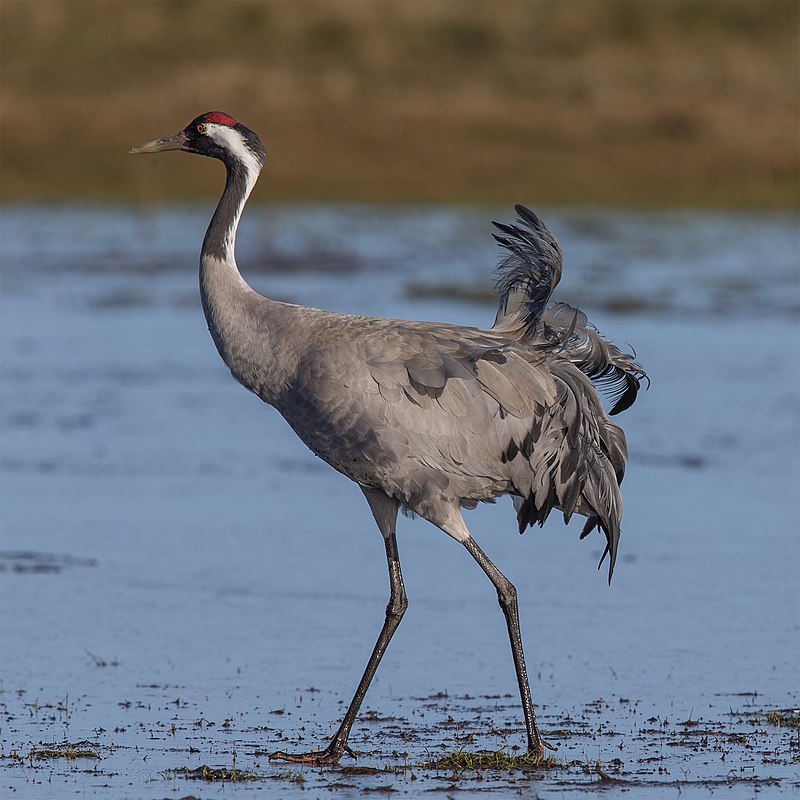
File:Common_crane_grus_grus.jpg · Wikimedia Commons · See Wikimedia Commons
OverviewAI-generated
The common crane, scientifically known as Grus grus, is a species within the family Gruidae. It belongs to the order Gruiformes, class Aves, and phylum Chordata. The organism is an oviparous omnivore with a wingspan of 2.22. It typically lays a litter size of 2 eggs, which have an incubation period of 30 days.
Its taxon range includes the Nanling Mountains and Africa. The species has been recorded as endemic to Nandur Madhmeshwar Bird Sanctuary, Little Rann of Kutch, Thol Lake, and Dehing Patkai National Park. It inhabits freshwater environments. The International Union for Conservation of Nature lists its conservation status as Least Concern, a designation recorded in 2025.
In the wild, the common crane has a maximum longevity of 43 years. It has received the award of Bird of the Year. The taxon is also referred to by the common names garan, Kranich, and Grulla común.
Synthesized by Vinony from 36 facts across 6 sources: Wikidata, IUCN Red List, iNaturalist, WoRMS, Encyclopedia of Life, Vinony graph. Generated from structured data (not the Wikipedia text) and checked against those facts — may still contain errors.
Species
Least Concerncommon crane
Species
- PhylumChordata
- ClassAves
- OrderGruiformes
- FamilyGruidae
Maximum longevity: 43 years (wild)
via IUCN
Wikidata facts
- Instance of
- taxon
- Parent taxon
- Grus
- Award
- Bird of the Year
- Image
- 2017.07.04.-01-Wendisch Rietz--Kranich.jpg
Show 14 more facts
- taxon rank
- species
- IUCN conservation status
- Least Concern
- taxon name
- Grus grus
- Commons category
- Grus grus
- Commons gallery
- Grus grus
- taxon common name
- grou-eurasiático
- wingspan
- 2.22
- litter size
- 2
- egg incubation period
- 30
- endemic to
- Majuli
- short name
- G. grus
- has characteristic
- oviparity
- main food source
- omnivore
- taxon range
- Africa
Sources (10)
via Wikidata · CC0
~22 min read
Encyclopedic overview
The common crane (Grus grus), also known as the Eurasian crane, is a bird of the family Gruidae, the cranes. A medium-sized species, it is the only crane commonly found in Europe besides the demoiselle crane (Grus virgo) and the Siberian crane (Leucogeranus leucogeranus) that only are regular in the far eastern part of the continent. Along with the sandhill crane (Antigone canadensis), demoiselle crane and the brolga (Antigone rubicunda), it is one of only four crane species not currently classified as threatened with extinction or conservation dependent on the species level. Despite the species' large numbers, local extinctions and extirpations have taken place in part of its range, and an ongoing reintroduction project is underway in the United Kingdom.
Taxonomy
Excerpted from Wikipedia’s “Common Crane” article, available under the CC BY-SA 4.0 licence.
Gallery (14)
Available in 97 languages
- Español
- Français
- Deutsch
- 中文
- 日本語
- Русский
- Português
- Italiano
- العربية
- हिन्दी
- Aragonese
- Armenian
- Asturian
- Azerbaijani
- Bahasa Indonesia
- Bangla
- Bashkir
- Basque
Show 78 more
- bat_smg
- be_x_old
- Belarusian
- Bhojpuri
- Breton
- Bulgarian
- Burmese
- Catalan
- Cebuano
- Central Kurdish
- Chechen
- Chuvash
- Corsican
- Croatian
- Czech
- Danish
- Egyptian Arabic
- Esperanto
- Estonian
- Faroese
- Finnish
- Fon
- Galician
- Georgian
- Greek
- Gujarati
- Hebrew
- Hungarian
- Inari Sami
- Interlingua
- Irish
- Kabardian
- Kashubian
- Kazakh
- Kotava
- Kurdish
- Latvian
- Limburgish
- Lithuanian
- Low German
- Luxembourgish
- Macedonian
- Marathi
- Mongolian
- Navajo
- Nederlands
- Nepali
- Northern Frisian
- Norwegian
- Norwegian Nynorsk
- olo
- Palatine German
- Piedmontese
- Polski
- Romanian
- Serbian
- Serbian (Latin)
- simple
- Sindhi
- Slovak
- Slovenian
- Svenska
- Swahili
- Tamil
- Tiếng Việt
- Türkçe
- Ukrainian
- Veps
- Waray
- Welsh
- Western Frisian
- Western Mari
- Western Panjabi
- Wu Chinese
- zh_yue
- فارسی
- ไทย
- 한국어
via Wikidata sitelinks · CC0